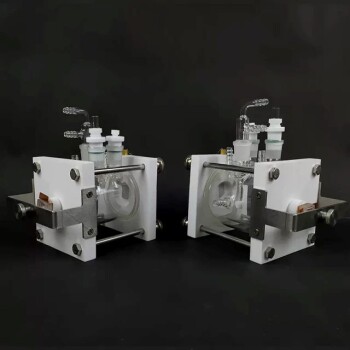
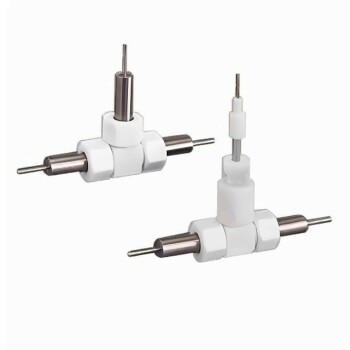
Customized pressure test molds and electrolytic cells serve a single, critical function: they apply continuous and constant external stack pressure to the battery assembly during operation. For systems using [email protected], this mechanical pressure is the primary safeguard against the physical failure of the battery caused by the expansion and contraction of lithium metal.
Core Takeaway In solid-state batteries, the electrode and electrolyte are rigid solids that cannot flow to fill gaps like liquid electrolytes. The essential purpose of these customized cells is to mechanically compensate for volume changes, preventing the layers from physically separating (delaminating) and ensuring the low interfacial impedance required for the battery to function.
The Mechanics of Interface Stability
Counteracting Volume Fluctuations
Lithium metal is dynamic. During the charging process (deposition) and discharging process (stripping), the lithium anode undergoes significant volume changes.
Without a mechanism to absorb and counteract this movement, the structural integrity of the cell is compromised. Customized molds are designed to accommodate this "breathing" while maintaining a tight seal.
preventing Physical Delamination
The most immediate risk in all-solid-state batteries is the loss of contact between layers. Unlike liquid electrolytes, which wet surfaces regardless of shape, solid electrolytes like LPSCl0.3F0.7 require physical pressure to maintain connection.
If the external pressure is insufficient, the volume contraction of lithium during discharge creates voids. These voids lead to physical separation at the solid-solid interface, effectively breaking the circuit in localized areas.
Minimizing Interfacial Impedance
Performance is directly linked to contact area. High interfacial impedance (resistance) is often a symptom of poor physical contact between the active materials and the electrolyte.
By applying constant pressure, typically ranging from 1.5 MPa to over 10 MPa depending on the specific setup, these cells force the components together. This maximizes the active contact area and keeps impedance low, facilitating efficient ion transport.
Critical Operational Constraints
The Requirement for "Constant" Pressure
It is not enough to simply clamp the cell shut during assembly. The pressure must remain constant throughout the cycling process.
If the pressure device is static and does not account for the expansion of the battery, internal pressure could spike dangerously. Conversely, if it cannot follow the contraction, gaps will form. The customized mold acts as a dynamic stabilizer.
Structural Consolidation
Beyond the active cycling phase, these molds play a role in the initial manufacturing and setup.
They are used to consolidate the monolithic structure of the battery, ensuring that the initial interface contact is uniform before the first cycle even begins. This establishes a baseline of effective connectivity between the Li-metal and the sulfide/halide electrolyte.
Making the Right Choice for Your Goal
When selecting or designing pressure test cells for [email protected] research, align your hardware with your specific testing objectives.
- If your primary focus is electrochemical characterization: Prioritize cells that offer precise pressure control to minimize impedance artifacts, ensuring your data reflects the chemistry, not contact resistance.
- If your primary focus is long-term cycle life: Ensure the mold can maintain constant pressure over thousands of expansion/contraction cycles without mechanical relaxation or fatigue.
Success in solid-state battery testing is as much about mechanical engineering as it is about chemistry; without the right pressure, even the best electrolyte will fail.
Summary Table:
| Key Feature | Functional Purpose | Impact on Battery Performance |
|---|---|---|
| Constant Stack Pressure | Counteracts Li-metal volume expansion/contraction | Prevents physical delamination and mechanical failure |
| Interface Maintenance | Ensures intimate solid-solid contact | Minimizes interfacial impedance for efficient ion transport |
| Dynamic Stabilization | Adjusts to "breathing" during cycling | Maintains circuit integrity throughout charge/discharge cycles |
| Structural Consolidation | Forms a uniform monolithic baseline | Establishes reliable connectivity before the first cycle |
Elevate Your Solid-State Battery Research with KINTEK
Precision in mechanical pressure is as critical as your chemistry. KINTEK specializes in high-performance laboratory equipment designed for the rigorous demands of energy storage research. From customized pressure test molds and electrolytic cells optimized for Li-metal systems to our advanced hydraulic presses and battery research tools, we provide the hardware necessary to eliminate contact resistance and ensure long-term cycle stability.
Ready to optimize your battery assembly? Contact our technical experts today to discover how our high-precision solutions can enhance your lab's efficiency and data accuracy.
Related Products
- Super Sealed Electrolytic Electrochemical Cell
- Electrolytic Electrochemical Cell with Five-Port
- Electrolytic Electrochemical Cell for Coating Evaluation
- Flat Corrosion Electrolytic Electrochemical Cell
- PTFE Electrolytic Cell Electrochemical Cell Corrosion-Resistant Sealed and Non-Sealed
People Also Ask
- What is the typical volume range and aperture configuration of a super-sealed electrolytic cell? Optimize Your Electrochemical Setup
- What are the key safety precautions for operating a super-sealed electrolytic cell? Essential Protocols for Laboratory Safety
- What procedures should be followed during an experiment with a super-sealed electrolytic cell? Ensure Precision and Safety
- What is the typical experimental setup for a super-sealed electrolytic cell? Achieve Superior Control in Electrochemical Analysis
- What are the common applications of a super-sealed electrolytic cell? Ensure Purity for Sensitive Electrochemical Research