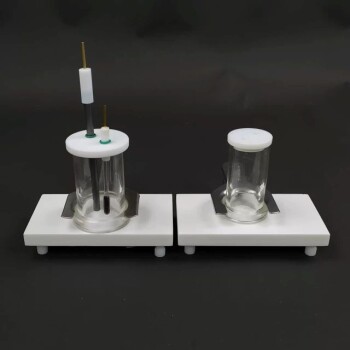
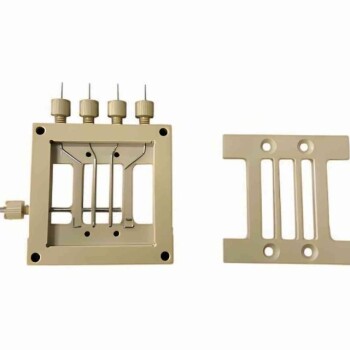
Before initiating any experiment, you must rigorously inspect the all-PTFE electrolytic cell for physical structural integrity. Specifically, verify that the unit is free from damage, cracks, or deformation, and ensure the PTFE surface is perfectly smooth and devoid of any impurities.
The reliability of your electrochemical data depends on the physical integrity of the cell; a compromised PTFE surface or structural deformation can introduce contaminants and alter reaction kinetics.
Verifying Structural Integrity
To ensure the cell functions correctly under experimental conditions, you must look beyond obvious breakage and assess the material's stability.
Checking for Cracks and Breaks
Carefully examine the entire cell body for visible cracks or fractures. Even hairline fractures can propagate under stress or thermal fluctuation, leading to leaks of the electrolyte solution.
Identifying Deformation
Inspect the geometry of the cell to ensure there is no deformation. PTFE is a thermoplastic that can creep or warp over time; any warping may compromise the seal or the alignment of electrodes.
Confirming Material Intactness
Ensure the PTFE material is intact throughout the unit. There should be no signs of peeling, gouging, or deep scratches that could compromise the chemical resistance of the vessel.
Ensuring Surface Quality
The quality of the PTFE surface directly influences the cleanliness of your reaction environment.
Assessing Surface Smoothness
Verify that the interior surface of the cell is smooth. A rough or pitted surface increases the surface area where contaminants can hide, making cleaning difficult and potentially interfering with sensitive measurements.
Eliminating Impurities
Inspect the cell to ensure it is free of any impurities or residues from previous runs. Any foreign matter on the PTFE surface can leach into the electrolyte, causing background noise or side reactions in your data.
Common Pitfalls in Handling
While PTFE is chemically robust, it requires specific handling considerations to maintain its integrity for precise electrochemical work.
The Illusion of Durability
Although PTFE is not brittle like glass, it is susceptible to physical deformation if dropped or compressed. Do not assume the cell is undamaged simply because it did not shatter; check for warping that could prevent a tight seal.
Overlooking Micro-Contamination
A visual inspection for "impurities" may miss microscopic residues trapped in surface micro-abrasions. If the surface smoothness has been compromised by scratching, simple rinsing may not be sufficient to remove contaminants.
Making the Right Choice for Your Goal
Finalizing your inspection protocol depends on the sensitivity of your specific application.
- If your primary focus is Trace Analysis: Prioritize surface smoothness and absolute cleanliness to prevent background noise from trapped contaminants.
- If your primary focus is Long-Duration Electrolysis: Prioritize structural inspection to ensure the cell has no deformation that could lead to leaks over time.
A meticulous pre-use inspection is the cheapest insurance against wasted time and compromised experimental data.
Summary Table:
| Inspection Category | Key Checkpoints | Importance for Research |
|---|---|---|
| Structural Integrity | Cracks, fractures, and deformations | Prevents electrolyte leaks and electrode misalignment. |
| Surface Quality | Smoothness and absence of scratches | Reduces risk of trapped contaminants and background noise. |
| Cleanliness | Free of impurities or previous residues | Ensures chemical purity and prevents unintended side reactions. |
| Material Stability | Peeling, gouging, or warping | Maintains chemical resistance and ensures a perfect airtight seal. |
Elevate Your Electrochemical Research with KINTEK
Don't let faulty equipment compromise your critical data. KINTEK specializes in high-performance laboratory solutions, providing premium all-PTFE electrolytic cells, electrodes, and battery research tools designed for extreme chemical resistance and precision.
From high-temperature furnaces and pressure reactors to our durable PTFE consumables, we offer the reliability your lab demands. Our team is ready to help you select the perfect equipment to ensure your experiments are leak-free and contamination-pure.
Ready to upgrade your lab's performance? Contact KINTEK today to discuss your project requirements!
Related Products
- PTFE Electrolytic Cell Electrochemical Cell Corrosion-Resistant Sealed and Non-Sealed
- Electrolytic Electrochemical Cell with Five-Port
- Double Layer Five-Port Water Bath Electrolytic Electrochemical Cell
- Thin-Layer Spectral Electrolysis Electrochemical Cell
- Optical Water Bath Electrolytic Electrochemical Cell
People Also Ask
- What is the necessity of selecting a PTFE electrolytic cell? Ensure Precise Graphene Corrosion Testing Accuracy
- What is the proper method for cleaning the surface of an all-PTFE electrolytic cell? Ensure Accurate Results with a Pristine Surface
- How should an all-PTFE electrolytic cell be stored after use? Expert Maintenance Tips for Long-Lasting Performance
- What is the proper cleaning method for an all-PTFE electrolytic cell? Essential Tips for Surface Integrity
- What are the standard opening specifications for all-PTFE electrolytic cells? A Guide to Sealed vs. Non-Sealed Ports