Knowledge What role does a planetary ball mill play in the preparation of Fe3Si? Mastering Atomic Mixing for Phase Purity
Author avatar

Tech Team · Kintek Solution

Updated 1 day ago

What role does a planetary ball mill play in the preparation of Fe3Si? Mastering Atomic Mixing for Phase Purity


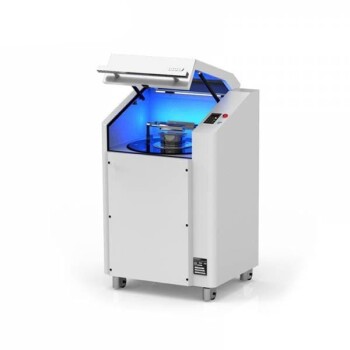
In the synthesis of Fe3Si intermetallic compounds, the planetary ball mill serves as the critical mechanical mixing agent. It utilizes high-frequency impact and grinding forces to transform reduced iron powder and silicon powder into a uniformly blended precursor.

The planetary ball mill is not merely a mixer; it is a facilitator of atomic interaction. By ensuring microscopic contact between iron and silicon atoms, it creates the necessary conditions for full solid-phase diffusion and the successful formation of a single Fe3Si phase during sintering.

The Mechanism of Mechanical Preparation

High-Frequency Impact

The planetary ball mill operates by utilizing the kinetic energy of grinding balls. Through the combined motion of rotation and revolution, the mill generates high-frequency impacts and intense grinding forces.

Uniform Dispersion

This mechanical action breaks down agglomerates in the raw materials. It ensures that the reduced iron powder and silicon powder are distributed evenly throughout the mixture, preventing localized inconsistencies.

Criticality for Phase Formation

Achieving Microscopic Contact

For intermetallic compounds like Fe3Si to form correctly, the reactant particles must be in intimate contact. The ball mill forces the iron and silicon particles into microscopic contact, going beyond what simple stirring or tumbling can achieve.

Enabling Solid-Phase Diffusion

This intimate contact is the prerequisite for the subsequent processing step (typically sintering). It reduces the diffusion distance between atoms, allowing for full solid-phase diffusion when heat is applied.

Ensuring Single-Phase Results

Without this intensive pre-treatment, the final material may contain unreacted elements. The milling process is vital to ensuring the final product is a pure, single Fe3Si phase rather than a heterogeneous mixture.

Understanding the Process Trade-offs

Mechanical Activation vs. Temperature

While the primary goal is mixing, the intense shear and friction forces can also mechanically activate the powders. This effectively pre-energizes the material, potentially allowing for deeper mixing and reaction at lower temperatures than conventional methods might require.

The Necessity of Uniformity

Skipping or shortening this step is a common pitfall. If the milling does not achieve total uniformity, the subsequent sintering process—even using advanced methods like Spark Plasma Sintering (SPS)—cannot correct the lack of atomic proximity, leading to structural or phase defects.

Making the Right Choice for Your Goal

  • If your primary focus is Phase Purity: Prioritize milling parameters that maximize microscopic contact to ensure no unreacted iron or silicon remains after sintering.
  • If your primary focus is Sintering Efficiency: Ensure the milling process is aggressive enough to activate the particle surfaces, which facilitates rapid densification during the SPS process.

The planetary ball mill acts as the essential bridge between raw metallic powders and high-performance intermetallic compounds.

Summary Table:

Process Element Role in Fe3Si Synthesis Impact on Final Material
High-Frequency Impact Breaks agglomerates & reduces particle size Increases surface area for reaction
Mechanical Activation Pre-energizes iron and silicon powders Lowers required sintering temperatures
Microscopic Contact Facilitates atomic interaction Enables full solid-phase diffusion
Uniform Dispersion Prevents localized elemental concentration Ensures a pure, single-phase Fe3Si structure

Elevate Your Material Synthesis with KINTEK Precision

Achieving phase purity in intermetallic compounds starts with superior mechanical preparation. KINTEK specializes in advanced crushing and milling systems, including high-performance planetary ball mills designed to ensure the microscopic contact and mechanical activation your research demands.

From high-temperature furnaces and hydraulic presses to specialized battery research tools and cooling solutions, our laboratory equipment is engineered for precision and reliability.

Ready to optimize your Fe3Si synthesis? Contact our technical experts today to find the perfect milling solution for your laboratory needs.

Related Products

People Also Ask

Related Products

Mini Planetary Ball Mill Machine for Laboratory Milling

Mini Planetary Ball Mill Machine for Laboratory Milling

Discover the KT-P400 desktop planetary ball mill, ideal for grinding and mixing small samples in the lab. Enjoy stable performance, long service life, and practicality. Functions include timing and overload protection.

Laboratory Horizontal Planetary Ball Mill Milling Machine

Laboratory Horizontal Planetary Ball Mill Milling Machine

Improve sample uniformity with our Horizontal Planetary Ball Mills. KT-P400H reduces sample deposition and KT-P400E has multi-directional capabilities. Safe, convenient and efficient with overload protection.

High-Energy Omnidirectional Planetary Ball Mill Milling Machine for Laboratory

High-Energy Omnidirectional Planetary Ball Mill Milling Machine for Laboratory

The KT-P4000E is a new product derived from the vertical high-energy planetary ball mill with a 360° swivel function. Experience faster, uniform, and smaller sample output results with 4 ≤1000ml ball mill jars.

Laboratory Jar Ball Mill with Alumina Zirconia Grinding Jar and Balls

Laboratory Jar Ball Mill with Alumina Zirconia Grinding Jar and Balls

Grind to perfection with alumina/zirconia grinding jars and balls. Available in volume sizes from 50ml to 2500ml, compatible with various mills.

Laboratory Micro Tissue Grinding Mill Grinder

Laboratory Micro Tissue Grinding Mill Grinder

KT-MT10 is a miniature ball mill with a compact structure design. The width and depth are only 15X21 cm, and the total weight is only 8 kg. It can be used with a minimum 0.2ml centrifuge tube or a maximum 15ml ball mill jar.

Laboratory High Throughput Tissue Grinding Mill Grinder

Laboratory High Throughput Tissue Grinding Mill Grinder

KT-MT is a high-quality, small, and versatile tissue grinder used for crushing, grinding, mixing, and cell wall breaking in various fields, including food, medical, and environmental protection. It is equipped with 24 or 48 2ml adapters and ball grinding tanks and is widely employed for DNA, RNA, and protein extraction.

Laboratory Grinding Mill Mortar Grinder for Sample Preparation

Laboratory Grinding Mill Mortar Grinder for Sample Preparation

KT-MG200 mortar grinder can be used for mixing and homogenizing powder, suspension, paste and even viscous samples. It can help users realize the ideal operation of sample preparation with more regularization and higher repeatability.

Laboratory Disc Cup Vibratory Mill for Sample Grinding

Laboratory Disc Cup Vibratory Mill for Sample Grinding

The vibrating disc mill is suitable for non-destructive crushing and fine grinding of samples with large particle sizes, and can quickly prepare samples with analytical fineness and purity.

Small Cryogenic Grinder Cryomill Cryogrinder with Liquid Nitrogen for Laboratory Use

Small Cryogenic Grinder Cryomill Cryogrinder with Liquid Nitrogen for Laboratory Use

Our KINTEK Cryomilling is perfect for small runs and R&D trials. With a versatile cryogenic system, it can handle a variety of materials, including plastics, rubber, pharmaceuticals, and food grades. Plus, our specialized hydraulic laboratory crushers ensure accurate results through multiple passes, making it suitable for XRF analysis. Get finely-powdered samples with ease!

Liquid Nitrogen Cryogenic Grinder Mill Cryomill Airflow Ultrafine Pulverizer

Liquid Nitrogen Cryogenic Grinder Mill Cryomill Airflow Ultrafine Pulverizer

Discover the Liquid Nitrogen Cryogenic Grinding Machine, perfect for lab use, ultra-fine pulverization, and preserving material properties. Ideal for pharmaceuticals, cosmetics, and more.

Custom PTFE Teflon Parts Manufacturer for Acid and Alkali Resistant Chemical Powder Material Scoops

Custom PTFE Teflon Parts Manufacturer for Acid and Alkali Resistant Chemical Powder Material Scoops

Known for its excellent thermal stability, chemical resistance and electrical insulating properties, PTFE is a versatile thermoplastic material.

Battery Lab Equipment Battery Capacity and Comprehensive Tester

Battery Lab Equipment Battery Capacity and Comprehensive Tester

The scope of application of the battery comprehensive tester can be tested: 18650 and other cylindrical, square lithium batteries, polymer batteries, nickel-cadmium batteries, nickel-metal hydride batteries, lead-acid batteries, etc.

Desktop Fast Laboratory Autoclave Sterilizer 35L 50L 90L for Lab Use

Desktop Fast Laboratory Autoclave Sterilizer 35L 50L 90L for Lab Use

The desktop fast steam sterilizer is a compact and reliable device used for rapid sterilization of medical, pharmaceutical, and research items. It efficiently sterilizes surgical instruments, glassware, medicines, and resistant materials, making it suitable for various applications.

Lab Blown Film Extrusion Three Layer Co-Extrusion Film Blowing Machine

Lab Blown Film Extrusion Three Layer Co-Extrusion Film Blowing Machine

Lab blown film extrusion is mainly used to detect the feasibility of film blowing of polymer materials and the colloid condition in the materials, as well as the dispersion of colored dispersions, controlled mixtures, and extrudates;

Benchtop Laboratory Freeze Dryer for Lab Use

Benchtop Laboratory Freeze Dryer for Lab Use

Premium benchtop laboratory freeze dryer for lyophilization, preserving samples with ≤ -60°C cooling. Ideal for pharmaceuticals & research.

Custom PTFE Teflon Parts Manufacturer for PTFE Mesh F4 Sieve

Custom PTFE Teflon Parts Manufacturer for PTFE Mesh F4 Sieve

PTFE mesh sieve is a specialized test sieve designed for particle analysis in various industries, featuring a non-metallic mesh woven from PTFE filament. This synthetic mesh is ideal for applications where metal contamination is a concern . PTFE sieves are crucial for maintaining the integrity of samples in sensitive environments, ensuring accurate and reliable results in particle size distribution analysis.


Leave Your Message