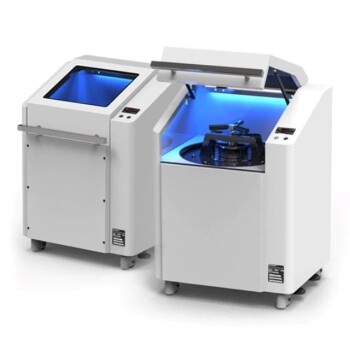
The primary role of an ultrasonic cleaner in this specific process is to provide a deep, physical decontamination that standard rinsing cannot achieve. By combining high-energy impact forces generated by cavitation with an ethanol-acetone mixed solvent, the cleaner removes stubborn contaminants from both the surface and the internal micropores of the ductile iron.
Core Takeaway Success in electroless nickel plating relies heavily on "wetting"—the ability of the plating solution to make total contact with the substrate. Ultrasonic cleaning is the critical preparation step that clears microscopic pores of debris, ensuring adhesion and preventing fatal defects like pinholes or coating detachment.
The Mechanics of Deep Cleaning
Harnessing the Cavitation Effect
The engine of this cleaning process is the cavitation effect.
Ultrasonic waves create microscopic bubbles in the liquid that collapse with high energy.
These collapses generate intense impact forces that physically dislodge contaminants that are otherwise adhered to the metal.
Chemical Synergy with Solvents
Mechanical force alone is often insufficient for chemical residues.
The process utilizes an ethanol-acetone mixed solvent as the medium for the ultrasonic waves.
This chemical combination dissolves organic binders and oils, while the ultrasonic agitation ensures fresh solvent constantly reaches the contaminant interface.
Why Ductile Iron Requires Special Attention
Targeting Microporosity
Ductile iron is characterized by its complex surface structure, which includes micropores.
Surface-level washing often bridges over these tiny holes, leaving trapped air or debris inside.
Ultrasonic cleaning forces the solvent deep into these micropores, flushing out impurities that would later gas out or block plating chemistry.
Removing Specific Impurities
The pre-plating stage often leaves behind specific, hard-to-remove byproducts.
Specifically, this stage targets residual polishing particles and oils left over from mechanical preparation.
Removing these is essential to expose the raw iron substrate completely.
Understanding the Risks of Omission
The Trade-off of "Good Enough" Cleaning
Skipping ultrasonic cleaning to save time or equipment costs creates a high risk of latent failure.
Without the high-energy impact of cavitation, solvents may not penetrate the micropores deeply enough.
The Consequence: Defect Formation
If the substrate is not microscopically clean, the electroless plating solution cannot fully wet the surface.
This lack of wetting leads to voids where the nickel cannot deposit.
The physical manifestation of this failure includes pinholes in the final layer or gross coating detachment (peeling) under stress.
Making the Right Choice for Your Goal
If your primary focus is Adhesion:
- Prioritize the duration of the ultrasonic cycle to ensure the ethanol-acetone mix has fully flushed all micropores of oil.
If your primary focus is Defect Prevention (Pinholes):
- Ensure the ultrasonic frequency is sufficient to generate the cavitation needed to dislodge solid polishing particles from the surface.
Ultrasonic cleaning is not merely a washing step; it is the foundational interface engineering required for a durable nickel coating.
Summary Table:
| Feature | Role in Ductile Iron Pre-Plating |
|---|---|
| Mechanism | Cavitation effect creating high-energy impact forces |
| Solvent Synergy | Ethanol-acetone mix to dissolve organic oils and binders |
| Target Area | Deep decontamination of surface and internal micropores |
| Key Outcome | Enhanced wetting for superior adhesion and pinhole prevention |
| Contaminants Removed | Residual polishing particles, oils, and trapped air |
Achieve Flawless Plating Results with KINTEK
Don't let microscopic contaminants compromise your coating integrity. KINTEK specializes in high-performance laboratory equipment designed for the most demanding material preparation workflows.
From advanced ultrasonic cleaners for deep decontamination to precision crushing and milling systems and high-temperature furnaces, we provide the tools essential for superior adhesion and defect-free finishes. Our expertise extends to supporting battery research, hydraulic pressing, and specialized cooling solutions, ensuring your lab operates at peak efficiency.
Ready to elevate your plating process? Contact our technical experts today to find the perfect cleaning and preparation solutions for your ductile iron and metal substrate applications.
References
- Igor Forestier, Y. Wouters. Study of Electroless Nickel Coatings on EN-GJS-500-7 Spheroidal Graphite Cast Iron. DOI: 10.3390/coatings8070239
This article is also based on technical information from Kintek Solution Knowledge Base .
Related Products
- Laboratory Sterilizer Lab Autoclave Pulsating Vacuum Desktop Steam Sterilizer
- Laboratory Oscillating Orbital Shaker
- Custom PTFE Teflon Parts Manufacturer Corrosion Resistant Cleaning Rack Flower Basket
- Laboratory Scientific Electric Heating Blast Drying Oven
- Portable High Pressure Laboratory Autoclave Steam Sterilizer for Lab Use
People Also Ask
- What is the primary function of a laboratory sterilization autoclave? Master the Physics of Wet Heat Sterilization
- In what industries and applications are steam sterilizers or autoclaves used? Discover Key Uses Across 4 Major Sectors
- What precautions should be taken during autoclave in laboratory? A Complete Safety Guide to Prevent Burns and Explosions
- What extreme conditions does a laboratory autoclave simulate? Testing Wear Resistance of Nuclear Fuel Cladding
- What role does a laboratory autoclave play in HEA corrosion research? Key to Validating Advanced Reactor Materials