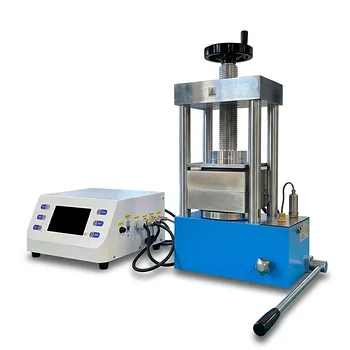
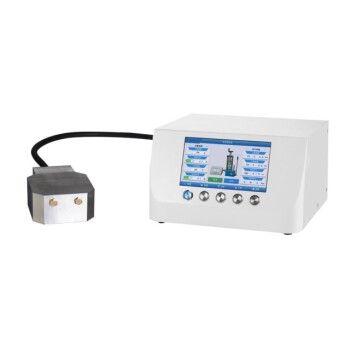
Precise pressure control in a laboratory hot press serves as the mechanical driver that maximizes the efficiency of liquid phase sintering (LPS). By maintaining specific pressure levels (such as 12 MPa) as the temperature reaches the melting point of a binder metal like copper, the press forces the liquid phase to actively penetrate the interstitial spaces between solid particles like chromium. This pressure-assisted mechanism is superior to passive sintering because it actively eliminates voids, leading to a denser, harder, and stronger final alloy.
The application of controlled pressure transforms the liquid phase from a passive component into an active filling agent. By mechanically forcing liquid metal into microscopic voids, the hot press creates a porosity-free structure that significantly improves hardness and transverse rupture strength.
The Mechanics of Pressure-Assisted Sintering
Inducing the Liquid Phase
The process begins with precise temperature management. The hot press heats the alloy mixture until it reaches the specific melting point of the lower-melting component, such as copper.
At this stage, the copper transitions into a liquid state, creating a pool of molten material surrounding the unmelted, solid particles (e.g., chromium).
The Role of Mechanical Force
While temperature creates the liquid, pressure dictates where that liquid goes. The laboratory hot press applies a sustained force, noted in your reference as 12 MPa.
This external pressure overcomes the natural surface tension and friction that might otherwise trap air or prevent flow.
It physically forces the liquid copper to flow efficiently, navigating and filling the complex gaps between the solid chromium framework.
Material Improvements and Performance Gains
Eliminating Porosity
The most immediate physical change driven by this pressure is the reduction of porosity.
In passive sintering, small voids often remain where the liquid fails to penetrate. The hot press ensures these spaces are filled completely with the liquid phase.
This results in a material with high density and vastly improved structural continuity.
Enhancing Mechanical Properties
Because the internal structure is solid and free of voids, the alloy's performance metrics improve drastically.
The reduction in porosity directly correlates to an increase in hardness, making the material more resistant to surface deformation.
Furthermore, the process enhances Transverse Rupture Strength (TRS), meaning the alloy is significantly less likely to fracture under bending stress.
Understanding the Trade-offs
The Necessity of Synchronization
The effectiveness of this process relies entirely on the synchronization of heat and pressure.
If pressure is applied without precise temperature control, the liquid phase will not form correctly, rendering the pressure ineffective at filling voids.
Dependence on Specific Parameters
The benefits cited—reduced porosity and increased TRS—are contingent on maintaining specific parameters, such as the 12 MPa pressure threshold.
Deviating from these established pressure settings can lead to incomplete infiltration of the binder metal, resulting in a sub-par alloy that retains structural weaknesses.
Making the Right Choice for Your Goal
To maximize the performance of your alloy using a laboratory hot press, focus on the following operational targets:
- If your primary focus is Maximizing Density: Ensure the pressure application is sustained exactly as the binder metal enters its liquid phase to force complete pore filling.
- If your primary focus is Mechanical Durability: Calibrate your process to maintain the specific pressure (e.g., 12 MPa) required to achieve the highest possible Transverse Rupture Strength (TRS).
Controlled pressure is not just a variable; it is the defining factor that ensures a liquid phase yields a high-performance solid.
Summary Table:
| Feature | Impact on Liquid Phase Sintering (LPS) | Performance Outcome |
|---|---|---|
| Precise Pressure (12 MPa) | Forces liquid binder into microscopic voids | Near-zero porosity and high density |
| Thermal Synchronization | Ensures pressure is applied at the exact melting point | Uniform material infiltration |
| Mechanical Force | Overcomes surface tension of molten metal | Superior Transverse Rupture Strength (TRS) |
| Atmosphere Control | Prevents oxidation during the liquid phase | Enhanced alloy purity and hardness |
Elevate Your Material Research with KINTEK Precision
Unlock the full potential of your alloy development with KINTEK’s advanced laboratory hot presses. Our equipment provides the precise pressure and temperature synchronization essential for mastering Liquid Phase Sintering, ensuring your materials achieve maximum density and mechanical durability.
Beyond hot presses, KINTEK specializes in a comprehensive range of laboratory solutions, including:
- High-Temperature Furnaces: Muffle, vacuum, CVD, and tube furnaces for precise thermal processing.
- Sample Preparation: Hydraulic pellet presses, crushing and milling systems, and sieving equipment.
- Advanced Reactors: High-temperature high-pressure reactors and autoclaves for complex synthesis.
- Specialized Labware: High-purity ceramics, crucibles, and PTFE products.
Ready to achieve superior Transverse Rupture Strength and void-free structures? Contact KINTEK today to discuss your project requirements and find the perfect equipment for your research goals.
Related Products
- 30T 40T Split Automatic Heated Hydraulic Press Machine with Heated Plates for Laboratory Hot Press
- Automatic Heated Hydraulic Press Machine with Heated Plates for Laboratory Hot Press
- Heated Hydraulic Press Machine with Heated Plates Split Manual Laboratory Hot Press
- Automatic Laboratory Heat Press Machine
- 24T 30T 60T Heated Hydraulic Press Machine with Heated Plates for Laboratory Hot Press
People Also Ask
- What are the advantages of using a laboratory hydraulic press for hot pressing? Achieve Peak Nano-Composite Density
- What are the core advantages of using a laboratory hot press to produce Bi2Se3? Achieve 93% Density & High Conductivity
- Why is a laboratory hydraulic hot press essential for high-density, additive-free Silicon Carbide? Unlock Pure SiC.
- How does a laboratory hydraulic hot press ensure the quality of PHBV/natural fiber composites? Expert Guide
- What is the function of a laboratory hydraulic hot press in the assembly of solid-state photoelectrochemical cells?