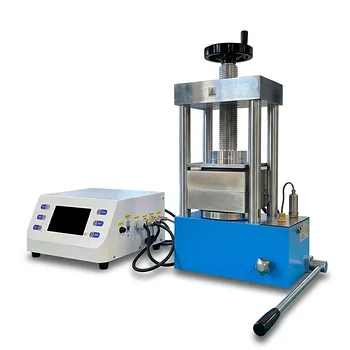
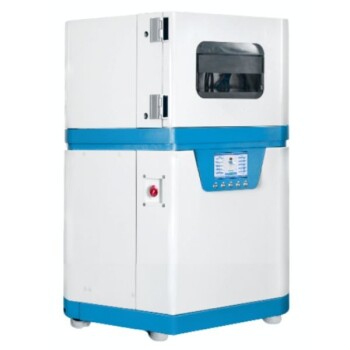
The hydraulic hot press serves as the critical bonding instrument in the fabrication of all-solid-state battery cells. It functions by applying simultaneous heat and pressure to the stacked structure of the cathode, solid electrolyte, and anode. This dual action is required to physically merge these distinct solid layers into a single, cohesive unit capable of electrochemical function.
Solid-state batteries face a fundamental challenge: solid layers do not naturally form perfect contacts, leading to gaps that block energy flow. The hydraulic hot press solves this by softening the polymer electrolyte to fill these voids, creating the seamless interface necessary for efficient lithium-ion transport.
The Mechanics of Interfacial Bonding
Applying Heat and Pressure
The fabrication process begins with a "sandwich" structure composed of the cathode, the solid electrolyte, and the anode.
The hydraulic hot press compresses this stack while simultaneously elevating its temperature.
Softening the Polymer Matrix
The primary reference specifically identifies the role of the Polyethylene Oxide (PEO) polymer electrolyte in this process.
Under the influence of the applied heat, the PEO softens, transitioning from a rigid solid into a more pliable state.
Optimizing Ionic Transport
Conforming to Surface Irregularities
Once softened, the pressure forces the PEO electrolyte to conform tightly to the microscopic contours of the electrode surfaces.
This physical deformation is essential because it eliminates the interfacial gaps that naturally exist between two solid materials.
Reducing Interfacial Impedance
By removing these gaps, the press ensures there is maximum physical contact area between the layers.
This direct contact significantly reduces interfacial impedance, which is the resistance that opposes the flow of ions.
Enabling Lithium-Ion Flow
The ultimate goal of this process is to establish a continuous, unbroken path for lithium ions.
Effective transport across solid-solid interfaces is impossible without the seamless bonding achieved through this hot-pressing method.
Understanding the Process Requirements
The Role of Material Properties
The success of this fabrication step is entirely dependent on the behavior of the PEO polymer.
The process relies on the specific ability of the polymer to soften under heat; materials that do not soften would not conform effectively using this method.
The Consequence of Inadequate Bonding
If the heat or pressure is insufficient, the PEO will not adequately fill the voids between layers.
This failure results in high impedance, preventing the efficient movement of lithium ions and rendering the battery cell ineffective.
Maximizing Cell Efficiency
To ensure the successful fabrication of all-solid-state cells, you must align your processing parameters with the material properties of your electrolyte.
- If your primary focus is mechanical integrity: Verify that the applied heat is sufficient to fully soften the PEO polymer, allowing it to act as a binder between the electrodes.
- If your primary focus is electrochemical performance: Calibrate the pressure to ensure complete elimination of interfacial gaps, thereby minimizing impedance and maximizing ion transport.
The hydraulic hot press transforms a stack of disparate components into a high-performance energy storage device by simply ensuring they touch perfectly.
Summary Table:
| Process Phase | Action | Impact on Battery Cell |
|---|---|---|
| Heating | Softens PEO polymer electrolyte | Transitions rigid matrix to a pliable state |
| Compression | Applies uniform hydraulic pressure | Eliminates interfacial gaps and voids |
| Bonding | Merges cathode, electrolyte, and anode | Creates a cohesive, high-performance unit |
| Optimization | Maximizes surface contact area | Reduces interfacial impedance for ion flow |
Elevate Your Battery Research with KINTEK Precision
Unlock the full potential of your energy storage innovations with KINTEK’s advanced hydraulic hot presses. Specifically designed for the rigorous demands of all-solid-state battery fabrication, our equipment ensures precise temperature control and uniform pressure to eliminate interfacial impedance and optimize lithium-ion transport.
Beyond our industry-leading pellet, hot, and isostatic hydraulic presses, KINTEK offers a comprehensive ecosystem for battery labs, including:
- High-Temperature Furnaces (Vacuum, CVD, and Atmosphere) for material synthesis.
- Crushing and Milling Systems for electrode preparation.
- Battery Research Tools & Consumables tailored for PEO and solid-state chemistry.
- ULT Freezers and Cooling Solutions for sensitive material storage.
Ready to achieve seamless bonding in your solid-state cells? Contact our laboratory specialists today to find the perfect equipment solution for your research goals.
Related Products
- Automatic High Temperature Heated Hydraulic Press Machine with Heated Plates for Lab
- Manual High Temperature Heated Hydraulic Press Machine with Heated Plates for Lab
- Heated Hydraulic Press Machine with Heated Plates for Vacuum Box Laboratory Hot Press
- 24T 30T 60T Heated Hydraulic Press Machine with Heated Plates for Laboratory Hot Press
- Heated Hydraulic Press Machine with Heated Plates for Vacuum Box Laboratory Hot Press
People Also Ask
- What is a heated hydraulic press used for? Essential Tool for Curing, Molding, and Laminating
- Why is a heated hydraulic press used for warm pressing NASICON green tapes? Optimize Your Solid Electrolyte Density
- Why is a heated laboratory hydraulic press necessary for composite laminates? Achieve Void-Free Structural Integrity
- What is a hot hydraulic press? Harness Heat and Pressure for Advanced Manufacturing
- What role does a heated hydraulic press play in Cold Sintering (CSP)? Enhancing LATP-Halide Densification