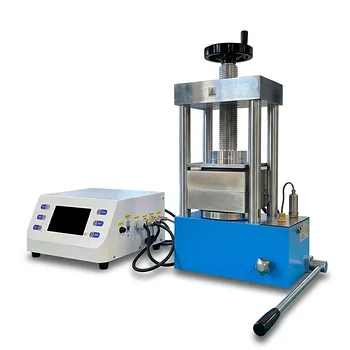
Precise pressure control within a hydraulic system is the fundamental driver for accelerating densification and inducing critical microstructural evolution in multi-particle nanocopper. This process goes beyond simple compaction; it forces the rapid expansion of particle contact areas and drives dislocation interactions that are physically impossible to achieve in pressureless environments. By accurately managing pressure maintenance and release, the system eliminates structural defects, resulting in a material with superior work hardening rates and mechanical performance.
Core Insight Pressure is not merely a shaping tool; it is an active thermodynamic variable that overcomes lattice orientation mismatches and kinetic delays. The application of precise hydraulic force induces the formation of Lomer-Cottrell dislocation locks, a microstructural phenomenon that significantly enhances the material's strength and structural integrity.
Driving Microstructural Evolution
Inducing Dislocation Locks
The primary reference highlights that pressure drives the evolution of dislocations within the nanocopper lattice. This specific interaction leads to the formation of Lomer-Cottrell dislocation locks.
Improving Work Hardening
These dislocation locks act as barriers to further dislocation movement, which directly improves the material's work hardening rate. This microstructural change is essential for enhancing the final mechanical performance of the sintered copper.
Accelerating Particle Contact
Hydraulic pressure promotes the rapid expansion of contact areas between individual nanoparticles. This accelerated contact is the prerequisite for effective sintering and material continuity.
Overcoming Physical Bottlenecks
Eliminating Residual Defects
Without external pressure, sintering often suffers from kinetic delays that leave behind complex residual pores. The hydraulic system forcibly eliminates these defects, ensuring the removal of structural voids that would otherwise weaken the material.
Resolving Lattice Mismatches
Hot pressing introduces the external force necessary to overcome sintering bottlenecks caused by lattice orientation mismatches. This facilitates grain fusion and reorganization that pressureless methods cannot achieve.
Ensuring Uniform Density
The hydraulic system allows for accurate control over pressure maintenance and release. This precision ensures a uniform internal density distribution within the green body, preventing macroscopic defects.
Understanding the Risks of Imprecise Control
The Danger of Micro-Cracks
While pressure is beneficial, the control must be exact. Inaccurate pressure release or uneven application can introduce micro-cracks or cause particle deformation.
The "Green Body" Vulnerability
If the initial density distribution in the green body (the compacted powder before sintering) is not uniform, the defects will persist. The hydraulic precision is critical at this stage to ensure particles do not crack during the subsequent heating process.
Making the Right Choice for Your Goal
To maximize the utility of your hydraulic hot pressing system, align your pressure strategy with your specific material requirements:
- If your primary focus is Mechanical Strength: Prioritize pressure profiles that maximize the formation of Lomer-Cottrell dislocation locks to enhance work hardening.
- If your primary focus is Conductivity: Focus on pressure levels that forcibly eliminate residual pore defects and promote complete grain fusion to lower porosity.
- If your primary focus is Structural Integrity: Ensure precise control during the pressure release phase to prevent micro-cracks and ensure uniform internal density.
Precise hydraulic control transforms nanocopper from a loose powder into a high-performance, defect-free solid by mechanically enforcing microstructural perfection.
Summary Table:
| Key Factor | Impact of Precise Hydraulic Control | Microstructural Result |
|---|---|---|
| Dislocation Density | Induces specific lattice interactions | Formation of Lomer-Cottrell locks |
| Particle Contact | Accelerates contact area expansion | Rapid densification & grain fusion |
| Defect Management | Forcibly eliminates residual pores | Zero-void structural integrity |
| Stress Management | Accurate pressure maintenance & release | Prevention of micro-cracks |
| Mechanical Property | High work hardening rate | Enhanced strength & durability |
Elevate Your Material Research with KINTEK Precision
Achieving microstructural perfection in nanocopper requires more than just heat—it demands the extreme precision of KINTEK’s hydraulic presses and hot pressing systems. Whether you are developing high-strength alloys or high-conductivity electronics, our advanced pellet, hot, and isostatic presses provide the exact pressure control needed to eliminate defects and induce critical dislocation locks.
From high-temperature vacuum furnaces to specialized crushing and milling systems, KINTEK equips laboratories with the comprehensive tools required for cutting-edge material science. Don't let imprecise pressure compromise your results.
Ready to optimize your sintering process? Contact our technical experts today to find the perfect hydraulic solution for your laboratory’s unique requirements.
Related Products
- Automatic High Temperature Heated Hydraulic Press Machine with Heated Plates for Lab
- Vacuum Heat Treat and Sintering Furnace with 9MPa Air Pressure
- 24T 30T 60T Heated Hydraulic Press Machine with Heated Plates for Laboratory Hot Press
- Heated Hydraulic Press Machine with Heated Plates for Vacuum Box Laboratory Hot Press
- Vacuum Heat Treat and Pressure Sintering Furnace for High Temperature Applications
People Also Ask
- Why is a heated hydraulic press used for warm pressing NASICON green tapes? Optimize Your Solid Electrolyte Density
- What is a heated hydraulic press used for? Essential Tool for Curing, Molding, and Laminating
- Why is a heated laboratory hydraulic press necessary for composite laminates? Achieve Void-Free Structural Integrity
- What is a hot hydraulic press? Harness Heat and Pressure for Advanced Manufacturing
- Why is the heating function of a laboratory hydraulic press essential for MEA assembly in DEFC? Optimize Cell Bonding