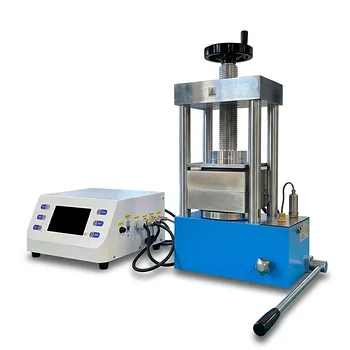
A laboratory hydraulic hot press is the critical instrument for creating high-performance interfaces in solid-state photoelectrochemical cells. Its primary function is to apply simultaneous heat and pressure to fuse the catalyst layer with the polymer electrolyte membrane. This process creates a robust physical bond that is essential for both the structural integrity and the electrochemical efficiency of the cell.
Achieving a functional solid-state cell requires more than just layering materials; it demands the elimination of microscopic voids. The hydraulic hot press forces intimate contact between the catalyst and electrolyte, significantly reducing resistance and enhancing the material's ability to absorb light.
Optimizing the Physical Interface
Bonding the Catalyst to the Membrane
In solid-state architectures, liquid electrolytes are replaced by solid polymers or ceramics. The hot press is used to mechanically and thermally merge the catalyst layer onto the polymer electrolyte membrane. This ensures the two distinct materials function as a single, cohesive unit.
Reducing Interfacial Resistance
Without sufficient pressure and heat, microscopic gaps remain between cell layers. These voids act as barriers to ion flow. By regulating the density and porosity of the interface, the hot press minimizes solid-solid contact resistance, which is vital for efficient operation.
Enhancing Charge Transport
For the cell to function, charges must move freely between the photoanode and the electrolyte. The "tight physical bond" achieved through hot pressing facilitates this transfer. The primary reference notes that this specific assembly step directly improves charge transport efficiency.
Impact on Optical Properties
Inducing the Red Shift
Beyond simple mechanical bonding, the hot press actively modifies the optical characteristics of Titanium Dioxide (TiO2) photoanodes. The process induces a red shift in the optical absorption edge of the material.
Improving Spectral Utilization
This red shift is not merely a side effect; it is a functional enhancement. It allows the TiO2 to absorb a broader range of the light spectrum. Consequently, the hot pressing process optimizes the spectral utilization efficiency of the cell.
Critical Considerations and Trade-offs
The Importance of Precision Sealing
While the primary focus is often on the active layers, the hot press also performs a critical sealing function. It applies heat (often around 125°C) to melt thermoplastic gaskets like Surlyn. This hermetic seal prevents air penetration and ensures the long-term stability of the internal components.
Managing Heat and Pressure Balance
Success relies on precise control rather than brute force. Excessive pressure can damage delicate structural frameworks, while insufficient heat may fail to bond the polymer membrane. You must calibrate the press to the specific glass transition temperatures and compressive strength of your materials.
Making the Right Choice for Your Goal
To maximize the utility of a hydraulic hot press in your assembly process, prioritize your specific experimental outcomes:
- If your primary focus is Electrical Efficiency: Prioritize maximizing pressure to minimize porosity and contact resistance between the catalyst and polymer membrane.
- If your primary focus is Optical Performance: Calibrate your temperature and pressure specifically to induce the red shift in TiO2 photoanodes for better light absorption.
- If your primary focus is Device Longevity: Ensure the press can maintain stable temperatures (e.g., 125°C) to hermetically bond thermoplastic sealing gaskets.
By strictly controlling the interface between the catalyst and the electrolyte, you transform a stack of raw materials into a highly efficient, integrated photoelectrochemical device.
Summary Table:
| Feature | Function in Cell Assembly | Impact on Performance |
|---|---|---|
| Thermal Fusion | Merges catalyst layer with polymer electrolyte | Ensures structural integrity and cohesive unit function |
| Pressure Application | Eliminates microscopic voids and gaps | Minimizes interfacial resistance and facilitates ion flow |
| Interface Engineering | Improves charge transport between layers | Boosts electrochemical efficiency and charge transfer |
| Optical Modification | Induces red shift in TiO2 photoanodes | Expands light absorption and spectral utilization |
| Hermetic Sealing | Melts thermoplastic gaskets (e.g., Surlyn) | Prevents air penetration and ensures long-term stability |
Elevate Your Materials Research with KINTEK Precision
High-performance solid-state photoelectrochemical cells require the exact balance of heat and pressure that only professional-grade equipment can provide. KINTEK specializes in advanced laboratory solutions, offering a robust range of manual and automatic hydraulic hot presses designed for precision interface engineering.
Beyond assembly tools, our comprehensive portfolio includes high-temperature furnaces (CVD, PECVD, Vacuum), crushing and milling systems, and essential consumables like PTFE and ceramics. Whether you are optimizing TiO2 photoanodes or perfecting battery research, KINTEK provides the reliability and expertise your lab needs to succeed.
Ready to reduce interfacial resistance and enhance your device efficiency? Contact KINTEK today to find the perfect hot press for your application!
References
- Kingsley O. Iwu, Truls Norby. Effects of temperature, triazole and hot-pressing on the performance of TiO2 photoanode in a solid-state photoelectrochemical cell. DOI: 10.1016/j.electacta.2013.10.095
This article is also based on technical information from Kintek Solution Knowledge Base .
Related Products
- 30T 40T Split Automatic Heated Hydraulic Press Machine with Heated Plates for Laboratory Hot Press
- 24T 30T 60T Heated Hydraulic Press Machine with Heated Plates for Laboratory Hot Press
- Automatic Heated Hydraulic Press Machine with Heated Plates for Laboratory Hot Press 25T 30T 50T
- Automatic Heated Hydraulic Press Machine with Heated Plates for Laboratory Hot Press
- Heated Hydraulic Press Machine with Heated Plates for Vacuum Box Laboratory Hot Press
People Also Ask
- What are the advantages of using a laboratory hydraulic press for hot pressing? Achieve Peak Nano-Composite Density
- What are the core advantages of using a laboratory hot press to produce Bi2Se3? Achieve 93% Density & High Conductivity
- Why is a laboratory hydraulic hot press essential for high-density, additive-free Silicon Carbide? Unlock Pure SiC.
- How does a laboratory hydraulic hot press ensure the quality of PHBV/natural fiber composites? Expert Guide
- How does a laboratory hot press improve alloy performance? Optimize Liquid Phase Sintering for High-Strength Materials