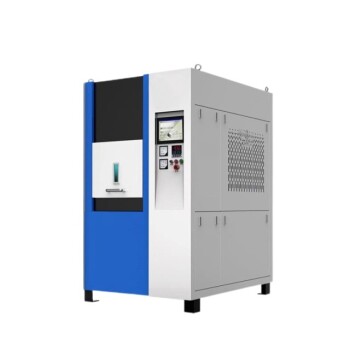
Hot-pressing sintering equipment offers a decisive advantage over traditional powder annealing by enabling the simultaneous occurrence of phase transformation and material densification. While traditional methods often treat these as separate steps, hot-pressing utilizes mechanical pressure to suppress grain growth, preserving the ultra-fine nanostructure essential for high-performance thermoelectric materials.
The synergy of heat, pressure, and vacuum allows hot-pressing to produce dense, phase-pure CoSb3 solids without sacrificing the nanostructural benefits of mechanical alloying. This process is the key to maximizing the thermoelectric figure of merit (ZT).
The Power of Simultaneous Processing
Coupling Transformation and Densification
In traditional processing, phase transformation and densification are often distinct stages. Hot-pressing equipment consolidates these into a single, efficient event.
By applying thermal energy and mechanical force at the same time, the equipment forces the loose CoSb3 powders to densify rapidly while they undergo the necessary phase changes.
Preserving Nanostructure via Pressure
The defining feature of mechanically alloyed powders is their ultra-fine nanostructure, which significantly boosts thermoelectric performance.
However, heat naturally causes grains to grow, which can destroy this nanostructure. The mechanical pressure applied during hot-pressing actively suppresses this excessive grain growth, locking in the benefits of the alloying process.
Maximizing the Figure of Merit (ZT)
The ultimate goal of using CoSb3 is thermoelectric efficiency.
By achieving high density while restricting grain size, hot-pressing directly optimizes the material's properties. This balance is critical for achieving a high thermoelectric figure of merit (ZT), which is difficult to replicate with pressureless annealing.
Protecting Material Integrity
Handling High Reactivity
Powders produced via mechanical alloying possess a very high specific surface area.
This physical characteristic makes them extremely reactive and prone to degradation when exposed to air.
The Role of the Vacuum Environment
Hot-pressing furnaces operate under a vacuum, which serves as a critical shield for the material.
This environment prevents oxidation during the heating and holding stages. By inhibiting the formation of impurity phases, the vacuum ensures the final material maintains high phase purity and consistent electrical performance.
Understanding the Trade-offs
Geometry Limitations
While hot-pressing excels at creating dense, high-performance materials, it is generally limited to simple shapes.
Because the pressure is applied uniaxially (usually via a ram), producing complex 3D geometries is difficult compared to pressureless sintering or annealing methods.
Equipment Complexity
Hot-pressing requires sophisticated vacuum and hydraulic systems.
This increases the operational complexity and cost compared to a standard annealing furnace. It is a precision tool designed for performance maximization rather than high-volume, low-cost batch processing.
Making the Right Choice for Your Project
To determine if hot-pressing is the correct solution for your CoSb3 workflow, consider your specific performance targets:
- If your primary focus is maximizing thermoelectric efficiency (ZT): Use hot-pressing to leverage mechanical pressure, which preserves the critical nanostructures responsible for high performance.
- If your primary focus is ensuring phase purity: Rely on the equipment's vacuum environment to prevent oxidation in highly reactive, mechanically alloyed powders.
Hot-pressing is not just a heating method; it is a structural preservation technique essential for advanced thermoelectric applications.
Summary Table:
| Feature | Hot-Pressing Sintering | Traditional Powder Annealing |
|---|---|---|
| Processing | Simultaneous transformation & densification | Separate, multi-stage processing |
| Grain Control | Pressure-suppressed grain growth | Prone to excessive grain growth |
| Nanostructure | Preserved ultra-fine structure | Often lost during heating |
| Phase Purity | High (Vacuum-protected) | Lower (Risk of oxidation/impurities) |
| Resulting ZT | Optimized Figure of Merit | Limited by porosity and grain size |
Elevate Your Thermoelectric Research with KINTEK
Maximize the potential of your mechanically alloyed powders with KINTEK’s advanced hot-pressing systems. Designed for precision, our equipment combines thermal energy, mechanical pressure, and vacuum environments to help you achieve superior densification while preserving the ultra-fine nanostructures critical for high ZT values.
Whether you are working on CoSb3 thermoelectric materials, battery research, or advanced ceramics, KINTEK provides a comprehensive range of laboratory solutions, including:
- High-Temperature Furnaces: Muffle, tube, rotary, and vacuum systems.
- Hydraulic Presses: Precision pellet, hot, and isostatic presses for material consolidation.
- Material Processing: Crushing, milling, and sieving equipment for powder preparation.
- Lab Consumables: High-quality PTFE products, ceramics, and crucibles.
Ready to optimize your material integrity and laboratory efficiency? Contact our technical experts today to find the perfect equipment solution tailored to your specific research needs.
Related Products
- 600T Vacuum Induction Hot Press Furnace for Heat Treat and Sintering
- Vacuum Heat Treat and Pressure Sintering Furnace for High Temperature Applications
- Vacuum Heat Treat and Sintering Furnace with 9MPa Air Pressure
- Automatic Heated Hydraulic Press Machine with Heated Plates for Laboratory Hot Press
- High Temperature Muffle Oven Furnace for Laboratory Debinding and Pre Sintering
People Also Ask
- What role does an induction vacuum hot pressing furnace play in sintering? Achieve 98% Density in Carbide Blocks
- What advantages does a vacuum hot press furnace provide for LSLBO ceramic electrolytes? Achieve 94% Relative Density
- What role does a Vacuum Hot Press (VHP) furnace play in the densification of austenitic stainless steel 316 composites?
- What are the advantages of a vacuum hot press furnace for W-50%Cu? Achieve 99.6% Density at Lower Temperatures
- What role does mechanical pressure play during the vacuum diffusion bonding of tungsten and copper? Keys to Solid Bonding