Blog Why Your Forged Components Crack: The Hidden Role of Temperature
Why Your Forged Components Crack: The Hidden Role of Temperature

Why Your Forged Components Crack: The Hidden Role of Temperature

4 hours ago

It’s a scenario that plays out in materials labs and R&D facilities all too often. You’ve just finished compressing a heated metal billet, shaping it into a new component. It looks perfect—the dimensions are right, the surface is clean. But during quality testing, or worse, in a prototype assembly, a tiny crack appears. The part fails. Weeks of work and expensive materials are wasted, and the team is back to square one, asking, "What went wrong?"

The Frustrating Cycle of Trial and Error

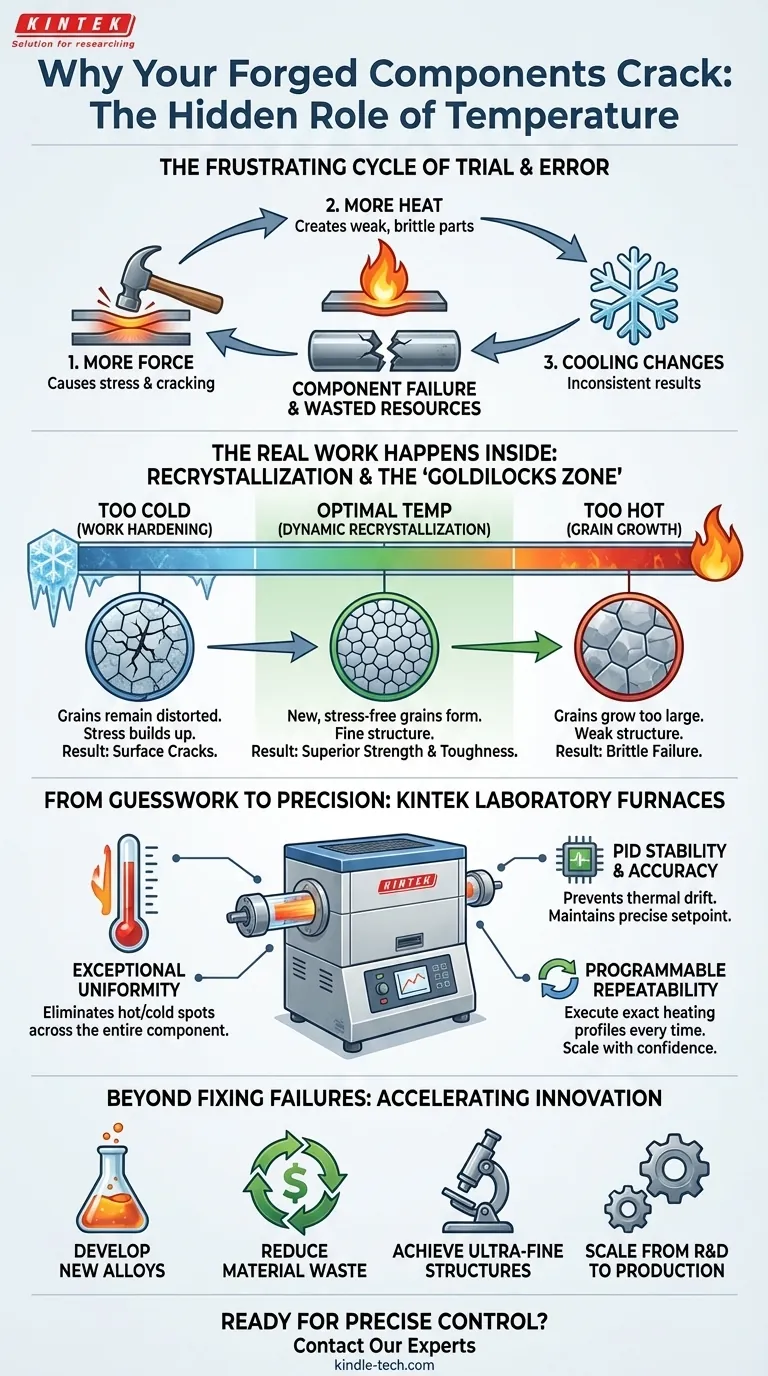
If this sounds familiar, you're not alone. The challenge of creating strong, reliable components through hot forming processes like forging or extrusion is a universal one. When faced with failures like cracking or brittleness, the instinctive reaction is to adjust the most obvious variables.

Engineers and technicians often find themselves in a loop of costly guesswork:

  • "Let's apply more force." The logic seems sound—if the metal isn't forming correctly, press it harder. But this often leads to more severe surface cracking and internal stress.
  • "Let's heat it more." The idea is to make the metal softer and more malleable. But this can result in a component that looks fine but is actually weak and brittle, failing unexpectedly under load.
  • "Maybe we're cooling it too fast?" Teams experiment with different quenching or cooling methods, but the results remain inconsistent and unpredictable.

These repeated failures aren't just a technical nuisance; they have serious business consequences. Project timelines stretch from weeks into months. Budgets are consumed by wasted high-value alloys. Most importantly, the inability to reliably produce high-performance materials stalls innovation and can damage your reputation for quality. The team gets stuck treating symptoms, because the true cause of the problem lies hidden from view.

The Real Work Happens Inside: Understanding Recrystallization

The fundamental mistake in the "more force, more heat" approach is that it focuses only on the external shape of the metal. The real secret to a strong, successful component lies in controlling its internal microscopic structure.

Imagine the metal is made of countless tiny, interconnected crystals, or "grains." When you apply compressive force, you are distorting and stressing these grains. The purpose of heating the metal isn't just to make it soft; it's to give these grains the energy to "heal" themselves.

This healing process is called dynamic recrystallization. The old, distorted grains are replaced by new, smaller, stress-free grains. A fine, uniform grain structure is what gives a component its superior strength and toughness.

The 'Goldilocks Zone': The Narrow Window Between Brittle and Cracked

Here is the critical insight: Recrystallization only happens correctly within a very specific temperature range for each alloy. This is the root of the problem.

  • If your metal is too hot (even slightly): The new grains grow too large. Large grains create a weak, brittle structure. This is why the "just heat it more" approach often creates parts that fail later.
  • If your metal is too cold: Recrystallization slows down or stops completely. The grains remain distorted and stressed, a condition called "work hardening." As you continue to apply force, this built-up stress has nowhere to go, resulting in surface cracks and catastrophic failure.

The common solutions fail because they don't address this fundamental principle. You can't solve a precision temperature problem with brute force. You need to stop guessing and start controlling.

From Guesswork to Precision: The Tool Designed for Perfect Recrystallization

To consistently achieve that perfect "Goldilocks" temperature, you need more than just an oven. You need a tool capable of maintaining a stable, uniform, and precisely controlled thermal environment throughout your entire process.

This is precisely the problem that KINTEK's laboratory furnaces are engineered to solve. They are not merely heating devices; they are precision thermal processing instruments designed for the rigorous demands of materials science.

Our furnaces directly address the root causes of hot forming failures:

  • The Problem of Inconsistent Temperature: Our furnaces provide exceptional temperature uniformity, ensuring the entire component—from surface to core—remains within the optimal recrystallization window. No hot spots causing grain growth, no cold spots causing work hardening.
  • The Problem of Temperature Fluctuation: Advanced PID controllers maintain the setpoint with extreme accuracy, preventing the thermal drift that can ruin an entire batch.
  • The Problem of Repeatability: With programmable, multi-stage thermal cycles, you can design, execute, and—most importantly—repeat the exact heating profile your material needs, every single time.

By replacing guesswork with precision control, you are no longer just shaping metal; you are intentionally engineering its internal structure for peak performance.

Beyond Fixing Failures: Accelerating Your Materials Innovation

Once you have mastered temperature control, a fundamental shift occurs. You move from a reactive mode of fixing failures to a proactive mode of creating possibilities. The time, resources, and mental energy once spent on troubleshooting are now freed up for genuine innovation.

With reliable and repeatable thermal processing, your lab can now:

  • Confidently develop new, advanced alloys knowing you can process them to their full potential.
  • Dramatically reduce material waste and accelerate your R&D cycles.
  • Achieve the ultra-fine grain structures required for mission-critical applications in aerospace, medical devices, and high-performance industries.
  • Create a reliable "recipe book" of thermal profiles, allowing you to scale from research to pilot production with predictable outcomes.

Ultimately, solving the hot compression puzzle isn't just about making better parts. It's about unlocking your team's ability to innovate faster and push the boundaries of what's possible with materials.

Your work is too important for guesswork. If you're ready to move from trial and error to precise, repeatable control in your thermal processing applications, our team is here to help. We can provide expert guidance on how the right equipment can solve not just this challenge, but many others across your lab's workflow. To discuss your specific project and material requirements, Contact Our Experts.

Visual Guide
Why Your Forged Components Crack: The Hidden Role of Temperature Visual Guide

Related Products

Related Articles

Related Products

1700℃ Muffle Oven Furnace for Laboratory

1700℃ Muffle Oven Furnace for Laboratory

Get superior heat control with our 1700℃ Muffle Furnace. Equipped with intelligent temperature microprocessor, TFT touch screen controller & advanced insulation materials for precise heating up to 1700C. Order now!

Graphite Vacuum Furnace High Thermal Conductivity Film Graphitization Furnace

Graphite Vacuum Furnace High Thermal Conductivity Film Graphitization Furnace

The high thermal conductivity film graphitization furnace has uniform temperature, low energy consumption and can operate continuously.

Ultra-High Temperature Graphite Vacuum Graphitization Furnace

Ultra-High Temperature Graphite Vacuum Graphitization Furnace

The ultra-high temperature graphitization furnace utilizes medium frequency induction heating in a vacuum or inert gas environment. The induction coil generates an alternating magnetic field, inducing eddy currents in the graphite crucible, which heats up and radiates heat to the workpiece, bringing it to the desired temperature. This furnace is primarily used for graphitization and sintering of carbon materials, carbon fiber materials, and other composite materials.

600T Vacuum Induction Hot Press Furnace for Heat Treat and Sintering

600T Vacuum Induction Hot Press Furnace for Heat Treat and Sintering

Discover the 600T Vacuum Induction Hot Press Furnace, designed for high-temperature sintering experiments in vacuum or protected atmospheres. Its precise temperature and pressure control, adjustable working pressure, and advanced safety features make it ideal for nonmetal materials, carbon composites, ceramics, and metal powders.

Vacuum Heat Treat and Molybdenum Wire Sintering Furnace for Vacuum Sintering

Vacuum Heat Treat and Molybdenum Wire Sintering Furnace for Vacuum Sintering

A vacuum molybdenum wire sintering furnace is a vertical or bedroom structure, which is suitable for withdrawal, brazing, sintering and degassing of metal materials under high vacuum and high temperature conditions. It is also suitable for dehydroxylation treatment of quartz materials.

Dental Porcelain Zirconia Sintering Ceramic Furnace Chairside with Transformer

Dental Porcelain Zirconia Sintering Ceramic Furnace Chairside with Transformer

Experience top-notch sintering with Chairside Sintering Furnace with Transformer. Easy to operate, noise-free pallet, and automatic temperature calibration. Order now!

Vacuum Hot Press Furnace Machine for Lamination and Heating

Vacuum Hot Press Furnace Machine for Lamination and Heating

Experience clean and precise lamination with Vacuum Lamination Press. Perfect for wafer bonding, thin-film transformations, and LCP lamination. Order now!

Graphite Vacuum Furnace IGBT Experimental Graphitization Furnace

Graphite Vacuum Furnace IGBT Experimental Graphitization Furnace

IGBT experimental graphitization furnace, a tailored solution for universities and research institutions, with high heating efficiency, user-friendliness, and precise temperature control.

Small Vacuum Heat Treat and Tungsten Wire Sintering Furnace

Small Vacuum Heat Treat and Tungsten Wire Sintering Furnace

The small vacuum tungsten wire sintering furnace is a compact experimental vacuum furnace specially designed for universities and scientific research institutes. The furnace features a CNC welded shell and vacuum piping to ensure leak-free operation. Quick-connect electrical connections facilitate relocation and debugging, and the standard electrical control cabinet is safe and convenient to operate.

Vacuum Dental Porcelain Sintering Furnace

Vacuum Dental Porcelain Sintering Furnace

Get precise and reliable results with KinTek's Vacuum Porcelain Furnace. Suitable for all porcelain powders, it features hyperbolic ceramic furnace function, voice prompt, and automatic temperature calibration.

HFCVD Machine System Equipment for Drawing Die Nano-Diamond Coating

HFCVD Machine System Equipment for Drawing Die Nano-Diamond Coating

The nano-diamond composite coating drawing die uses cemented carbide (WC-Co) as the substrate, and uses the chemical vapor phase method ( CVD method for short ) to coat the conventional diamond and nano-diamond composite coating on the surface of the inner hole of the mold.

Silicon Carbide SiC Thermal Heating Elements for Electric Furnace

Silicon Carbide SiC Thermal Heating Elements for Electric Furnace

Experience the advantages of Silicon Carbide (SiC) Heating Element: Long service life, high corrosion and oxidation resistance, fast heating speed, and easy maintenance. Learn more now!

Laboratory Test Sieves and Sieving Machines

Laboratory Test Sieves and Sieving Machines

Precision lab test sieves & sieving machines for accurate particle analysis. Stainless steel, ISO-compliant, 20μm-125mm range. Request specs now!

Laboratory Sterilizer Lab Autoclave Vertical Pressure Steam Sterilizer for Liquid Crystal Display Automatic Type

Laboratory Sterilizer Lab Autoclave Vertical Pressure Steam Sterilizer for Liquid Crystal Display Automatic Type

Liquid crystal display automatic vertical sterilizer is a safe, reliable and automatic control sterilization equipment, which is composed of heating system, microcomputer control system and overheating and overvoltage protection system.

Three-dimensional electromagnetic sieving instrument

Three-dimensional electromagnetic sieving instrument

KT-VT150 is a desktop sample processing instrument for both sieving and grinding. Grinding and sieving can be used both dry and wet. The vibration amplitude is 5mm and the vibration frequency is 3000-3600 times/min.

Laboratory Sterilizer Lab Autoclave Pulse Vacuum Lifting Sterilizer

Laboratory Sterilizer Lab Autoclave Pulse Vacuum Lifting Sterilizer

The pulse vacuum lifting sterilizer is a state-of-the-art equipment for efficient and precise sterilization. It uses pulsating vacuum technology, customizable cycles, and a user-friendly design for easy operation and safety.

Engineering Advanced Fine Ceramics Aluminum Oxide Al2O3 Heat Sink for Insulation

Engineering Advanced Fine Ceramics Aluminum Oxide Al2O3 Heat Sink for Insulation

The hole structure of the ceramic heat sink increases the heat dissipation area in contact with the air, which greatly enhances the heat dissipation effect, and the heat dissipation effect is better than that of super copper and aluminum.

Anti-Cracking Press Mold for Lab Use

Anti-Cracking Press Mold for Lab Use

The anti-cracking press mold is a specialized equipment designed for molding various shapes and sizes of film using high pressure and electric heating.

915MHz MPCVD Diamond Machine Microwave Plasma Chemical Vapor Deposition System Reactor

915MHz MPCVD Diamond Machine Microwave Plasma Chemical Vapor Deposition System Reactor

915MHz MPCVD Diamond Machine and its multi-crystal effective growth, the maximum area can reach 8 inches, the maximum effective growth area of single crystal can reach 5 inches. This equipment is mainly used for the production of large-size polycrystalline diamond films, the growth of long single crystal diamonds, the low-temperature growth of high-quality graphene, and other materials that require energy provided by microwave plasma for growth.

Benchtop Laboratory Vacuum Freeze Dryer

Benchtop Laboratory Vacuum Freeze Dryer

Benchtop laboratory freeze dryer for efficient lyophilization of biological, pharmaceutical, and food samples. Features intuitive touchscreen, high-performance refrigeration, and durable design. Preserve sample integrity—consult now!


Leave Your Message