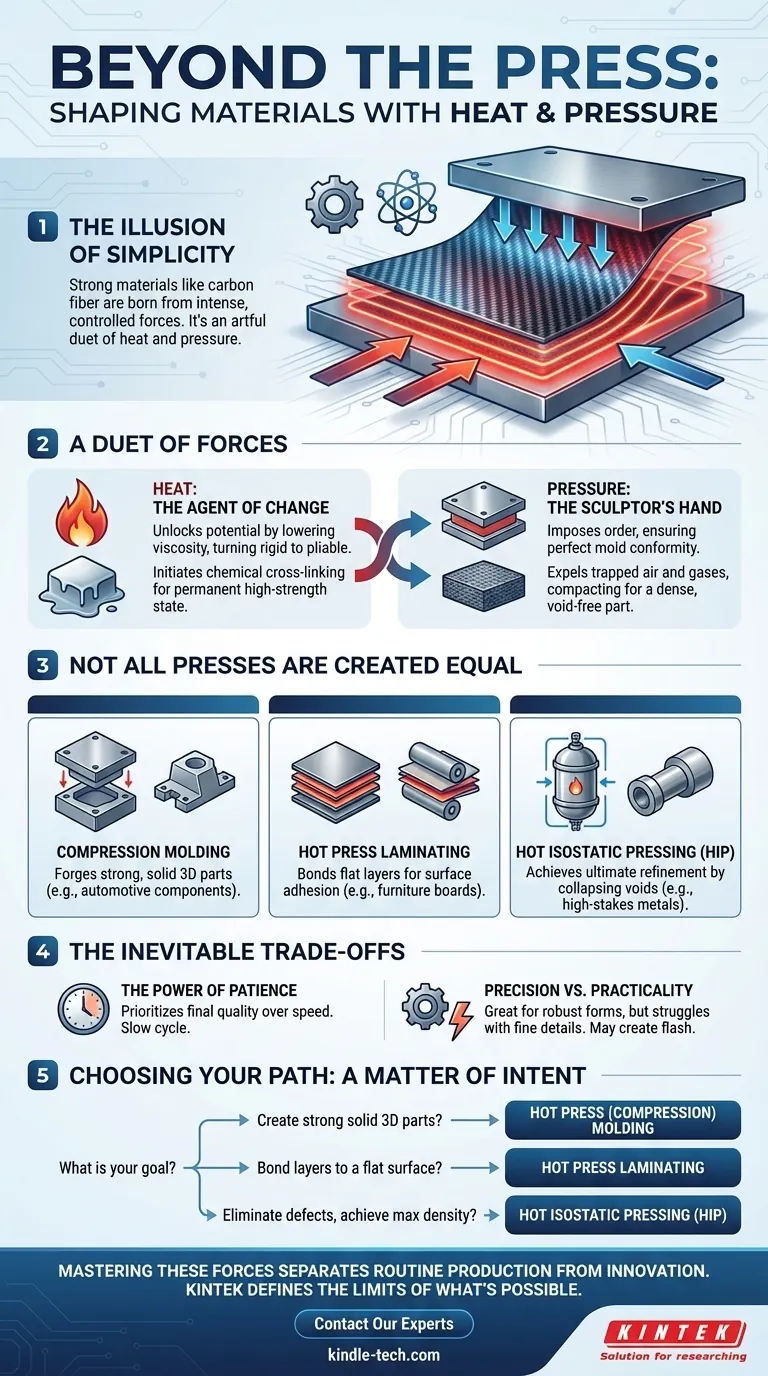
The Illusion of Simplicity
We see a finished product—a sleek carbon fiber panel on a race car, a durable composite deck, or a flawlessly laminated countertop—and our minds accept it as a singular object. We rarely consider the intense, controlled violence of its creation.
The truth is, many of the strongest materials that shape our world are born from two of the most fundamental forces in physics: heat and pressure. It’s a process that seems simple on the surface, but the application of these forces is an art form, a calculated duet where one without the other is just wasted energy.
A Duet of Forces
At its core, hot pressing is about orchestrating a material's transformation. It’s not just squeezing something until it takes a new form; it’s a fundamental manipulation of its internal state.
Heat: The Agent of Change
Heat is the catalyst. For polymers and composites, its first job is to unlock potential by dramatically lowering the material's viscosity. It turns a rigid, stubborn solid into something pliable and willing to flow into every crevice of a mold.
But its more profound role, especially in thermosetting materials, is to initiate an irreversible chemical reaction. It triggers cross-linking, forging new molecular bonds that lock the material into a permanent, high-strength state. Heat doesn't just soften; it transforms.
Pressure: The Sculptor's Hand
If heat creates the possibility for change, pressure provides the discipline. It is the force that imposes order.
Pressure ensures the now-malleable material conforms perfectly to the mold's geometry. More critically, it expels trapped air and volatile gases—the microscopic imperfections that become macroscopic points of failure. It compacts the material, ensuring the final part is dense, void-free, and strong. Pressure doesn't just shape; it perfects.
Not All Presses Are Created Equal
A common failure in engineering is misapplying a tool simply because its name sounds right. The term "hot press" is a dangerously broad umbrella, and using the wrong method is like a surgeon choosing a bone saw for a delicate incision. The intent behind the process changes everything.
Forging Solid Forms: Compression Molding
This is the classic interpretation. A pre-measured amount of raw material is placed in a heated mold, and a press closes it with immense force. The goal is to create a strong, solid, three-dimensional part from thermoset plastics or advanced composites. Think of high-performance automotive components or aerospace structures.
Building by Layers: Hot Press Laminating
Here, the objective isn't to create a new shape but to achieve an unbreakable bond between flat layers. Decorative veneers are pressed onto furniture boards, or protective layers are fused onto flooring. The "mold" is often just two massive heated plates (platens). The focus is on surface adhesion and integrity, not bulk formation.
The Pursuit of Perfection: Hot Isostatic Pressing (HIP)
This is a different beast entirely. Used for high-stakes metals and ceramics, HIP isn't about initial shaping but about ultimate refinement. Parts are placed in a high-pressure vessel filled with an inert gas. Extreme heat and uniform (isostatic) pressure from all directions collapse internal microscopic voids in castings or consolidate metal powders into a fully dense solid. It’s a process obsessed with chasing the final fraction of a percent in material performance.
The Inevitable Trade-Offs
There is no perfect manufacturing process, only a series of trade-offs. Understanding them is the key to making intelligent decisions.
The Power of Patience
The primary advantage of hot press molding is its ability to produce incredibly large, high-strength parts from materials that other processes can't handle. The trade-off is time. Heating the mold, curing the material, and cooling it down is a slow, deliberate cycle. It prioritizes final quality over manufacturing speed.
Precision vs. Practicality
While excellent for robust forms, hot pressing can struggle with the fine, intricate details that injection molding produces with ease. Furthermore, the immense force often squeezes a small amount of material out between the mold halves, creating a "flash" that must be trimmed in a secondary step. It’s a reminder that even elegant processes have messy realities.
Choosing Your Path: A Matter of Intent
The right technique depends entirely on your goal. A clear understanding of your objective is the first and most critical step.
- To create strong, solid 3D parts? Your path is Hot Press (Compression) Molding.
- To bond decorative or functional layers to a flat surface? You need Hot Press Laminating.
- To eliminate internal defects and achieve maximum density in metals or ceramics? You require the specialized process of Hot Isostatic Pressing (HIP).
Mastering these elemental forces of heat and pressure is what separates routine production from true material innovation. Controlling these variables with precision is where breakthroughs happen. For laboratories aiming to perfect their material processes, having the right equipment is non-negotiable. Whether you are developing advanced composites, testing new laminates, or researching material densification, the tools from KINTEK define the limits of what's possible. Contact Our Experts
Visual Guide
Related Products
- Special Heat Press Mold for Lab Use
- Ball Press Mold for Lab
- Double Plate Heating Press Mold for Lab
- Cylindrical Lab Electric Heating Press Mold for Laboratory Applications
- Anti-Cracking Press Mold for Lab Use
Related Articles
- Forging Perfection: The Physics and Psychology of Hot Press Molding
- Why Your Hot Press Samples Fail: The Hidden Culprit in Material R&D
- The Architecture of Atoms: Why Hot Press Forming Creates Superior Materials
- Taming the Void: The Art and Science of Hot Press Moulding
- How to choose a laboratory hot press