The Illusion of a Single Surface
Consider the sleek surface of a modern countertop or the dense, unyielding structure of a multi-layer circuit board. We perceive them as single, solid objects. Our minds accept their strength and stability without question.
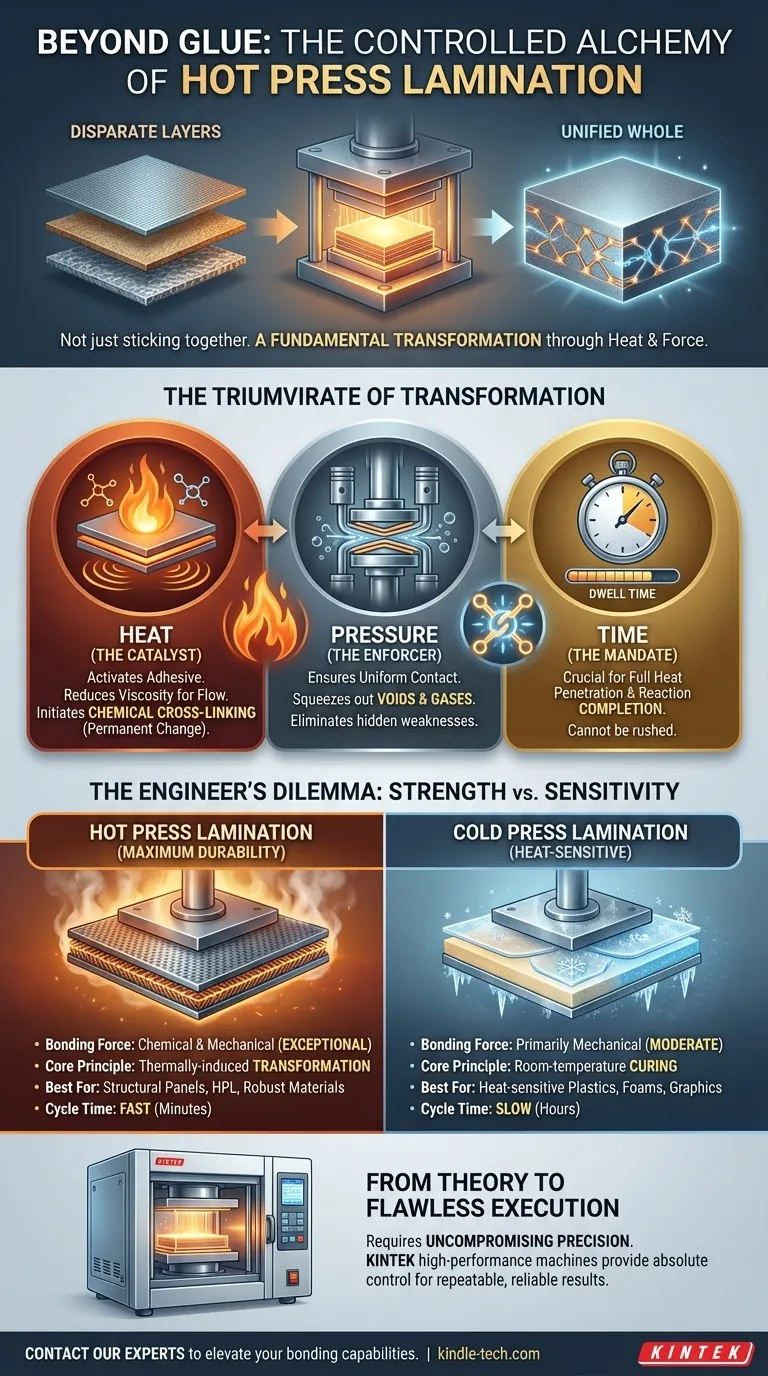
This perception is a carefully engineered illusion. These objects are not born monolithic; they are forged. They are composites, created through a process of immense heat and crushing force. This process, known as hot press lamination, is less about sticking things together and more about forcing disparate layers to become a new, unified whole. It’s a foundational technique built on a simple but powerful physical truth: under the right conditions, materials can be fundamentally transformed.
The Triumvirate of Transformation
Achieving this transformation requires mastering a delicate balance of three variables. Mismanage any one, and you get a weak bond, a damaged product, or a complete failure. It’s a high-stakes process where precision is everything.
Heat: The Catalyst for Change
Heat is the agent of activation. Its primary role is to energize the adhesive, reducing its viscosity until it flows like water. This allows it to penetrate the microscopic pores of the substrate materials, creating a deep, mechanical grip.
For thermosetting resins, heat does something more profound. It initiates a chemical reaction called cross-linking, weaving individual polymer chains into a rigid, three-dimensional net. This isn't just drying glue; it's a permanent, irreversible chemical change. The bond becomes part of the material's very structure.
Pressure: The Enforcer of Intimacy
Pressure is the enforcer. Its job is to ensure absolute, uniform contact between every layer. Measured in tons, this force squeezes out any trapped air or volatile gases that could create voids—the hidden weaknesses that lead to delamination.
From a psychological perspective, pressure eliminates uncertainty. It leaves no room for gaps or imperfections, forcing the molten adhesive into every possible crevice and ensuring the final bond is as complete and predictable as the laws of physics will allow.
Time: The Mandate for Completion
Time, or "dwell time," is the period during which the material is held captive under heat and pressure. This is not passive waiting. It is the crucial window needed for heat to fully penetrate the entire material stack and for the cross-linking reaction to run its course.
Cutting this short is a bet against chemistry—a bet you will always lose. Too little time results in a partially cured, unreliable bond. It’s a testament to the fact that some transformations cannot be rushed.
The Engineer's Dilemma: Strength vs. Sensitivity
The decision to use hot press lamination is a strategic one, rooted in the desired outcome for the final product. It represents a commitment to strength and durability above all else. But this power comes with a significant trade-off.
The high temperatures required are a form of controlled violence. They are perfect for robust materials like wood, phenolics, or fiberglass, but they are destructive to heat-sensitive substrates. Thin plastics, delicate foams, or pre-printed vinyls would warp, melt, or discolor under such conditions.
This leads to a fundamental choice:
- For maximum durability, structural integrity, and wear resistance, the intense process of hot pressing is the only logical path.
- For heat-sensitive materials, the gentler alternative is cold press lamination, which uses adhesives that cure at room temperature over many hours, resulting in a functionally weaker bond.
| Aspect | Hot Press Lamination | Cold Press Lamination |
|---|---|---|
| Bonding Force | Chemical & Mechanical (Exceptional) | Primarily Mechanical (Moderate) |
| Core Principle | Thermally-induced chemical transformation | Room-temperature adhesive curing |
| Best For | Structural panels, composites, HPL | Heat-sensitive plastics, foams, graphics |
| Cycle Time | Fast (Minutes) | Slow (Hours) |
From Theory to Flawless Execution
Understanding the physics of hot press lamination is one thing. Consistently executing it is another. The gap between a theoretical ideal and a perfect real-world result is bridged by the quality of the equipment.
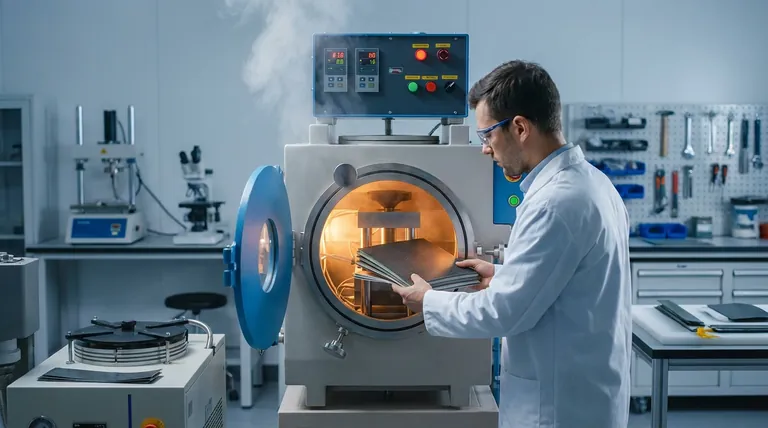
Achieving the precise temperature, applying uniform pressure across vast surfaces, and maintaining those conditions for an exact duration requires machinery built for uncompromising precision. This is where the process moves from a raw industrial technique to a refined science. A laboratory-grade hot press isn't just a machine; it is an instrument designed to provide absolute control over the forces of transformation.
For research, development, and production environments where bond integrity is non-negotiable, having equipment that can repeatably and reliably execute a programmed cycle is paramount. KINTEK specializes in providing these high-performance hot press machines, ensuring that your theoretical parameters translate into flawless, durable composite materials every time. Our equipment provides the control you need to master the alchemy of lamination.
To explore how the right equipment can elevate your material bonding capabilities, Contact Our Experts.
Visual Guide
Related Products
- Vacuum Hot Press Furnace Machine for Lamination and Heating
- Warm Isostatic Press for Solid State Battery Research
- Touchscreen Automatic Vacuum Heat Press
- Electric Heated Hydraulic Vacuum Heat Press for Lab
- Special Heat Press Mold for Lab Use
Related Articles
- Forging Perfection in a Void: The Physics of Ultra-Dense Materials
- Vacuum Hot Press Furnace: A Comprehensive Guide
- Comprehensive Guide to Vacuum Hot Press Furnace Application
- The Purity Paradox: Choosing the Heart of Your Vacuum Hot Press Furnace
- The Physics of Perfection: How Vacuum Hot Presses Overcome the Invisible Barriers in Material Science