The Enemy in the Empty Space
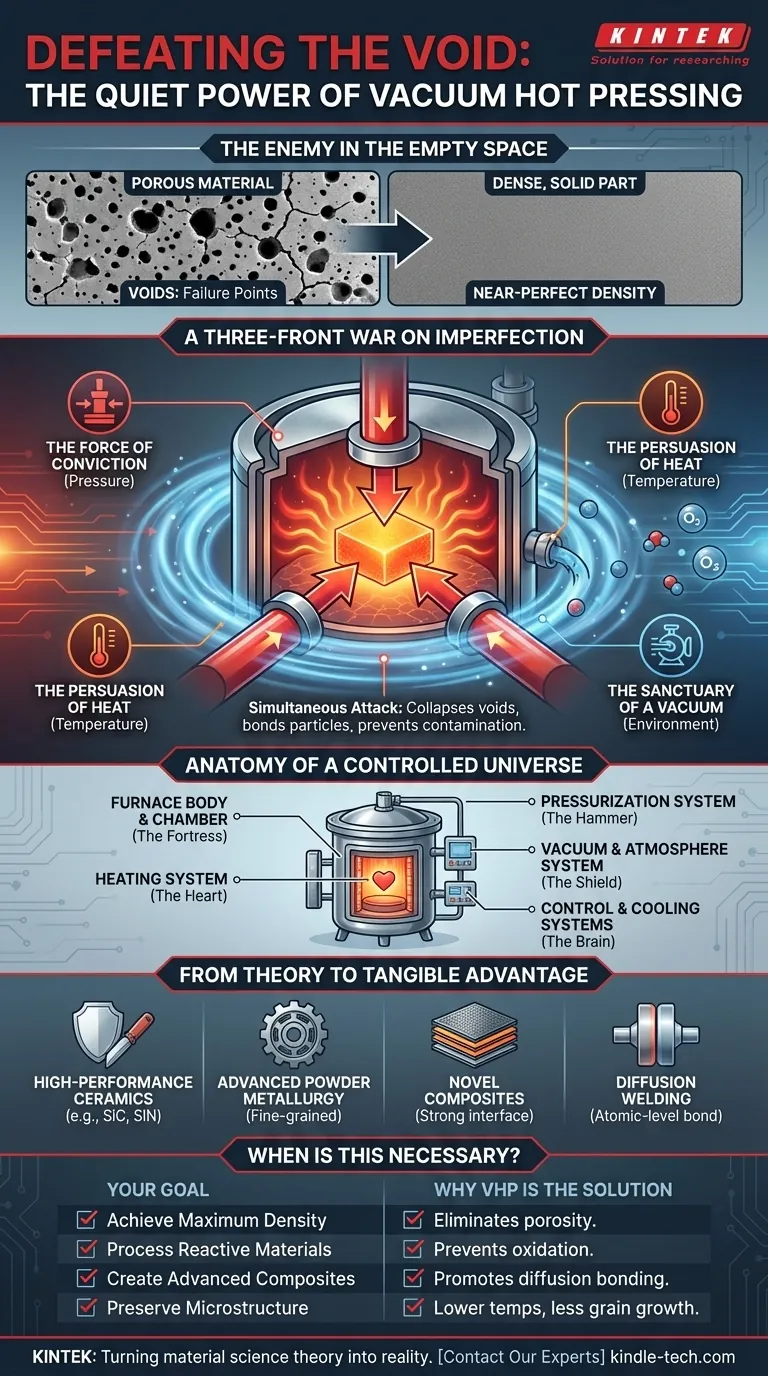
Imagine designing a turbine blade for a jet engine. It must withstand temperatures that would melt steel and forces that could rip it apart. You choose an advanced ceramic powder, a material with incredible potential. But after forming it, under a microscope, you see the truth: your "solid" part is riddled with microscopic voids.
These voids—tiny pockets of nothing—are where failure begins. Each one is a potential starting point for a catastrophic crack.
This is the engineer's fundamental battle: a fight against the empty spaces. In material science, porosity is the default. It's the natural, imperfect state of things. Overcoming it requires not just force, but a strategy for achieving near-perfect density.
A Three-Front War on Imperfection
Simply heating a material (sintering) can reduce some voids, but it’s often slow and incomplete. Simply pressing it cold leaves particles fractured but not fused.
A vacuum hot pressing furnace wages a more sophisticated war. It attacks the problem of porosity and contamination on three fronts simultaneously, creating a controlled universe where "impossible" materials can be forged.
The Persuasion of Heat
First, the furnace applies intense heat, raising the material's temperature just below its melting point. This isn't about liquefying it. It’s about persuasion. The thermal energy excites the atoms, making the material malleable and its particles ready to bond.
The Force of Conviction
While the material is softened, a powerful hydraulic system applies immense, uniform pressure. This is the brute force that physically collapses the voids, forcing particles into intimate contact and squeezing out the empty space between them. It turns a loose collection of grains into a monolithic, dense solid.
The Sanctuary of a Vacuum
The final, crucial element is the environment. By pulling a hard vacuum, the system removes the most common saboteur: oxygen. For sensitive materials like refractory metals or non-oxide ceramics, oxygen means instant contamination and weakness. The vacuum creates a pristine sanctuary where pure consolidation can happen. Alternatively, this sanctuary can be filled with an inert gas like argon to protect the material without a vacuum.
Anatomy of a Controlled Universe
To orchestrate this three-pronged attack, a vacuum hot press furnace is built from several critical, interconnected systems. Each plays a vital role in creating and maintaining the perfect conditions for densification.
- The Furnace Body & Chamber: The fortress. This sealed vessel is engineered to withstand extreme temperatures, high pressures, and a deep vacuum all at once.
- The Heating System: The heart. Graphite or refractory metal heating elements generate the required temperature, while layers of heat shields act as insulation, directing all that energy inward.
- The Pressurization System: The hammer. A precision-controlled hydraulic press delivers consistent and powerful force, ensuring uniform densification throughout the material.
- The Vacuum & Atmosphere System: The shield. A network of pumps removes reactive gases, while an automated control system can backfill the chamber with a specific inert gas when a protective atmosphere is needed.
- The Control & Cooling Systems: The brain and the bloodstream. A central controller monitors and logs every parameter—temperature, pressure, vacuum level—while a water cooling system protects the furnace body and seals from the intense internal heat.
From Theory to Tangible Advantage
This precise control over heat, pressure, and atmosphere isn't just an academic exercise. It unlocks capabilities that are simply impossible with other methods.
- High-Performance Ceramics: It allows for the sintering of materials like silicon carbide (SiC) and silicon nitride (SiN) to near-theoretical density, creating components with exceptional hardness and thermal resistance for armor or cutting tools.
- Advanced Powder Metallurgy: It consolidates metal powders without fully melting them. This preserves a fine-grained microstructure, which is critical for achieving superior strength and toughness in refractory metal parts.
- Novel Composites: It's essential for creating ceramic/metal composites, ensuring an incredibly strong, diffusion-bonded interface between dissimilar materials.
- Diffusion Welding: It can join two solid parts at an atomic level, creating a bond as strong as the parent material itself, with no melting or weak points.
When is This Unreasonable Power Necessary?
A vacuum hot press is not for every application. It is a specialized tool for when good enough isn't good enough. The decision to use it comes down to a few key objectives.
| Your Goal | Why Vacuum Hot Pressing is the Solution |
|---|---|
| Achieve Maximum Density | The combination of high pressure and heat is the most effective known method for eliminating porosity. |
| Process Reactive Materials | The vacuum or inert gas environment is essential for preventing oxidation of sensitive metals and non-oxide ceramics. |
| Create Advanced Composites | The system forces intimate contact, promoting the diffusion bonding required for high-strength composite materials. |
| Preserve Microstructure | Densification occurs at lower temperatures and for shorter times than conventional sintering, preventing unwanted grain growth. |
Pushing the boundaries of material performance means waging a war on imperfection. For researchers and engineers working with the most demanding applications, the vacuum hot press furnace provides the ultimate control needed to win.
At KINTEK, we provide the robust, precision-engineered vacuum hot pressing furnaces that turn material science theory into reality. If your work demands maximum density, superior purity, and unparalleled performance, our equipment provides the controlled universe you need. Contact Our Experts to discuss your specific application.
Visual Guide
Related Products
- Vacuum Hot Press Furnace Machine Heated Vacuum Press
- Vacuum Hot Press Furnace Machine for Lamination and Heating
- Vacuum Hot Press Furnace Heated Vacuum Press Machine Tube Furnace
- 600T Vacuum Induction Hot Press Furnace for Heat Treat and Sintering
- Touchscreen Automatic Vacuum Heat Press
Related Articles
- The Purity Paradox: Choosing the Heart of Your Vacuum Hot Press Furnace
- Comprehensive Guide to Vacuum Hot Press Furnace Application
- Vacuum Hot Press Furnace: A Comprehensive Guide
- Forging Perfection in a Void: The Physics of Ultra-Dense Materials
- The Physics of Perfection: How Vacuum Hot Presses Overcome the Invisible Barriers in Material Science