The Hidden Variable
Imagine an aerospace engineer inspecting a newly bonded turbine blade. The process was perfect: temperature exact, vacuum absolute. Yet, under a microscope, a microscopic flaw compromises the joint—a single particle of dust, shed from a graphite insulator. The entire multi-million dollar component is now scrap.
This isn't a failure of heat. It's a failure of purity.
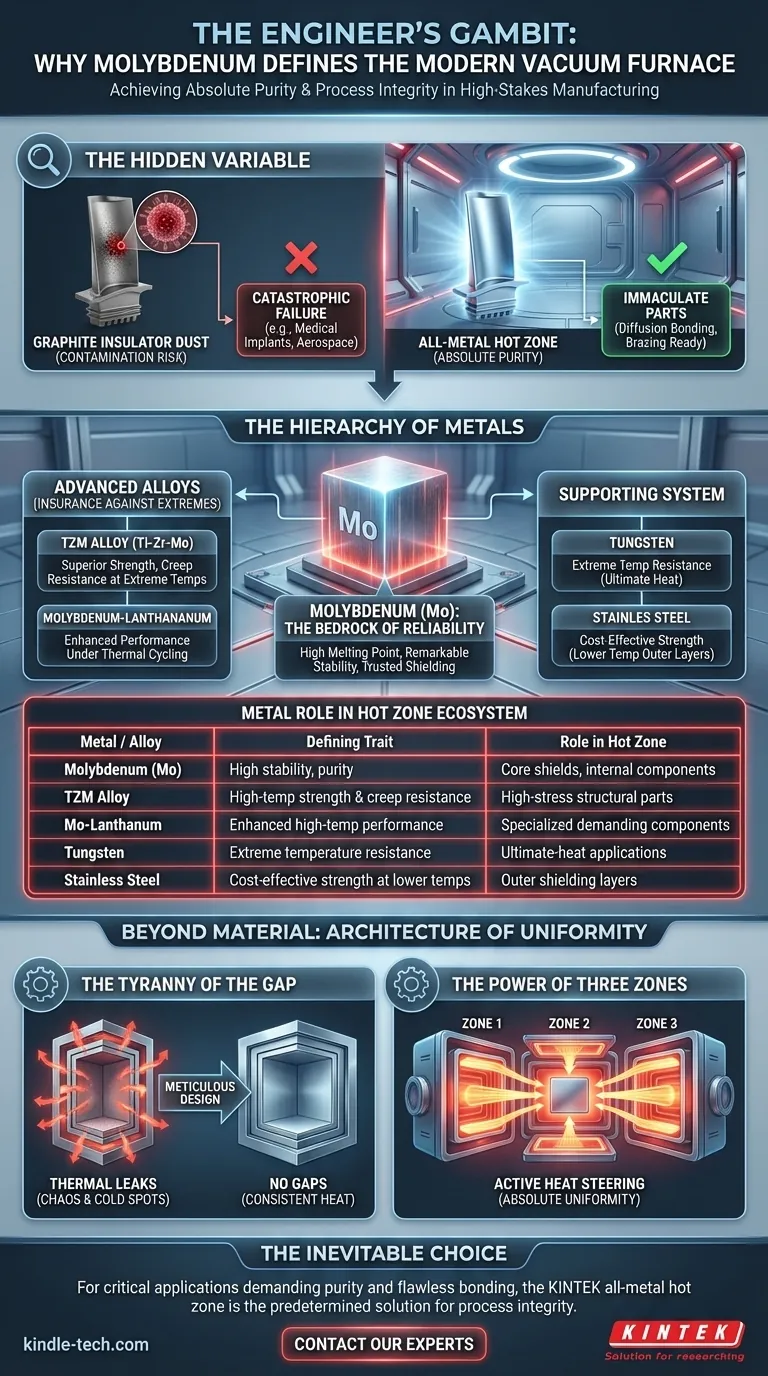
In the world of high-stakes manufacturing, from medical implants to satellite components, the most dangerous variable is often the one you can't see. This is why the conversation about vacuum furnaces must begin not with temperature, but with the pristine environment of an all-metal hot zone.
A Commitment to Absolute Purity
Choosing an all-metal hot zone is less a technical specification and more a philosophical commitment. It is a decision to eliminate an entire class of variables from your process.
Graphite and other insulators, while effective, can shed particles. For most applications, this is trivial. But for industries where any contamination is a catastrophic failure—like medical devices or sensitive superalloys—it's an unacceptable risk.
An all-metal environment produces parts that are immaculately bright and clean. It's a non-negotiable requirement for processes like diffusion bonding and aluminum brazing, where surface integrity is paramount.
The Hierarchy of Metals
The heart of the furnace is built from a select group of materials, each chosen for its composure under duress.
Molybdenum (Mo): The Bedrock of Reliability
Molybdenum is the industry's cornerstone for a reason. Its high melting point and remarkable stability in a vacuum make it the default, trusted choice for a furnace's internal shielding and components. It’s the reliable workhorse that provides a predictable, clean, and stable foundation.
Advanced Alloys: Insurance Against Extremes
When processes push the boundaries, pure molybdenum needs reinforcement. This is where alloys come in.
- TZM Alloy (Titanium-Zirconium-Molybdenum): Offers superior strength and creep resistance at extreme temperatures. It's the material you choose when you need your components to hold their shape under immense thermal stress.
- Molybdenum-Lanthanum Alloy: Provides similar enhancements, ensuring performance doesn't degrade during the most demanding thermal cycles.
The Supporting System: Tungsten & Stainless Steel
A hot zone is a system, and every part has a role. Tungsten is reserved for the absolute highest temperature applications, acting as a specialized reinforcement. Stainless steel, more economical, is used in the outer layers where temperatures are lower, completing the insulation package efficiently.
| Metal / Alloy | Defining Trait | Role in the Hot Zone Ecosystem |
|---|---|---|
| Molybdenum (Mo) | High stability, purity | Core shields, internal components |
| TZM Alloy | High-temp strength & creep resistance | High-stress structural parts |
| Molybdenum-Lanthanum | Enhanced high-temp performance | Specialized demanding components |
| Tungsten | Extreme temperature resistance | Ultimate-heat applications |
| Stainless Steel | Cost-effective strength at lower temps | Outer shielding layers |
Beyond Material: The Architecture of Uniformity
Owning the best materials is meaningless if the design is flawed. The performance of a vacuum furnace is dictated by its architecture.
The Tyranny of the Gap
Temperature uniformity isn't a passive state; it's an actively engineered condition. A single poorly designed opening or an unacceptable gap in the insulation package creates a thermal leak. This isn't just a loss of efficiency; it's a source of chaos, creating unpredictable cold spots that ruin a process. Meticulous design is about eliminating these thermal inconsistencies.
The Power of Three Zones
To achieve true control, a furnace requires a minimum of three distinct heating zones. This isn't just about adding more heating elements. It's about giving the engineer the ability to actively "steer" the heat, adding or subtracting power in different areas to counteract the natural laws of thermodynamics. It is the only way to ensure a component is heated with absolute uniformity from front to back, top to bottom.
The Inevitable Choice
For engineers working on the cutting edge, the choice of equipment is a strategic one. If your work demands absolute purity for medical compliance or the flawless bonding of advanced superalloys, the solution is predetermined. You need the control and cleanliness that only a meticulously designed, all-metal hot zone can provide.
At KINTEK, we understand that a vacuum furnace is more than a piece of lab equipment; it's the guardian of your process integrity. Our furnaces are engineered with this philosophy, utilizing the optimal materials and design architecture to deliver the purity and uniformity your most critical applications demand. To ensure your results are defined by intention, not by chance, Contact Our Experts.
Visual Guide
Related Products
- Vacuum Hot Press Furnace Heated Vacuum Press Machine Tube Furnace
- 600T Vacuum Induction Hot Press Furnace for Heat Treat and Sintering
- Vacuum Hot Press Furnace Machine Heated Vacuum Press
- Vacuum Heat Treat Furnace and Levitation Induction Melting Furnace
- 2200 ℃ Tungsten Vacuum Heat Treat and Sintering Furnace
Related Articles
- The Purity Paradox: Choosing the Heart of Your Vacuum Hot Press Furnace
- Comprehensive Guide to Vacuum Hot Press Furnace Application
- Vacuum Hot Press Furnace: A Comprehensive Guide
- Forging Perfection in a Void: The Physics of Ultra-Dense Materials
- Defeating the Void: The Quiet Power of Vacuum Hot Pressing