Blog The Art of Absence: Why Advanced Materials Demand Vacuum Furnaces
The Art of Absence: Why Advanced Materials Demand Vacuum Furnaces

The Art of Absence: Why Advanced Materials Demand Vacuum Furnaces

1 week ago

The Hidden Variable in Material Science

In most engineering challenges, we solve problems by adding variables. We add reinforcements for strength. We add alloys for flexibility. We add sensors for data.

But in high-temperature thermodynamics, the solution is often about what you remove.

A vacuum furnace is technically an oven. But calling it an oven is like calling a sterile operating theater a "room." It misses the point entirely.

The primary function of a vacuum furnace isn't just to generate heat. It is to create a chemically pristine environment.

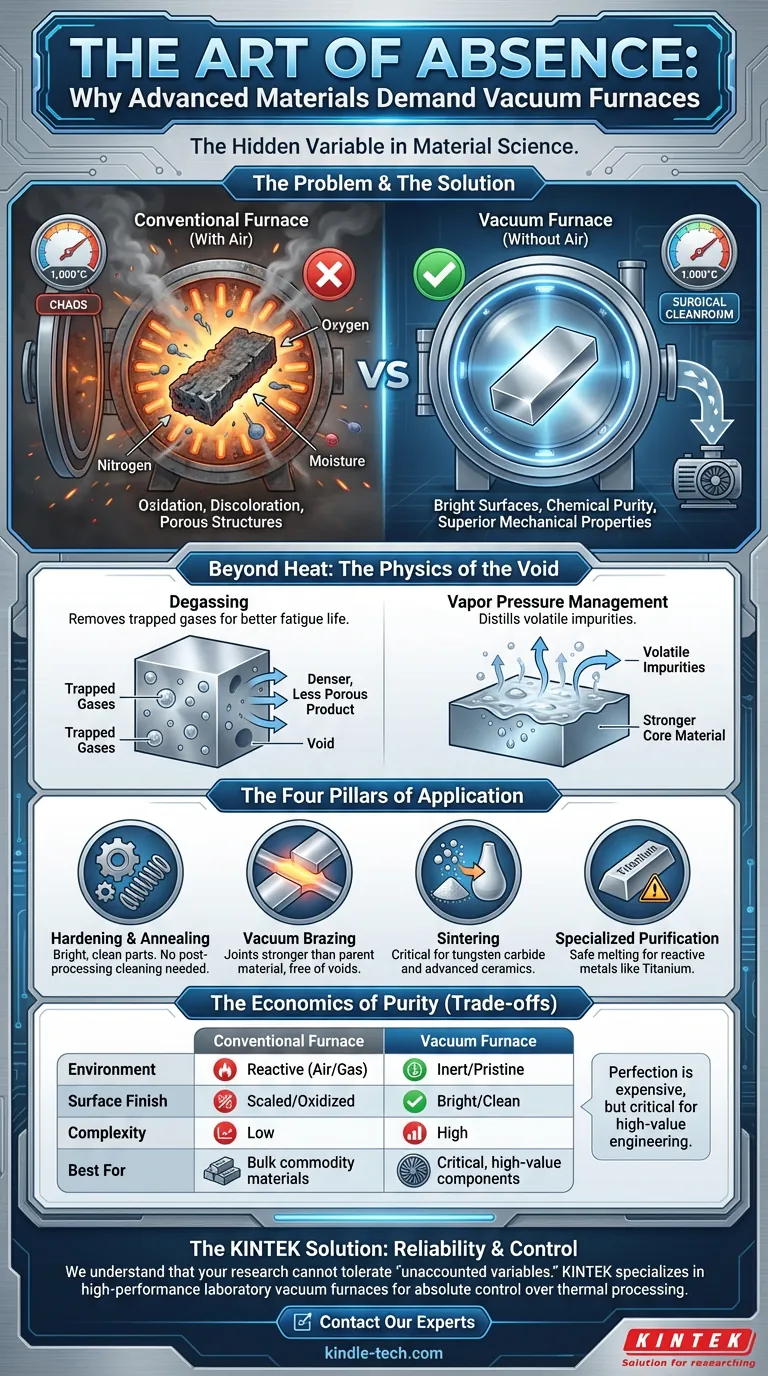
When you heat a metal in the open air, you are inviting chaos. Oxygen, nitrogen, and moisture are not passive observers; they are aggressive reactants. A vacuum furnace removes the atmosphere to stop the war before it begins.

The Oxygen Problem

Imagine performing open-heart surgery in a dusty field. No matter how skilled the surgeon, the environment dictates the failure.

The same applies to metallurgy.

At room temperature, oxygen is manageable. At 1,000°C, oxygen becomes a destroyer. It reacts with metals to form oxides—rust and scale—that compromise surface integrity and structural strength.

The vacuum furnace solves this via denial. By removing air, we create a "surgical cleanroom" for the material.

The results are binary:

  • With Air: Oxidation, discoloration, and porous structures.
  • Without Air: Bright surfaces, chemical purity, and superior mechanical properties.

Beyond Heat: The Physics of the Void

The true power of vacuum processing lies in its ability to change the rules of physics inside the chamber.

It does more than just stop rust. It actively cleans the material.

Degassing

Materials often hold trapped gases within their structure. Under a vacuum, these gases are pulled out. The result is a denser, less porous product with better fatigue life.

Vapor Pressure Management

In a vacuum, liquids boil at lower temperatures. This allows for specific purification processes, such as distilling volatile impurities out of a base metal, leaving the core material stronger than before.

The Four Pillars of Application

Where is this level of precision actually necessary? It is found wherever failure is not an option.

1. Hardening and Annealing

Steel and superalloys need to be softened (annealed) or strengthened (hardened) without losing their surface finish. Vacuum treatment produces parts that emerge bright and clean, eliminating the need for expensive post-processing cleaning.

2. Vacuum Brazing

This is the art of joining. Unlike welding, which melts the base metal, brazing melts a filler metal to join two parts. In a vacuum, the filler metal flows like water over the surface. It creates a joint that is often stronger than the parent material itself, free of voids or air pockets.

3. Sintering

Turning powder into solid metal or ceramic requires immense heat and pressure. Doing this in a vacuum ensures that the fusing particles are not inhibited by oxide layers. It is critical for tungsten carbide and advanced ceramics.

4. Specialized Purification

For reactive metals like Titanium, the atmosphere is poison. Vacuum furnaces are the only safe way to melt and refine these materials without irreversible contamination.

The Economics of Purity

If vacuum furnaces are so superior, why isn't every oven a vacuum furnace?

Because perfection is expensive.

  • Complexity: These systems require sophisticated pumps and seals.
  • Time: You cannot just turn it on. You must pump it down. The cycle times are longer.
  • Throughput: It is a batch process, not a continuous conveyor belt.

The engineering decision comes down to a trade-off. If you are baking bricks, a standard kiln is fine. If you are engineering aerospace turbine blades, the cost of the vacuum is a fraction of the cost of failure.

Summary of Trade-offs

Feature Conventional Furnace Vacuum Furnace
Environment Reactive (Air/Gas) Inert/Pristine
Surface Finish Scaled/Oxidized Bright/Clean
Complexity Low High
Best For Bulk commodity materials Critical, high-value components

The KINTEK Solution

There is a romance to the vacuum furnace—it is the discipline of creating something from nothing. But for the lab manager and the engineer, it is simply about reliability.

At KINTEK, we understand that your research or production line cannot tolerate "unaccounted variables."

We specialize in high-performance laboratory equipment designed to give you absolute control over your thermal processing. Whether you are sintering advanced ceramics or brazing complex geometries, our vacuum furnaces provide the stability you need.

Do not let invisible gases compromise your visible results.

Contact Our Experts to discuss how KINTEK can help you master the void and upgrade your laboratory capabilities.

Visual Guide
The Art of Absence: Why Advanced Materials Demand Vacuum Furnaces Visual Guide

Related Products

Related Articles

Related Products

Molybdenum Vacuum Heat Treat Furnace

Molybdenum Vacuum Heat Treat Furnace

Discover the benefits of a high-configuration molybdenum vacuum furnace with heat shield insulation. Ideal for high-purity, vacuum environments like sapphire crystal growth and heat treatment.

Vacuum Heat Treat Furnace with Ceramic Fiber Liner

Vacuum Heat Treat Furnace with Ceramic Fiber Liner

Vacuum furnace with polycrystalline ceramic fiber insulation liner for excellent heat insulation and uniform temperature field. Choose from 1200℃ or 1700℃ max. working temperature with high vacuum performance and precise temperature control.

2200 ℃ Graphite Vacuum Heat Treat Furnace

2200 ℃ Graphite Vacuum Heat Treat Furnace

Discover the power of the KT-VG Graphite Vacuum Furnace - with a maximum working temperature of 2200℃, it's perfect for vacuum sintering of various materials. Learn more now.

2200 ℃ Tungsten Vacuum Heat Treat and Sintering Furnace

2200 ℃ Tungsten Vacuum Heat Treat and Sintering Furnace

Experience the ultimate refractory metal furnace with our Tungsten vacuum furnace. Capable of reaching 2200℃, perfect for sintering advanced ceramics and refractory metals. Order now for high-quality results.

Vacuum Heat Treat Sintering Brazing Furnace

Vacuum Heat Treat Sintering Brazing Furnace

A vacuum brazing furnace is a type of industrial furnace used for brazing, a metalworking process that joins two pieces of metal using a filler metal that melts at a lower temperature than the base metals. Vacuum brazing furnaces are typically used for high-quality applications where a strong, clean joint is required.

Vacuum Heat Treat and Molybdenum Wire Sintering Furnace for Vacuum Sintering

Vacuum Heat Treat and Molybdenum Wire Sintering Furnace for Vacuum Sintering

A vacuum molybdenum wire sintering furnace is a vertical or bedroom structure, which is suitable for withdrawal, brazing, sintering and degassing of metal materials under high vacuum and high temperature conditions. It is also suitable for dehydroxylation treatment of quartz materials.

1400℃ Controlled Atmosphere Furnace with Nitrogen and Inert Atmosphere

1400℃ Controlled Atmosphere Furnace with Nitrogen and Inert Atmosphere

Achieve precise heat treatment with KT-14A controlled atmosphere furnace. Vacuum sealed with a smart controller, it's ideal for lab and industrial use up to 1400℃.

Vacuum Heat Treat and Sintering Furnace with 9MPa Air Pressure

Vacuum Heat Treat and Sintering Furnace with 9MPa Air Pressure

The air pressure sintering furnace is a high-tech equipment commonly used for the sintering of advanced ceramic materials. It combines vacuum sintering and pressure sintering techniques to achieve high-density and high-strength ceramics.

Graphite Vacuum Furnace Bottom Discharge Graphitization Furnace for Carbon Materials

Graphite Vacuum Furnace Bottom Discharge Graphitization Furnace for Carbon Materials

Bottom-out graphitization furnace for carbon materials, ultra-high temperature furnace up to 3100°C, suitable for graphitization and sintering of carbon rods and carbon blocks. Vertical design, bottom discharging, convenient feeding and discharging, high temperature uniformity, low energy consumption, good stability, hydraulic lifting system, convenient loading and unloading.

Vacuum Hot Press Furnace Heated Vacuum Press Machine Tube Furnace

Vacuum Hot Press Furnace Heated Vacuum Press Machine Tube Furnace

Reduce forming pressure & shorten sintering time with Vacuum Tube Hot Press Furnace for high-density, fine-grain materials. Ideal for refractory metals.

Vertical High Temperature Graphite Vacuum Graphitization Furnace

Vertical High Temperature Graphite Vacuum Graphitization Furnace

Vertical high temperature graphitization furnace for carbonization and graphitization of carbon materials up to 3100℃.Suitable for shaped graphitization of carbon fiber filaments and other materials sintered in a carbon environment.Applications in metallurgy, electronics, and aerospace for producing high-quality graphite products like electrodes and crucibles.

Horizontal High Temperature Graphite Vacuum Graphitization Furnace

Horizontal High Temperature Graphite Vacuum Graphitization Furnace

Horizontal Graphitization Furnace: This type of furnace is designed with the heating elements placed horizontally, allowing for uniform heating of the sample. It's well-suited for graphitizing large or bulky samples that require precise temperature control and uniformity.

1200℃ Controlled Atmosphere Furnace Nitrogen Inert Atmosphere Furnace

1200℃ Controlled Atmosphere Furnace Nitrogen Inert Atmosphere Furnace

Discover our KT-12A Pro Controlled atmosphere furnace - high precision, heavy duty vacuum chamber, versatile smart touch screen controller, and excellent temperature uniformity up to 1200C. Ideal for both laboratory and industrial application.

600T Vacuum Induction Hot Press Furnace for Heat Treat and Sintering

600T Vacuum Induction Hot Press Furnace for Heat Treat and Sintering

Discover the 600T Vacuum Induction Hot Press Furnace, designed for high-temperature sintering experiments in vacuum or protected atmospheres. Its precise temperature and pressure control, adjustable working pressure, and advanced safety features make it ideal for nonmetal materials, carbon composites, ceramics, and metal powders.

Vacuum Hot Press Furnace Machine Heated Vacuum Press

Vacuum Hot Press Furnace Machine Heated Vacuum Press

Discover the advantages of Vacuum Hot Press Furnace! Manufacture dense refractory metals & compounds, ceramics, and composites under high temp and pressure.

Ultra-High Temperature Graphite Vacuum Graphitization Furnace

Ultra-High Temperature Graphite Vacuum Graphitization Furnace

The ultra-high temperature graphitization furnace utilizes medium frequency induction heating in a vacuum or inert gas environment. The induction coil generates an alternating magnetic field, inducing eddy currents in the graphite crucible, which heats up and radiates heat to the workpiece, bringing it to the desired temperature. This furnace is primarily used for graphitization and sintering of carbon materials, carbon fiber materials, and other composite materials.

Graphite Vacuum Furnace High Thermal Conductivity Film Graphitization Furnace

Graphite Vacuum Furnace High Thermal Conductivity Film Graphitization Furnace

The high thermal conductivity film graphitization furnace has uniform temperature, low energy consumption and can operate continuously.

Small Vacuum Heat Treat and Tungsten Wire Sintering Furnace

Small Vacuum Heat Treat and Tungsten Wire Sintering Furnace

The small vacuum tungsten wire sintering furnace is a compact experimental vacuum furnace specially designed for universities and scientific research institutes. The furnace features a CNC welded shell and vacuum piping to ensure leak-free operation. Quick-connect electrical connections facilitate relocation and debugging, and the standard electrical control cabinet is safe and convenient to operate.

Vacuum Dental Porcelain Sintering Furnace

Vacuum Dental Porcelain Sintering Furnace

Get precise and reliable results with KinTek's Vacuum Porcelain Furnace. Suitable for all porcelain powders, it features hyperbolic ceramic furnace function, voice prompt, and automatic temperature calibration.

1800℃ Muffle Oven Furnace for Laboratory

1800℃ Muffle Oven Furnace for Laboratory

KT-18 muffle furnace with Japan Al2O3 polycrystalline fibe and Silicon Molybdenum heating element, up to 1900℃, PID temperature control and 7" smart touch screen. Compact design, low heat loss, and high energy efficiency. Safety interlock system and versatile functions.


Leave Your Message