Blog The Art of the Void: When Precision Matters More Than Power
The Art of the Void: When Precision Matters More Than Power

The Art of the Void: When Precision Matters More Than Power

3 hours ago

The Seduction of Extremes

There is a natural human instinct in engineering to chase the edges of the chart. We want the fastest processor, the strongest steel, the deepest ocean.

In the world of thermal processing, this instinct manifests as a desire for the highest possible vacuum. The logic seems sound: if air is the enemy—bringing oxidation and contamination—then surely the total absence of air is the ultimate solution.

But in the physics of materials, "more" is not always "better." Sometimes, "more" is destructive.

The critical insight in selecting a vacuum furnace is not to pursue the deepest void possible. It is to understand the precise environment your material requires to thrive.

The Taxonomy of Nothingness

To understand the tool, we must first measure the emptiness.

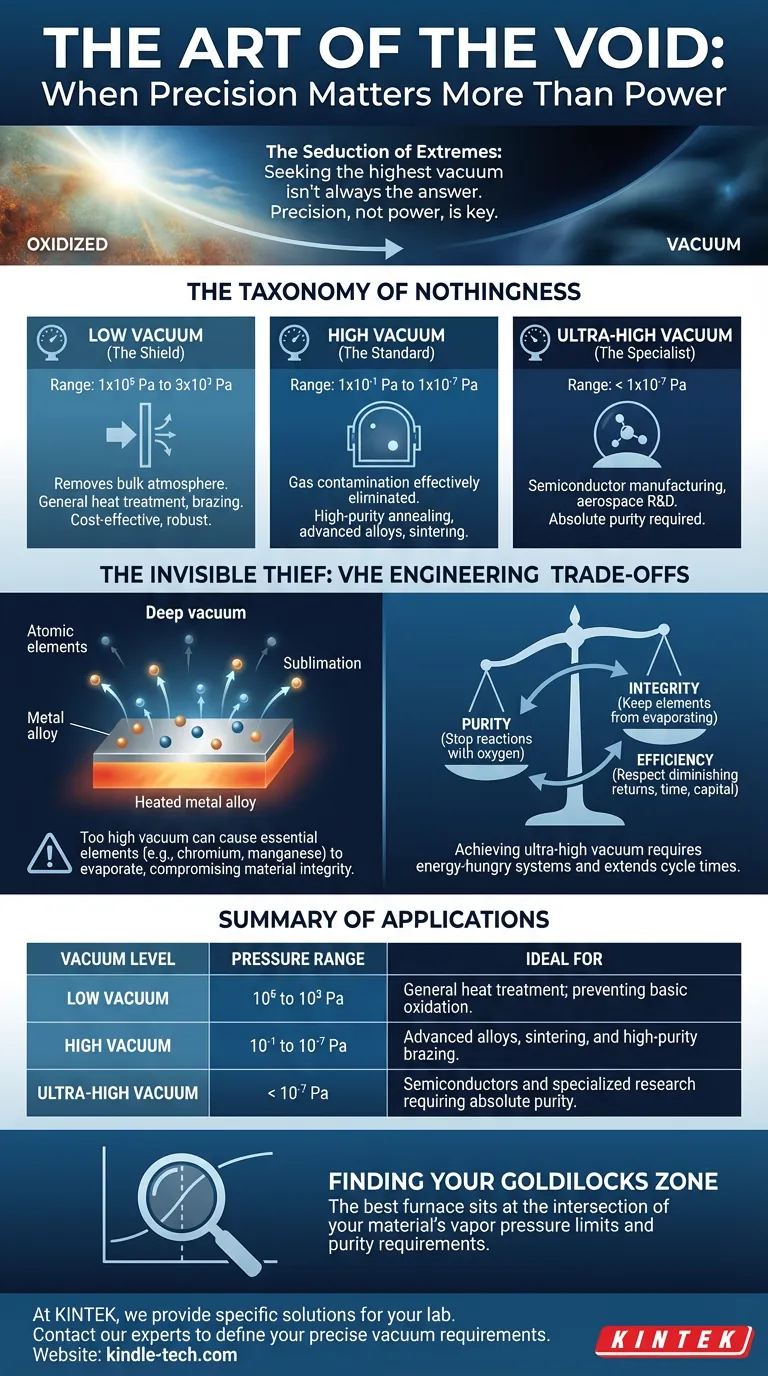
A vacuum furnace is defined not by how hot it gets, but by the minimum pressure it can reliably maintain. We categorize these systems into three distinct tiers, measured in Pascals (Pa). Each tier represents a different level of technological complexity and a different philosophy of protection.

1. Low Vacuum (The Shield)

Range: 1×10⁵ Pa down to 3×10³ Pa

Think of low vacuum not as a void, but as a clean room. It removes the bulk of the atmosphere.

These furnaces are the workhorses for general heat treatment and brazing. If your goal is simply to prevent heavy oxidation on standard materials, this is your solution. It is cost-effective, robust, and sufficient.

2. High Vacuum (The Standard)

Range: 1×10⁻¹ Pa down to 1×10⁻⁷ Pa

This is where the vast majority of modern metallurgy lives. At this level, gas contamination is effectively eliminated.

High vacuum systems are essential for:

  • High-purity annealing.
  • Vacuum brazing of advanced alloys.
  • Sintering sensitive materials.

3. Ultra-High Vacuum (The Specialist)

Range: < 1×10⁻⁷ Pa

This is the realm of semiconductor manufacturing and aerospace R&D. Here, even a stray molecule is a threat. These systems are marvels of engineering, designed for materials where purity is the only metric that matters.

The Invisible Thief: Vapor Pressure

Why not simply buy an Ultra-High Vacuum furnace for everything, just to be safe?

Because of a physical phenomenon called vapor pressure.

Every element has a tipping point. As you heat a material, its atoms vibrate with increasing energy. If the pressure surrounding that material drops too low (the vacuum becomes too deep), the atoms at the surface simply let go.

They don't melt. They sublimate. They turn directly from solid to gas and vanish into the vacuum pump.

If you place a complex alloy in a vacuum that is too high for its specific chemistry, you might successfully prevent oxidation, but you might also boil off essential alloying elements like chromium or manganese.

The result is a part that looks perfect on the outside but has been chemically hollowed out on the inside. Its mechanical properties are ruined, not by contamination, but by over-processing.

The Engineering Trade-Offs

Selecting a vacuum furnace is a balancing act between three competing forces:

  1. Purity: You need a vacuum deep enough to stop reactions with oxygen.
  2. Integrity: You need enough pressure to keep your alloy's elements from evaporating.
  3. Efficiency: You need to respect the laws of diminishing returns.

Achieving high or ultra-high vacuum requires sophisticated, energy-hungry multi-stage pump systems (like turbomolecular pumps). It extends cycle times significantly as the system fights to remove those last few molecules.

If your process doesn't require it, you are paying a premium in time and capital to potentially damage your own product.

Summary of Applications

Here is a quick guide to matching the void to the value:

Vacuum Level Pressure Range Ideal For
Low Vacuum 10⁵ to 10³ Pa General heat treatment; preventing basic oxidation.
High Vacuum 10⁻¹ to 10⁻⁷ Pa Advanced alloys, sintering, and high-purity brazing.
Ultra-High Vacuum < 10⁻⁷ Pa Semiconductors and specialized research requiring absolute purity.

Finding Your Goldilocks Zone

The "best" furnace is not the one with the most impressive spec sheet. It is the one that sits exactly at the intersection of your material's vapor pressure limits and your purity requirements.

It is a decision that requires looking at a phase diagram, not just a price tag.

At KINTEK, we understand that lab equipment is not about generic power; it is about specific solutions. We specialize in navigating these trade-offs. Whether you are working with robust steel or sensitive superalloys, we help you identify the equipment that ensures purity without compromising integrity.

Do not leave your material science to chance. Contact Our Experts to define the precise vacuum requirements for your laboratory today.

Visual Guide
The Art of the Void: When Precision Matters More Than Power Visual Guide

Related Products

Related Articles

Related Products

Vacuum Heat Treat Sintering Brazing Furnace

Vacuum Heat Treat Sintering Brazing Furnace

A vacuum brazing furnace is a type of industrial furnace used for brazing, a metalworking process that joins two pieces of metal using a filler metal that melts at a lower temperature than the base metals. Vacuum brazing furnaces are typically used for high-quality applications where a strong, clean joint is required.

Vacuum Heat Treat Furnace with Ceramic Fiber Liner

Vacuum Heat Treat Furnace with Ceramic Fiber Liner

Vacuum furnace with polycrystalline ceramic fiber insulation liner for excellent heat insulation and uniform temperature field. Choose from 1200℃ or 1700℃ max. working temperature with high vacuum performance and precise temperature control.

Molybdenum Vacuum Heat Treat Furnace

Molybdenum Vacuum Heat Treat Furnace

Discover the benefits of a high-configuration molybdenum vacuum furnace with heat shield insulation. Ideal for high-purity, vacuum environments like sapphire crystal growth and heat treatment.

2200 ℃ Tungsten Vacuum Heat Treat and Sintering Furnace

2200 ℃ Tungsten Vacuum Heat Treat and Sintering Furnace

Experience the ultimate refractory metal furnace with our Tungsten vacuum furnace. Capable of reaching 2200℃, perfect for sintering advanced ceramics and refractory metals. Order now for high-quality results.

2200 ℃ Graphite Vacuum Heat Treat Furnace

2200 ℃ Graphite Vacuum Heat Treat Furnace

Discover the power of the KT-VG Graphite Vacuum Furnace - with a maximum working temperature of 2200℃, it's perfect for vacuum sintering of various materials. Learn more now.

Vacuum Heat Treat and Molybdenum Wire Sintering Furnace for Vacuum Sintering

Vacuum Heat Treat and Molybdenum Wire Sintering Furnace for Vacuum Sintering

A vacuum molybdenum wire sintering furnace is a vertical or bedroom structure, which is suitable for withdrawal, brazing, sintering and degassing of metal materials under high vacuum and high temperature conditions. It is also suitable for dehydroxylation treatment of quartz materials.

Vacuum Heat Treat and Sintering Furnace with 9MPa Air Pressure

Vacuum Heat Treat and Sintering Furnace with 9MPa Air Pressure

The air pressure sintering furnace is a high-tech equipment commonly used for the sintering of advanced ceramic materials. It combines vacuum sintering and pressure sintering techniques to achieve high-density and high-strength ceramics.

1400℃ Controlled Atmosphere Furnace with Nitrogen and Inert Atmosphere

1400℃ Controlled Atmosphere Furnace with Nitrogen and Inert Atmosphere

Achieve precise heat treatment with KT-14A controlled atmosphere furnace. Vacuum sealed with a smart controller, it's ideal for lab and industrial use up to 1400℃.

1200℃ Controlled Atmosphere Furnace Nitrogen Inert Atmosphere Furnace

1200℃ Controlled Atmosphere Furnace Nitrogen Inert Atmosphere Furnace

Discover our KT-12A Pro Controlled atmosphere furnace - high precision, heavy duty vacuum chamber, versatile smart touch screen controller, and excellent temperature uniformity up to 1200C. Ideal for both laboratory and industrial application.

Graphite Vacuum Furnace Bottom Discharge Graphitization Furnace for Carbon Materials

Graphite Vacuum Furnace Bottom Discharge Graphitization Furnace for Carbon Materials

Bottom-out graphitization furnace for carbon materials, ultra-high temperature furnace up to 3100°C, suitable for graphitization and sintering of carbon rods and carbon blocks. Vertical design, bottom discharging, convenient feeding and discharging, high temperature uniformity, low energy consumption, good stability, hydraulic lifting system, convenient loading and unloading.

Graphite Vacuum Furnace High Thermal Conductivity Film Graphitization Furnace

Graphite Vacuum Furnace High Thermal Conductivity Film Graphitization Furnace

The high thermal conductivity film graphitization furnace has uniform temperature, low energy consumption and can operate continuously.

Vacuum Hot Press Furnace Heated Vacuum Press Machine Tube Furnace

Vacuum Hot Press Furnace Heated Vacuum Press Machine Tube Furnace

Reduce forming pressure & shorten sintering time with Vacuum Tube Hot Press Furnace for high-density, fine-grain materials. Ideal for refractory metals.

Horizontal High Temperature Graphite Vacuum Graphitization Furnace

Horizontal High Temperature Graphite Vacuum Graphitization Furnace

Horizontal Graphitization Furnace: This type of furnace is designed with the heating elements placed horizontally, allowing for uniform heating of the sample. It's well-suited for graphitizing large or bulky samples that require precise temperature control and uniformity.

600T Vacuum Induction Hot Press Furnace for Heat Treat and Sintering

600T Vacuum Induction Hot Press Furnace for Heat Treat and Sintering

Discover the 600T Vacuum Induction Hot Press Furnace, designed for high-temperature sintering experiments in vacuum or protected atmospheres. Its precise temperature and pressure control, adjustable working pressure, and advanced safety features make it ideal for nonmetal materials, carbon composites, ceramics, and metal powders.

Vacuum Dental Porcelain Sintering Furnace

Vacuum Dental Porcelain Sintering Furnace

Get precise and reliable results with KinTek's Vacuum Porcelain Furnace. Suitable for all porcelain powders, it features hyperbolic ceramic furnace function, voice prompt, and automatic temperature calibration.

Vacuum Hot Press Furnace Machine Heated Vacuum Press

Vacuum Hot Press Furnace Machine Heated Vacuum Press

Discover the advantages of Vacuum Hot Press Furnace! Manufacture dense refractory metals & compounds, ceramics, and composites under high temp and pressure.

Small Vacuum Heat Treat and Tungsten Wire Sintering Furnace

Small Vacuum Heat Treat and Tungsten Wire Sintering Furnace

The small vacuum tungsten wire sintering furnace is a compact experimental vacuum furnace specially designed for universities and scientific research institutes. The furnace features a CNC welded shell and vacuum piping to ensure leak-free operation. Quick-connect electrical connections facilitate relocation and debugging, and the standard electrical control cabinet is safe and convenient to operate.

Laboratory Vacuum Tilt Rotary Tube Furnace Rotating Tube Furnace

Laboratory Vacuum Tilt Rotary Tube Furnace Rotating Tube Furnace

Discover the versatility of Laboratory Rotary Furnace: Ideal for calcination, drying, sintering, and high-temperature reactions. Adjustable rotating and tilting functions for optimal heating. Suitable for vacuum and controlled atmosphere environments. Learn more now!

Vertical High Temperature Graphite Vacuum Graphitization Furnace

Vertical High Temperature Graphite Vacuum Graphitization Furnace

Vertical high temperature graphitization furnace for carbonization and graphitization of carbon materials up to 3100℃.Suitable for shaped graphitization of carbon fiber filaments and other materials sintered in a carbon environment.Applications in metallurgy, electronics, and aerospace for producing high-quality graphite products like electrodes and crucibles.

Ultra-High Temperature Graphite Vacuum Graphitization Furnace

Ultra-High Temperature Graphite Vacuum Graphitization Furnace

The ultra-high temperature graphitization furnace utilizes medium frequency induction heating in a vacuum or inert gas environment. The induction coil generates an alternating magnetic field, inducing eddy currents in the graphite crucible, which heats up and radiates heat to the workpiece, bringing it to the desired temperature. This furnace is primarily used for graphitization and sintering of carbon materials, carbon fiber materials, and other composite materials.


Leave Your Message