Blog Why Your Brazed Joints Are Inconsistent—And the Fix Isn't in the Furnace
Why Your Brazed Joints Are Inconsistent—And the Fix Isn't in the Furnace

Why Your Brazed Joints Are Inconsistent—And the Fix Isn't in the Furnace

1 week ago

You’ve done everything by the book. The components are meticulously designed, the furnace profile is programmed to the exact degree, and you’re using a high-grade filler alloy. The cycle completes, you open the furnace, and your heart sinks. Some joints are perfect, strong, and clean. Others are weak, porous, or didn't form at all. It’s another batch with an unacceptable failure rate, and you’re back to square one, with deadlines looming and costs mounting.

If this scenario feels painfully familiar, you are not alone.

The Vicious Cycle of "Fixing" the Wrong Problem

When faced with inconsistent brazing results, most engineering and production teams instinctively turn to the most visible part of the process: the furnace. The response is a frantic cycle of adjustments:

  • "Let's raise the peak temperature by 10 degrees."
  • "Maybe we need a longer hold time."
  • "Try a different filler metal paste."
  • "Let's adjust the joint clearance by a few thousandths of an inch."

Each tweak requires another expensive, time-consuming furnace run, yet the results remain stubbornly unpredictable. This isn't just a technical frustration; it's a significant business drain. Every failed batch translates directly into wasted high-value materials, lost production hours, and delayed project timelines. For critical components in aerospace or medical devices, this inconsistency introduces a level of risk that is simply unacceptable, jeopardizing contracts and a company's reputation.

The struggle is real because these efforts, while logical, are focused on the symptoms, not the disease. The true source of the problem is often established long before your parts even feel the heat.

The Real Culprit: A Microscopic Battle on the Metal's Surface

Image of water vapor on the machine

The success or failure of a brazed joint is decided by a fundamental principle of physics: wetting.

Think of it like water on glass. On a perfectly clean pane of glass, a drop of water spreads out into a thin, even film. This is good wetting. On a waxy or greasy surface, the same drop of water beads up and refuses to spread. This is poor wetting.

Molten brazing filler behaves in exactly the same way. It needs a perfectly clean, high-energy metal surface to flow into the joint through capillary action and form a strong, continuous bond.

The silent killer of your joint is a microscopic layer of contamination—oils from handling, residual drawing compounds, or invisible oxide films that form instantly on most metals exposed to air. When you place a seemingly "clean" part into the furnace, the intense heat dramatically accelerates the reaction between this contamination and the metal surface, creating a stubborn, non-wettable barrier.

This is why your other fixes fail. It doesn't matter how perfect your temperature is or how advanced your filler alloy is. If the molten filler is physically repelled by the contaminated surface, it cannot and will not form a proper joint. You're trying to glue a dusty surface—the failure is pre-ordained.

From Guesswork to Guarantee: The Right Tools for a Flawless Process

To conquer inconsistency, you must shift your focus from tweaking the furnace to mastering the preparation. You don't need to guess; you need a systematic, repeatable process that guarantees a truly clean, active surface every single time.

This is where a process-oriented approach, supported by the right equipment and consumables, transforms brazing from a black art into a reliable science. The goal is to create a component surface so pristine that good wetting is not just possible, but inevitable.

This is achieved by implementing a robust pre-brazing protocol:

  • Precision Cleaning: To remove all organic and inorganic contaminants. This goes beyond a simple wipe-down, often requiring multi-stage ultrasonic cleaning systems that can reach into the microscopic peaks and valleys of a metal's surface.
  • Controlled Assembly: To prevent re-contamination between cleaning and furnace loading. Handling parts—even with gloves—can transfer enough residue to compromise a joint.
  • High-Purity Consumables: To ensure that the filler metals and any cleaning agents you use don't introduce new, unexpected contaminants into the equation.

KINTEK's equipment and consumables are designed based on this deep understanding of the process. Our solutions are not just products; they are enablers of a reliable system. They directly target and eliminate the root cause of failure—surface contamination—allowing your furnace to do what it does best.

Beyond Reliable Joints: Unlocking New Manufacturing Potential
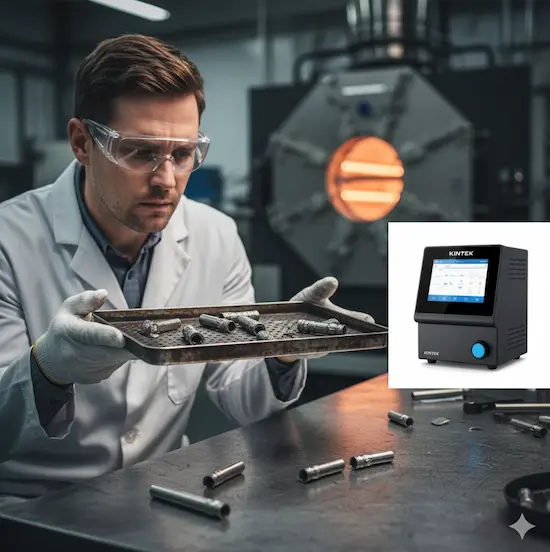
Photos of researchers

Once you eliminate the guesswork and solve the chronic problem of inconsistency, the entire dynamic of your operation changes. Reliable brazing doesn't just mean fewer failed parts; it unlocks a new level of manufacturing capability.

  • Accelerate R&D: You can now confidently develop processes for new, complex assemblies or challenging dissimilar materials, knowing your baseline is stable. Validation time can shrink from months to weeks.
  • Boost Production Yield: Imagine reducing your scrap rate from a painful 15% to a predictable sub-1%. You've effectively increased your production capacity without adding a single new furnace.
  • Manufacture with Confidence: For industries where failure is not an option, you can build parts with the assurance that every single joint meets stringent quality and performance standards. This opens the door to more demanding and lucrative contracts.
  • Reduce Overall Costs: The savings from eliminated waste, reduced labor for rework, and faster production cycles go straight to your bottom line.

By shifting focus to the fundamentals and implementing a robust preparation process, you're not just fixing a joint; you're transforming your entire manufacturing potential.

Let's move your process from a source of frustration to a competitive advantage. Our team understands the microscopic details that determine macroscopic success. We can help you analyze your current workflow and build a reliable, high-yield brazing process tailored to your specific components and business goals. To start the conversation about your project, Contact Our Experts.

Visual Guide
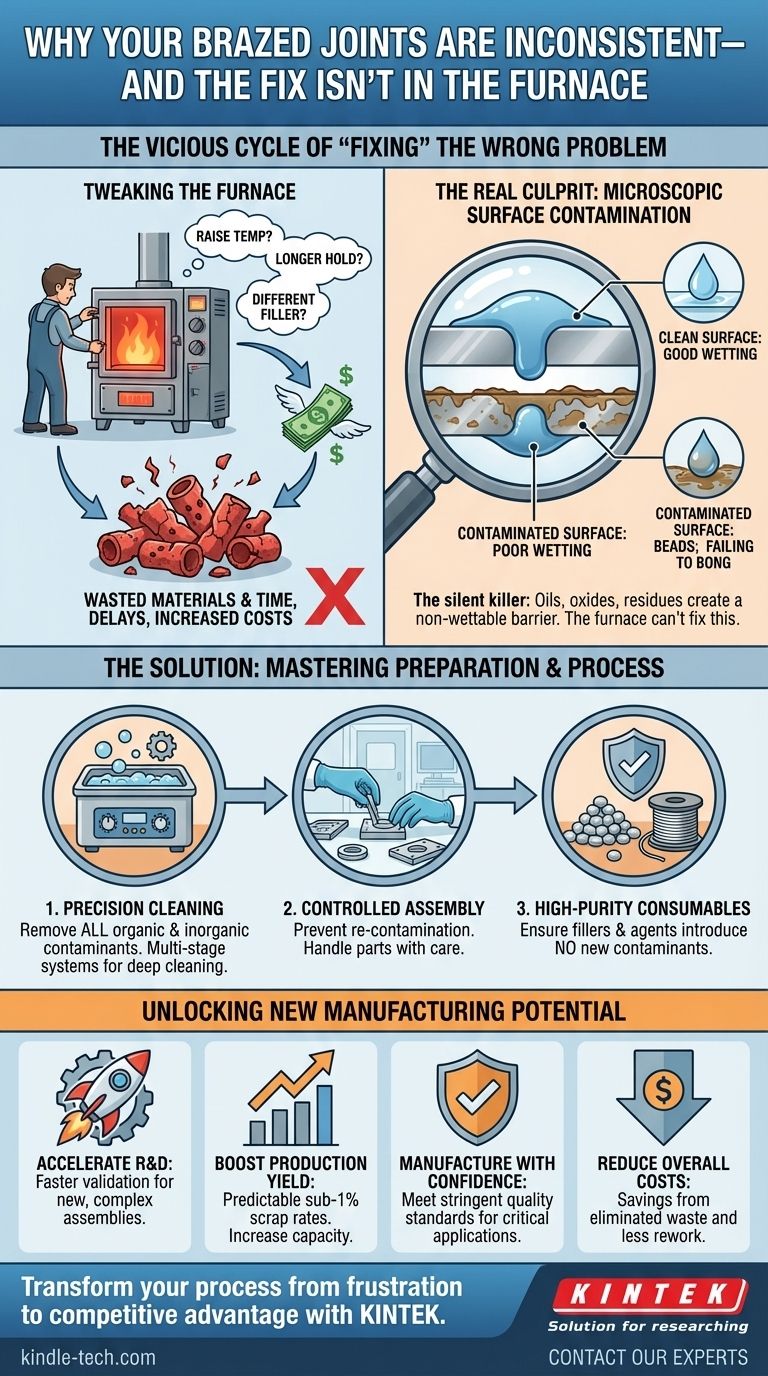
Why Your Brazed Joints Are Inconsistent—And the Fix Isn't in the Furnace Visual Guide

Related Products

Related Articles

Related Products

Vacuum Heat Treat Sintering Brazing Furnace

Vacuum Heat Treat Sintering Brazing Furnace

A vacuum brazing furnace is a type of industrial furnace used for brazing, a metalworking process that joins two pieces of metal using a filler metal that melts at a lower temperature than the base metals. Vacuum brazing furnaces are typically used for high-quality applications where a strong, clean joint is required.

Molybdenum Vacuum Heat Treat Furnace

Molybdenum Vacuum Heat Treat Furnace

Discover the benefits of a high-configuration molybdenum vacuum furnace with heat shield insulation. Ideal for high-purity, vacuum environments like sapphire crystal growth and heat treatment.

2200 ℃ Tungsten Vacuum Heat Treat and Sintering Furnace

2200 ℃ Tungsten Vacuum Heat Treat and Sintering Furnace

Experience the ultimate refractory metal furnace with our Tungsten vacuum furnace. Capable of reaching 2200℃, perfect for sintering advanced ceramics and refractory metals. Order now for high-quality results.

2200 ℃ Graphite Vacuum Heat Treat Furnace

2200 ℃ Graphite Vacuum Heat Treat Furnace

Discover the power of the KT-VG Graphite Vacuum Furnace - with a maximum working temperature of 2200℃, it's perfect for vacuum sintering of various materials. Learn more now.

Vacuum Heat Treat Furnace with Ceramic Fiber Liner

Vacuum Heat Treat Furnace with Ceramic Fiber Liner

Vacuum furnace with polycrystalline ceramic fiber insulation liner for excellent heat insulation and uniform temperature field. Choose from 1200℃ or 1700℃ max. working temperature with high vacuum performance and precise temperature control.

1400℃ Laboratory High Temperature Tube Furnace with Alumina Tube

1400℃ Laboratory High Temperature Tube Furnace with Alumina Tube

Looking for a tube furnace for high-temperature applications? Our 1400℃ Tube Furnace with Alumina Tube is perfect for research and industrial use.

Vacuum Heat Treat Furnace and Levitation Induction Melting Furnace

Vacuum Heat Treat Furnace and Levitation Induction Melting Furnace

Experience precise melting with our Vacuum Levitation Melting Furnace. Ideal for high melting point metals or alloys, with advanced technology for effective smelting. Order now for high-quality results.

Laboratory Muffle Oven Furnace Bottom Lifting Muffle Furnace

Laboratory Muffle Oven Furnace Bottom Lifting Muffle Furnace

Efficiently produce batches with excellent temperature uniformity using our Bottom Lifting Furnace. Features two electric lifting stages and advanced temperature control up to 1600℃.

High Pressure Laboratory Vacuum Tube Furnace Quartz Tubular Furnace

High Pressure Laboratory Vacuum Tube Furnace Quartz Tubular Furnace

KT-PTF High Pressure Tube Furnace: Compact split tube furnace with strong positive pressure resistance. Working temp up to 1100°C and pressure up to 15Mpa. Also works under controller atmosphere or high vacuum.

Vacuum Heat Treat and Molybdenum Wire Sintering Furnace for Vacuum Sintering

Vacuum Heat Treat and Molybdenum Wire Sintering Furnace for Vacuum Sintering

A vacuum molybdenum wire sintering furnace is a vertical or bedroom structure, which is suitable for withdrawal, brazing, sintering and degassing of metal materials under high vacuum and high temperature conditions. It is also suitable for dehydroxylation treatment of quartz materials.

Vacuum Heat Treat and Sintering Furnace with 9MPa Air Pressure

Vacuum Heat Treat and Sintering Furnace with 9MPa Air Pressure

The air pressure sintering furnace is a high-tech equipment commonly used for the sintering of advanced ceramic materials. It combines vacuum sintering and pressure sintering techniques to achieve high-density and high-strength ceramics.

Vacuum Hot Press Furnace Heated Vacuum Press Machine Tube Furnace

Vacuum Hot Press Furnace Heated Vacuum Press Machine Tube Furnace

Reduce forming pressure & shorten sintering time with Vacuum Tube Hot Press Furnace for high-density, fine-grain materials. Ideal for refractory metals.

Graphite Vacuum Furnace High Thermal Conductivity Film Graphitization Furnace

Graphite Vacuum Furnace High Thermal Conductivity Film Graphitization Furnace

The high thermal conductivity film graphitization furnace has uniform temperature, low energy consumption and can operate continuously.

Ultra-High Temperature Graphite Vacuum Graphitization Furnace

Ultra-High Temperature Graphite Vacuum Graphitization Furnace

The ultra-high temperature graphitization furnace utilizes medium frequency induction heating in a vacuum or inert gas environment. The induction coil generates an alternating magnetic field, inducing eddy currents in the graphite crucible, which heats up and radiates heat to the workpiece, bringing it to the desired temperature. This furnace is primarily used for graphitization and sintering of carbon materials, carbon fiber materials, and other composite materials.

1700℃ Controlled Atmosphere Furnace Nitrogen Inert Atmosphere Furnace

1700℃ Controlled Atmosphere Furnace Nitrogen Inert Atmosphere Furnace

KT-17A Controlled atmosphere furnace: 1700℃ heating, vacuum sealing technology, PID temperature control, and versatile TFT smart touch screen controller for laboratory and industrial use.

Vertical Laboratory Tube Furnace

Vertical Laboratory Tube Furnace

Elevate your experiments with our Vertical Tube Furnace. Versatile design allows for operation under various environments and heat treatment applications. Order now for precise results!

High Temperature Muffle Oven Furnace for Laboratory Debinding and Pre Sintering

High Temperature Muffle Oven Furnace for Laboratory Debinding and Pre Sintering

KT-MD High temperature debinding and pre-sintering furnace for ceramic materials with various molding processes. Ideal for electronic components such as MLCC and NFC.

600T Vacuum Induction Hot Press Furnace for Heat Treat and Sintering

600T Vacuum Induction Hot Press Furnace for Heat Treat and Sintering

Discover the 600T Vacuum Induction Hot Press Furnace, designed for high-temperature sintering experiments in vacuum or protected atmospheres. Its precise temperature and pressure control, adjustable working pressure, and advanced safety features make it ideal for nonmetal materials, carbon composites, ceramics, and metal powders.

Vertical High Temperature Graphite Vacuum Graphitization Furnace

Vertical High Temperature Graphite Vacuum Graphitization Furnace

Vertical high temperature graphitization furnace for carbonization and graphitization of carbon materials up to 3100℃.Suitable for shaped graphitization of carbon fiber filaments and other materials sintered in a carbon environment.Applications in metallurgy, electronics, and aerospace for producing high-quality graphite products like electrodes and crucibles.

Vacuum Dental Porcelain Sintering Furnace

Vacuum Dental Porcelain Sintering Furnace

Get precise and reliable results with KinTek's Vacuum Porcelain Furnace. Suitable for all porcelain powders, it features hyperbolic ceramic furnace function, voice prompt, and automatic temperature calibration.


Leave Your Message