In high-stakes environments—whether an operating room or an aerospace laboratory—the greatest threat usually isn’t the procedure itself. It is the environment.
In surgery, the enemy is the invisible microbe. In metallurgy, the enemy is the atmosphere.
When you heat a metal in the presence of air, you invite a chaotic chemistry lesson. Oxygen reacts with surfaces to create rust. Nitrogen creates brittle layers. Water vapor introduces hydrogen, the silent killer of structural integrity.
Most conventional furnaces try to manage this chaos. A vacuum furnace eliminates it entirely.
By removing the atmosphere, we stop managing the problem and start engineering the solution. This is not just about heating a component; it is about creating a sanctuary where physics can operate without interference.
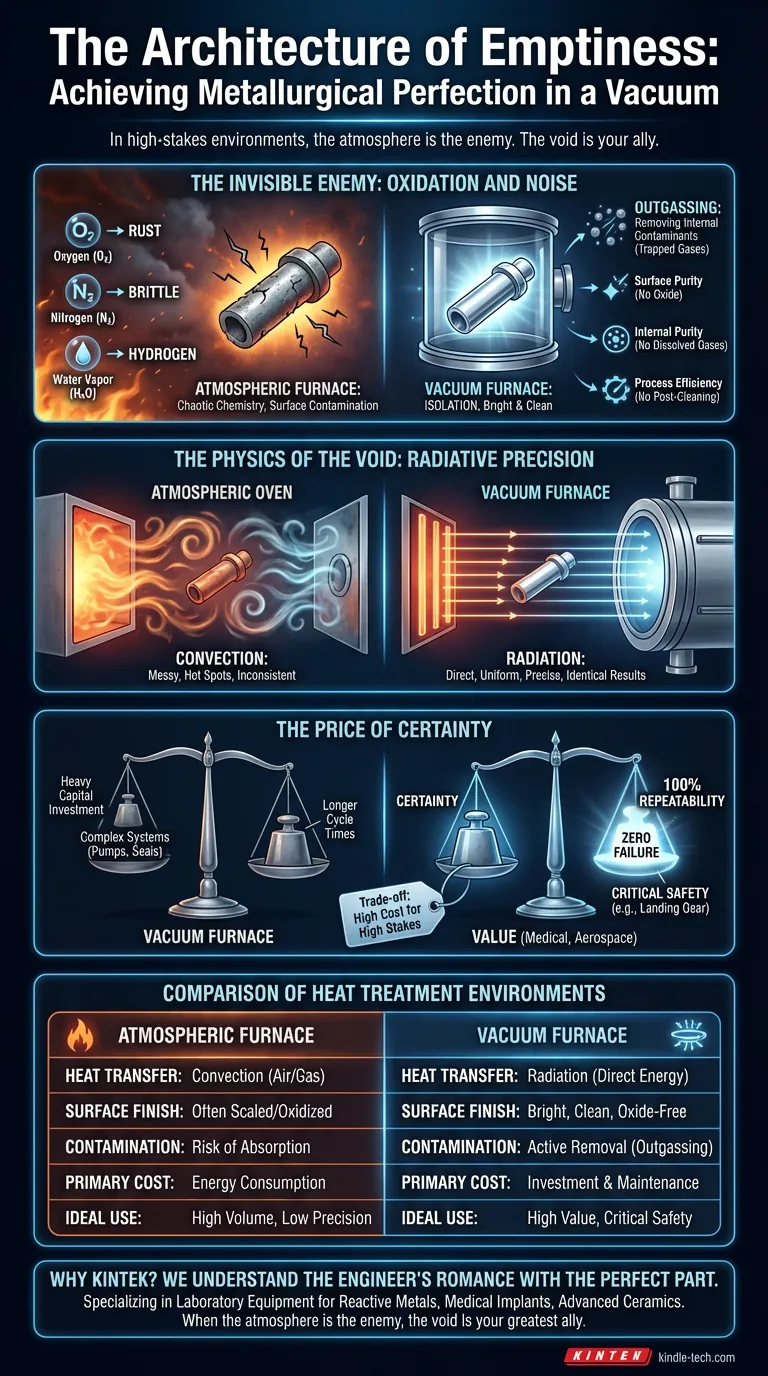
The Invisible Enemy: Oxidation and Noise
The primary benefit of a vacuum furnace is often described as "cleanliness," but that word feels too domestic for what is actually happening.
It is really about isolation.
When a chamber is evacuated, we strip away the reactive gases that cause oxidation and decarburization. In a standard furnace, a steel part might emerge with a scaled, dull gray surface that requires chemical cleaning or mechanical grinding.
In a vacuum, the same part emerges "bright." It looks exactly as it did when it went in, only molecularly transformed.
The Phenomenon of Outgassing
There is a deeper layer to this purity. A vacuum doesn't just prevent new contaminants from entering; it pulls existing contaminants out.
Under low pressure, trapped gases and volatile elements deep within the metal's lattice are forced to the surface and evacuated. This process, known as outgassing, improves the structural integrity of the material in a way that atmospheric heating simply cannot replicate.
- Surface Purity: No oxidation or discoloration.
- Internal Purity: Removal of dissolved gases (hydrogen, nitrogen).
- Process Efficiency: Elimination of post-heat cleaning steps.
The Physics of the Void: Radiative Precision
How do you heat something when there is no air to carry the heat?
In a standard oven, heat moves via convection—hot air currents swirling around the object. Convection is effective, but it is inherently messy. It creates shadows, hot spots, and inconsistencies depending on how the air flows.
Vacuum furnaces rely on radiation.
In the void, heat travels as pure energy waves, transferring directly from the heating elements to the workload. This allows for a level of temperature uniformity that convection struggles to match.
Because the process is computer-controlled and occurs in a static environment, the metallurgical results are identical, regardless of where the part sits in the work zone.
The Price of Certainty
Engineering is the study of trade-offs. The precision of a vacuum furnace comes at a cost, both literally and operationally.
Vacuum systems are complex. They require heavy capital investment in pumps, seals, and pressure vessels. The cycle times can be longer because pumping down to a high vacuum takes time, unlike a continuous belt furnace that runs non-stop.
But in industries like medical manufacturing or aerospace, we pay for certainty.
If a landing gear component fails because of a microscopic oxide inclusion, the efficiency of the furnace that treated it is irrelevant. The cost of failure is infinite. Therefore, the cost of the vacuum is justified.
Comparison of Heat Treatment Environments
| Feature | Atmospheric Furnace | Vacuum Furnace |
|---|---|---|
| Heat Transfer | Convection (Air/Gas movement) | Radiation (Direct energy transfer) |
| Surface Finish | Often scaled/oxidized | Bright, clean, oxide-free |
| Contamination | Risk of reactive gas absorption | Active removal via outgassing |
| Primary Cost | Energy consumption | Initial Investment & Maintenance |
| Ideal Use | High volume, low precision | High value, critical safety |
Why KINTEK?
We often confuse "expensive" with "costly."
A cheap process that results in a 5% rejection rate is costly. A premium process that guarantees 100% repeatability is an investment in reputation.
At KINTEK, we understand the engineer’s romance with the perfect part. We specialize in laboratory equipment designed for those who cannot afford variability. Our vacuum furnaces are engineered to provide the absolute environmental control necessary for reactive metals, medical implants, and advanced ceramics.
When the atmosphere is the enemy, the void is your greatest ally.
Visual Guide
Related Products
- Vacuum Hot Press Furnace Heated Vacuum Press Machine Tube Furnace
- 600T Vacuum Induction Hot Press Furnace for Heat Treat and Sintering
- Vacuum Hot Press Furnace Machine Heated Vacuum Press
- Vacuum Heat Treat Furnace and Levitation Induction Melting Furnace
- 2200 ℃ Tungsten Vacuum Heat Treat and Sintering Furnace
Related Articles
- The Purity Paradox: Choosing the Heart of Your Vacuum Hot Press Furnace
- Comprehensive Guide to Vacuum Hot Press Furnace Application
- Vacuum Hot Press Furnace: A Comprehensive Guide
- Forging Perfection in a Void: The Physics of Ultra-Dense Materials
- Defeating the Void: The Quiet Power of Vacuum Hot Pressing