Blog The Architecture of Silence: Why Indirect Heating Defines Material Purity
The Architecture of Silence: Why Indirect Heating Defines Material Purity

The Architecture of Silence: Why Indirect Heating Defines Material Purity

1 week ago

The Enemy is the Atmosphere

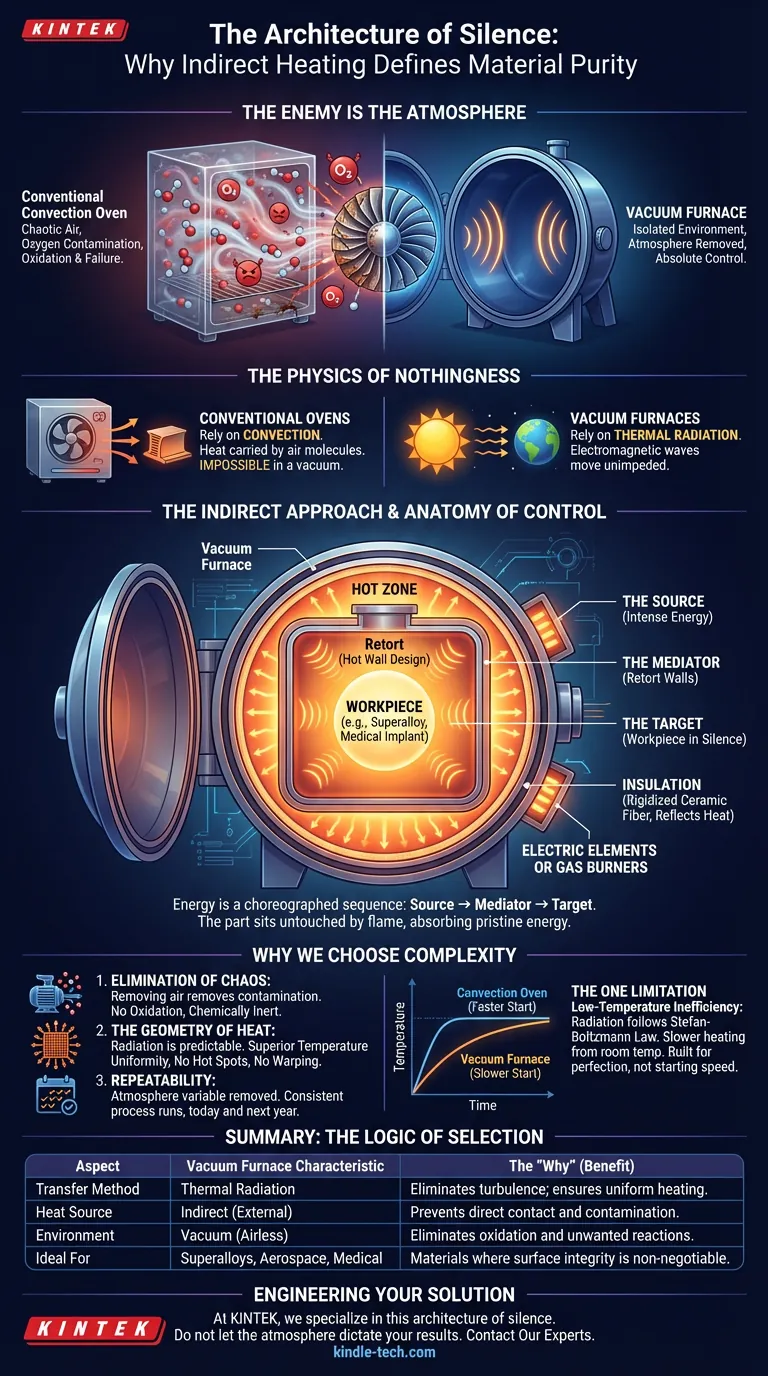
In the world of high-performance materials, the air we breathe is a chaotic variable.

For a superalloy turbine blade or a medical implant, oxygen is not life; it is corruption. A single microscopic interaction with the atmosphere during heat treatment can lead to oxidation, decarburization, or structural failure.

The solution is not just to heat the material. It is to isolate it.

This is the defining philosophy of the vacuum furnace. Unlike standard industrial ovens that rely on the brute force of hot air, a vacuum furnace operates on a principle of elegant separation. It is an exercise in "indirect heating."

The heat source never touches the workpiece. The atmosphere is removed. What remains is a system designed for absolute control.

The Physics of Nothingness

To understand how a vacuum furnace heats, you must first forget how your kitchen oven works.

Conventional ovens rely on convection. They heat the air, and fans blow that air around to transfer energy. But in a vacuum, there is no air. There are no molecules to carry the thermal load. Convection is impossible.

Instead, vacuum furnaces rely on thermal radiation.

It is the same physics that allows the sun to warm the earth through the vacuum of space. The energy travels as electromagnetic waves, moving unimpeded until it strikes a surface.

The Indirect Approach

In this system, the transfer of energy is a carefully choreographed sequence:

  • The Source: Electric elements or gas burners generate intense energy.
  • The Mediator: These heaters warm the internal chamber walls or a sealed container known as a retort.
  • The Target: The superheated surfaces radiate energy inward, bathing the workpiece in uniform heat from all sides.

The part sits in silence, untouched by flame or heating element, absorbing energy in a pristine environment.

The Anatomy of Control

A vacuum furnace is an integrated system where every component serves the god of Purity. It is engineered to manage the flow of radiation while withstanding extreme stress.

The Hot Zone

This is the heart of the furnace. It is an insulated interior designed to hold temperature stability. It must heat rapidly, but more importantly, it must cool rapidly to lock in material properties.

The Retort (Hot Wall Design)

In "hot wall" designs, the separation is physical. The parts are placed inside a vacuum-tight vessel called a retort. The heaters sit outside this vessel. They heat the wall of the retort, which then radiates heat to the parts inside.

It is a box within a box. The outer box handles the combustion; the inner box preserves the vacuum.

The Insulation

To contain this radiant energy, advanced insulation—often rigidized ceramic fiber—is used. It has low thermal mass, meaning it doesn't soak up heat like a sponge. Instead, it reflects it back toward the workload.

Why We Choose Complexity

Engineering a vacuum system is difficult. It requires heavy pumps, precise seals, and expensive materials. Why do we accept this complexity?

Because the trade-offs of the "easy way" are unacceptable for mission-critical parts.

1. The Elimination of Chaos

By removing the air, we remove the chemistry of contamination. There is no oxygen to rust the metal. There is no carbon to alter the surface hardness unexpectedly. The environment is chemically inert.

2. The Geometry of Heat

In a convection oven, air currents create turbulence. You get hot spots and cold shadows.

In a vacuum, radiation is geometric and predictable. It provides superior temperature uniformity. This is vital for complex shapes where uneven heating would cause warping or internal stress.

3. Repeatability

When you remove the variable of the atmosphere, you get consistency. A process run today will look exactly like a process run next year.

The One Limitation

There is no such thing as a perfect system, only the right system for the job.

The reliance on radiation comes with a physics-based constraint: Low-temperature inefficiency.

Radiation follows the Stefan-Boltzmann law, which dictates that heat transfer efficiency increases drastically as temperature rises. Consequently, heating a part from room temperature to 600°F in a vacuum can be slower than in a convection oven.

The vacuum furnace is not built for speed at the starting line. It is built for perfection at the finish line.

Summary: The Logic of Selection

Deciding to use a vacuum furnace is rarely a question of cost; it is a question of consequence.

If a part fails, what happens? If the answer involves a plane engine shutting down or a medical device corroding, the vacuum furnace is the only logical choice.

Aspect Vacuum Furnace Characteristic The "Why" (Benefit)
Transfer Method Thermal Radiation Eliminates turbulence; ensures uniform heating.
Heat Source Indirect (External to workload) Prevents direct contact and contamination.
Environment Vacuum (Airless) Eliminates oxidation and unwanted reactions.
Ideal For Superalloys, Aerospace, Medical Materials where surface integrity is non-negotiable.

Engineering Your Solution

Understanding how a vacuum furnace heats is understanding how to deliver reliability in an unreliable world. It is about creating a sanctuary for your materials where the laws of thermodynamics work in your favor, without the interference of the atmosphere.

At KINTEK, we specialize in this architecture of silence.

We provide the high-performance lab equipment and consumables necessary for these precise operations. Whether you are brazing complex geometries or treating aerospace alloys, our solutions are designed to maintain the strict environmental controls your science demands.

Do not let the atmosphere dictate your results.

Contact Our Experts

Visual Guide

The Architecture of Silence: Why Indirect Heating Defines Material Purity Visual Guide

Related Products

Related Articles

Related Products

Vacuum Heat Treat Furnace with Ceramic Fiber Liner

Vacuum Heat Treat Furnace with Ceramic Fiber Liner

Vacuum furnace with polycrystalline ceramic fiber insulation liner for excellent heat insulation and uniform temperature field. Choose from 1200℃ or 1700℃ max. working temperature with high vacuum performance and precise temperature control.

Small Vacuum Heat Treat and Tungsten Wire Sintering Furnace

Small Vacuum Heat Treat and Tungsten Wire Sintering Furnace

The small vacuum tungsten wire sintering furnace is a compact experimental vacuum furnace specially designed for universities and scientific research institutes. The furnace features a CNC welded shell and vacuum piping to ensure leak-free operation. Quick-connect electrical connections facilitate relocation and debugging, and the standard electrical control cabinet is safe and convenient to operate.

Vacuum Heat Treat Sintering Brazing Furnace

Vacuum Heat Treat Sintering Brazing Furnace

A vacuum brazing furnace is a type of industrial furnace used for brazing, a metalworking process that joins two pieces of metal using a filler metal that melts at a lower temperature than the base metals. Vacuum brazing furnaces are typically used for high-quality applications where a strong, clean joint is required.

Molybdenum Vacuum Heat Treat Furnace

Molybdenum Vacuum Heat Treat Furnace

Discover the benefits of a high-configuration molybdenum vacuum furnace with heat shield insulation. Ideal for high-purity, vacuum environments like sapphire crystal growth and heat treatment.

Graphite Vacuum Furnace IGBT Experimental Graphitization Furnace

Graphite Vacuum Furnace IGBT Experimental Graphitization Furnace

IGBT experimental graphitization furnace, a tailored solution for universities and research institutions, with high heating efficiency, user-friendliness, and precise temperature control.

Laboratory Rapid Thermal Processing (RTP) Quartz Tube Furnace

Laboratory Rapid Thermal Processing (RTP) Quartz Tube Furnace

Get lightning-fast heating with our RTP Rapid Heating Tube Furnace. Designed for precise, high-speed heating and cooling with convenient sliding rail and TFT touch screen controller. Order now for ideal thermal processing!

Vacuum Heat Treat and Molybdenum Wire Sintering Furnace for Vacuum Sintering

Vacuum Heat Treat and Molybdenum Wire Sintering Furnace for Vacuum Sintering

A vacuum molybdenum wire sintering furnace is a vertical or bedroom structure, which is suitable for withdrawal, brazing, sintering and degassing of metal materials under high vacuum and high temperature conditions. It is also suitable for dehydroxylation treatment of quartz materials.

Vacuum Hot Press Furnace Heated Vacuum Press Machine Tube Furnace

Vacuum Hot Press Furnace Heated Vacuum Press Machine Tube Furnace

Reduce forming pressure & shorten sintering time with Vacuum Tube Hot Press Furnace for high-density, fine-grain materials. Ideal for refractory metals.

2200 ℃ Graphite Vacuum Heat Treat Furnace

2200 ℃ Graphite Vacuum Heat Treat Furnace

Discover the power of the KT-VG Graphite Vacuum Furnace - with a maximum working temperature of 2200℃, it's perfect for vacuum sintering of various materials. Learn more now.

2200 ℃ Tungsten Vacuum Heat Treat and Sintering Furnace

2200 ℃ Tungsten Vacuum Heat Treat and Sintering Furnace

Experience the ultimate refractory metal furnace with our Tungsten vacuum furnace. Capable of reaching 2200℃, perfect for sintering advanced ceramics and refractory metals. Order now for high-quality results.

Graphite Vacuum Furnace Bottom Discharge Graphitization Furnace for Carbon Materials

Graphite Vacuum Furnace Bottom Discharge Graphitization Furnace for Carbon Materials

Bottom-out graphitization furnace for carbon materials, ultra-high temperature furnace up to 3100°C, suitable for graphitization and sintering of carbon rods and carbon blocks. Vertical design, bottom discharging, convenient feeding and discharging, high temperature uniformity, low energy consumption, good stability, hydraulic lifting system, convenient loading and unloading.

Vacuum Dental Porcelain Sintering Furnace

Vacuum Dental Porcelain Sintering Furnace

Get precise and reliable results with KinTek's Vacuum Porcelain Furnace. Suitable for all porcelain powders, it features hyperbolic ceramic furnace function, voice prompt, and automatic temperature calibration.

Laboratory Vacuum Tilt Rotary Tube Furnace Rotating Tube Furnace

Laboratory Vacuum Tilt Rotary Tube Furnace Rotating Tube Furnace

Discover the versatility of Laboratory Rotary Furnace: Ideal for calcination, drying, sintering, and high-temperature reactions. Adjustable rotating and tilting functions for optimal heating. Suitable for vacuum and controlled atmosphere environments. Learn more now!

Graphite Vacuum Furnace High Thermal Conductivity Film Graphitization Furnace

Graphite Vacuum Furnace High Thermal Conductivity Film Graphitization Furnace

The high thermal conductivity film graphitization furnace has uniform temperature, low energy consumption and can operate continuously.

600T Vacuum Induction Hot Press Furnace for Heat Treat and Sintering

600T Vacuum Induction Hot Press Furnace for Heat Treat and Sintering

Discover the 600T Vacuum Induction Hot Press Furnace, designed for high-temperature sintering experiments in vacuum or protected atmospheres. Its precise temperature and pressure control, adjustable working pressure, and advanced safety features make it ideal for nonmetal materials, carbon composites, ceramics, and metal powders.

Vacuum Heat Treat and Sintering Furnace with 9MPa Air Pressure

Vacuum Heat Treat and Sintering Furnace with 9MPa Air Pressure

The air pressure sintering furnace is a high-tech equipment commonly used for the sintering of advanced ceramic materials. It combines vacuum sintering and pressure sintering techniques to achieve high-density and high-strength ceramics.

Vacuum Hot Press Furnace Machine Heated Vacuum Press

Vacuum Hot Press Furnace Machine Heated Vacuum Press

Discover the advantages of Vacuum Hot Press Furnace! Manufacture dense refractory metals & compounds, ceramics, and composites under high temp and pressure.

1700℃ Laboratory High Temperature Tube Furnace with Alumina Tube

1700℃ Laboratory High Temperature Tube Furnace with Alumina Tube

Looking for a high-temperature tube furnace? Check out our 1700℃ Tube Furnace with Alumina Tube. Perfect for research and industrial applications up to 1700C.

Horizontal High Temperature Graphite Vacuum Graphitization Furnace

Horizontal High Temperature Graphite Vacuum Graphitization Furnace

Horizontal Graphitization Furnace: This type of furnace is designed with the heating elements placed horizontally, allowing for uniform heating of the sample. It's well-suited for graphitizing large or bulky samples that require precise temperature control and uniformity.

Ultra-High Temperature Graphite Vacuum Graphitization Furnace

Ultra-High Temperature Graphite Vacuum Graphitization Furnace

The ultra-high temperature graphitization furnace utilizes medium frequency induction heating in a vacuum or inert gas environment. The induction coil generates an alternating magnetic field, inducing eddy currents in the graphite crucible, which heats up and radiates heat to the workpiece, bringing it to the desired temperature. This furnace is primarily used for graphitization and sintering of carbon materials, carbon fiber materials, and other composite materials.


Leave Your Message