Blog Why Your High-Temperature Processes Fail: The Hidden Enemy in Your Vacuum Furnace
Why Your High-Temperature Processes Fail: The Hidden Enemy in Your Vacuum Furnace

Why Your High-Temperature Processes Fail: The Hidden Enemy in Your Vacuum Furnace

23 hours ago

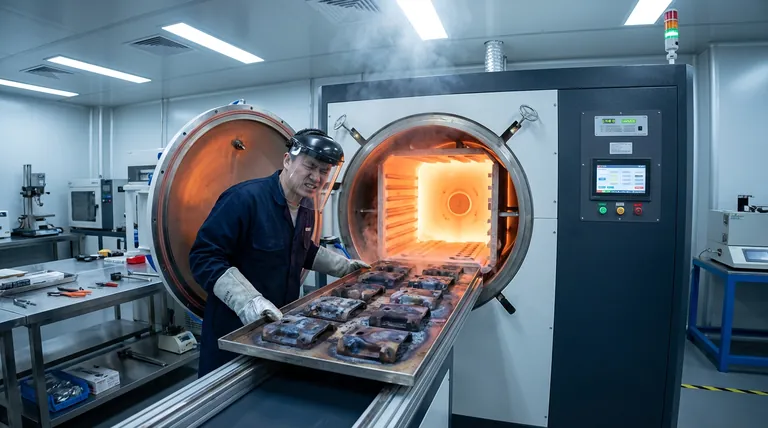
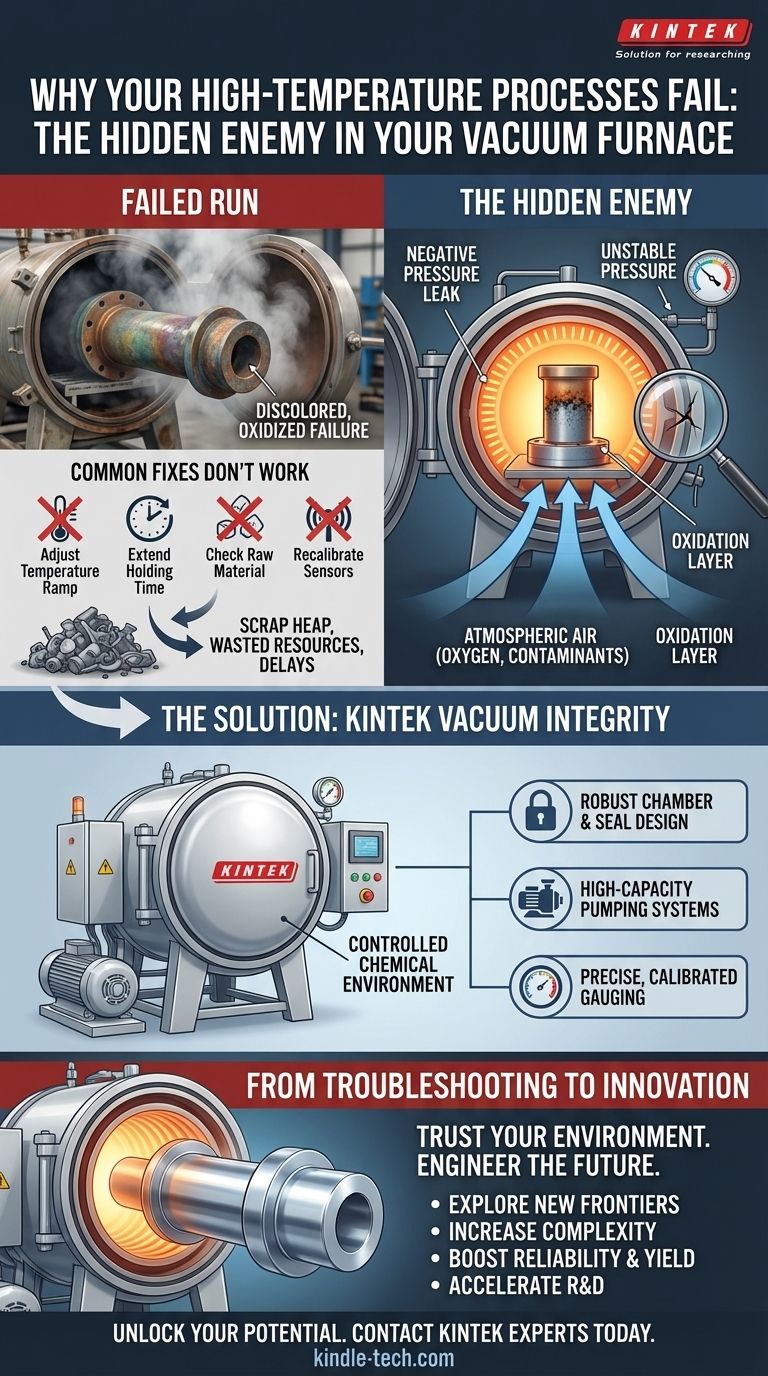
Imagine this: after hours, or even days, of a carefully planned heat treatment cycle, you open the vacuum furnace. Instead of the pristine, perfectly bonded component you expected, you find a discolored, oxidized failure. The part is ruined, the schedule is delayed, and you're left wondering: what went wrong this time?

This scenario is a costly and frustrating reality in many labs and manufacturing facilities. The component goes to the scrap heap, and the search for the cause begins.

Chasing Ghosts: Why Common Fixes Don't Work

When a high-temperature process like brazing, sintering, or annealing fails, the troubleshooting checklist is often predictable:

  • "Was the temperature ramp rate too fast?"
  • "Did the holding time need to be longer?"
  • "Is this batch of raw material contaminated?"
  • "Do the temperature sensors need recalibration?"

You might spend days tweaking process parameters, rerunning cycles, and analyzing materials, only to achieve another inconsistent result.

This isn't just an academic problem; it has severe business consequences. Each failed cycle wastes expensive raw materials, machine time, and significant energy. Project timelines slip, production yields drop, and you can't confidently guarantee the quality of your output. You're caught in a reactive loop, spending more time troubleshooting past failures than engineering future successes.

The Real Culprit: It's Not Your Process, It's Your Environment

Here is the fundamental truth that is often overlooked: a vacuum furnace is not just a hot box; it is a controlled chemical environment.

The entire purpose of pulling a vacuum is to remove reactive gases—primarily oxygen. At the extreme temperatures inside the furnace, even the smallest amount of oxygen can act as a potent contaminant, causing the very oxidation and discoloration you're trying to prevent. Your material becomes incredibly vulnerable, and its final properties depend entirely on the purity of its surroundings.

This reveals why your previous troubleshooting failed. You were adjusting the recipe while the oven itself was contaminated. The most common cause of this contamination is a negative pressure leak—a tiny, invisible breach in a seal, fitting, or weld that allows atmospheric air to be constantly sucked into the chamber.

Your vacuum pump works overtime, but it's fighting a losing battle against a steady trickle of incoming air. The gauge might show a pressure that seems "close enough," but it doesn't show the constant influx of contaminants that are actively ruining your product.

The Right Tool for the Job: Engineering for Vacuum Integrity

To solve this problem for good, you don't just need a furnace that gets hot. You need a system that can achieve and, more importantly, hold a pure, stable vacuum for the entire duration of your process. You need a tool built around the principle of pressure integrity.

This is where the focus shifts from the process to the equipment itself. A furnace designed for true vacuum integrity is fundamentally different. KINTEK's vacuum furnaces are engineered from the ground up to address this core challenge. They aren't just chambers that heat up; they are precision instruments for environmental control.

Our approach directly combats the root cause of failure:

  • Robust Chamber & Seal Design: We use high-quality materials and superior construction techniques to prevent the micro-leaks that plague lesser systems.
  • High-Capacity Pumping Systems: Our furnaces are equipped with pumps appropriately sized to not only reach the target vacuum quickly but also to overcome any minor outgassing from the material itself, maintaining pressure stability.
  • Precise, Calibrated Gauging: You can trust the pressure readings. This allows you to know with certainty that your process environment is exactly what it should be, from the beginning of the cycle to the end.

A KINTEK furnace is not just a piece of hardware; it's the physical embodiment of a deep understanding of vacuum science, designed to eliminate the guesswork and deliver a stable environment you can rely on.

From Troubleshooting to Innovation: What's Possible Now?

When you can finally trust your vacuum environment, a remarkable shift happens. You stop troubleshooting the past and start engineering the future.

The energy your team once spent on forensic analysis of failed parts is now redirected toward innovation.

  • Explore New Frontiers: You can confidently work with more sensitive, advanced materials that would have been impossible to process in an unstable environment.
  • Increase Complexity: Longer, more intricate multi-stage thermal cycles can be run without fear of pressure drift ruining the result.
  • Boost Reliability & Yield: In a production setting, you move from unpredictable yields to reliable, repeatable quality, increasing throughput and profitability.
  • Accelerate R&D: By eliminating a major source of variability, your researchers can get to meaningful results faster, shortening the path from idea to breakthrough.

Ultimately, inconsistent vacuum pressure isn't just a technical glitch; it's a barrier to innovation and a drain on your resources. If you're ready to move past the cycle of failed runs and unlock the full potential of your high-temperature processes, our team is here to help you design a system that delivers predictable, high-quality results every time. Let's discuss the unique demands of your project; Contact Our Experts to start the conversation.

Visual Guide
Why Your High-Temperature Processes Fail: The Hidden Enemy in Your Vacuum Furnace Visual Guide

Related Products

Related Articles

Related Products

Vacuum Heat Treat Furnace with Ceramic Fiber Liner

Vacuum Heat Treat Furnace with Ceramic Fiber Liner

Vacuum furnace with polycrystalline ceramic fiber insulation liner for excellent heat insulation and uniform temperature field. Choose from 1200℃ or 1700℃ max. working temperature with high vacuum performance and precise temperature control.

Molybdenum Vacuum Heat Treat Furnace

Molybdenum Vacuum Heat Treat Furnace

Discover the benefits of a high-configuration molybdenum vacuum furnace with heat shield insulation. Ideal for high-purity, vacuum environments like sapphire crystal growth and heat treatment.

Vacuum Heat Treat and Molybdenum Wire Sintering Furnace for Vacuum Sintering

Vacuum Heat Treat and Molybdenum Wire Sintering Furnace for Vacuum Sintering

A vacuum molybdenum wire sintering furnace is a vertical or bedroom structure, which is suitable for withdrawal, brazing, sintering and degassing of metal materials under high vacuum and high temperature conditions. It is also suitable for dehydroxylation treatment of quartz materials.

Vacuum Heat Treat Furnace and Levitation Induction Melting Furnace

Vacuum Heat Treat Furnace and Levitation Induction Melting Furnace

Experience precise melting with our Vacuum Levitation Melting Furnace. Ideal for high melting point metals or alloys, with advanced technology for effective smelting. Order now for high-quality results.

Vacuum Hot Press Furnace Heated Vacuum Press Machine Tube Furnace

Vacuum Hot Press Furnace Heated Vacuum Press Machine Tube Furnace

Reduce forming pressure & shorten sintering time with Vacuum Tube Hot Press Furnace for high-density, fine-grain materials. Ideal for refractory metals.

2200 ℃ Tungsten Vacuum Heat Treat and Sintering Furnace

2200 ℃ Tungsten Vacuum Heat Treat and Sintering Furnace

Experience the ultimate refractory metal furnace with our Tungsten vacuum furnace. Capable of reaching 2200℃, perfect for sintering advanced ceramics and refractory metals. Order now for high-quality results.

Vacuum Heat Treat Sintering Brazing Furnace

Vacuum Heat Treat Sintering Brazing Furnace

A vacuum brazing furnace is a type of industrial furnace used for brazing, a metalworking process that joins two pieces of metal using a filler metal that melts at a lower temperature than the base metals. Vacuum brazing furnaces are typically used for high-quality applications where a strong, clean joint is required.

2200 ℃ Graphite Vacuum Heat Treat Furnace

2200 ℃ Graphite Vacuum Heat Treat Furnace

Discover the power of the KT-VG Graphite Vacuum Furnace - with a maximum working temperature of 2200℃, it's perfect for vacuum sintering of various materials. Learn more now.

Laboratory Muffle Oven Furnace Bottom Lifting Muffle Furnace

Laboratory Muffle Oven Furnace Bottom Lifting Muffle Furnace

Efficiently produce batches with excellent temperature uniformity using our Bottom Lifting Furnace. Features two electric lifting stages and advanced temperature control up to 1600℃.

Vacuum Heat Treat and Sintering Furnace with 9MPa Air Pressure

Vacuum Heat Treat and Sintering Furnace with 9MPa Air Pressure

The air pressure sintering furnace is a high-tech equipment commonly used for the sintering of advanced ceramic materials. It combines vacuum sintering and pressure sintering techniques to achieve high-density and high-strength ceramics.

600T Vacuum Induction Hot Press Furnace for Heat Treat and Sintering

600T Vacuum Induction Hot Press Furnace for Heat Treat and Sintering

Discover the 600T Vacuum Induction Hot Press Furnace, designed for high-temperature sintering experiments in vacuum or protected atmospheres. Its precise temperature and pressure control, adjustable working pressure, and advanced safety features make it ideal for nonmetal materials, carbon composites, ceramics, and metal powders.

Graphite Vacuum Furnace High Thermal Conductivity Film Graphitization Furnace

Graphite Vacuum Furnace High Thermal Conductivity Film Graphitization Furnace

The high thermal conductivity film graphitization furnace has uniform temperature, low energy consumption and can operate continuously.

High Pressure Laboratory Vacuum Tube Furnace Quartz Tubular Furnace

High Pressure Laboratory Vacuum Tube Furnace Quartz Tubular Furnace

KT-PTF High Pressure Tube Furnace: Compact split tube furnace with strong positive pressure resistance. Working temp up to 1100°C and pressure up to 15Mpa. Also works under controller atmosphere or high vacuum.

1800℃ Muffle Oven Furnace for Laboratory

1800℃ Muffle Oven Furnace for Laboratory

KT-18 muffle furnace with Japan Al2O3 polycrystalline fibe and Silicon Molybdenum heating element, up to 1900℃, PID temperature control and 7" smart touch screen. Compact design, low heat loss, and high energy efficiency. Safety interlock system and versatile functions.

Vertical Laboratory Quartz Tube Furnace Tubular Furnace

Vertical Laboratory Quartz Tube Furnace Tubular Furnace

Elevate your experiments with our Vertical Tube Furnace. Versatile design allows for operation under various environments and heat treatment applications. Order now for precise results!

1700℃ Controlled Atmosphere Furnace Nitrogen Inert Atmosphere Furnace

1700℃ Controlled Atmosphere Furnace Nitrogen Inert Atmosphere Furnace

KT-17A Controlled atmosphere furnace: 1700℃ heating, vacuum sealing technology, PID temperature control, and versatile TFT smart touch screen controller for laboratory and industrial use.

Vacuum Dental Porcelain Sintering Furnace

Vacuum Dental Porcelain Sintering Furnace

Get precise and reliable results with KinTek's Vacuum Porcelain Furnace. Suitable for all porcelain powders, it features hyperbolic ceramic furnace function, voice prompt, and automatic temperature calibration.

1700℃ Muffle Oven Furnace for Laboratory

1700℃ Muffle Oven Furnace for Laboratory

Get superior heat control with our 1700℃ Muffle Furnace. Equipped with intelligent temperature microprocessor, TFT touch screen controller & advanced insulation materials for precise heating up to 1700C. Order now!

High Temperature Muffle Oven Furnace for Laboratory Debinding and Pre Sintering

High Temperature Muffle Oven Furnace for Laboratory Debinding and Pre Sintering

KT-MD High temperature debinding and pre-sintering furnace for ceramic materials with various molding processes. Ideal for electronic components such as MLCC and NFC.

Ultra-High Temperature Graphite Vacuum Graphitization Furnace

Ultra-High Temperature Graphite Vacuum Graphitization Furnace

The ultra-high temperature graphitization furnace utilizes medium frequency induction heating in a vacuum or inert gas environment. The induction coil generates an alternating magnetic field, inducing eddy currents in the graphite crucible, which heats up and radiates heat to the workpiece, bringing it to the desired temperature. This furnace is primarily used for graphitization and sintering of carbon materials, carbon fiber materials, and other composite materials.


Leave Your Message