Blog The Architecture of Silence: Mastery Through Total Environmental Control
The Architecture of Silence: Mastery Through Total Environmental Control

The Architecture of Silence: Mastery Through Total Environmental Control

1 week ago

The Hidden Variable in Metallurgy

In high-stakes engineering, we often obsess over the visible variables: the temperature of the furnace, the duration of the cycle, and the grade of the alloy.

But there is a hidden variable that dictates the success or failure of the entire process: The Atmosphere.

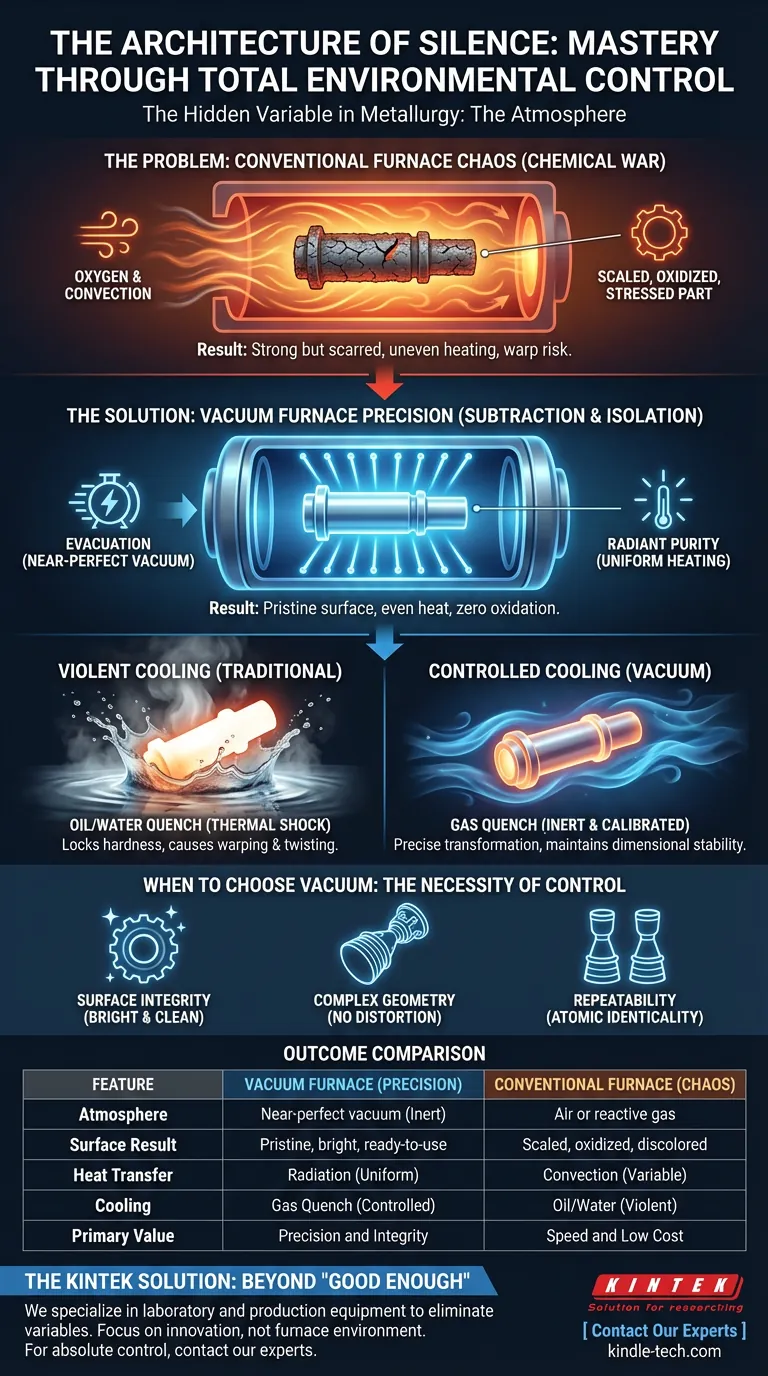
When you heat a metal part in a conventional furnace, you are effectively engaging in a chemical war. The oxygen in the air attacks the surface of the heated metal. The convection currents creating the heat introduce turbulence. The result is often a part that is strong but scarred—scaled, discolored, and internally stressed.

For basic manufacturing, this is acceptable. For critical applications—aerospace, medical devices, and high-precision tooling—it is a gamble you cannot afford to take.

Vacuum furnace heat treatment is the engineering answer to this chaos. It is a philosophy of subtraction. By removing the air, we remove the noise, leaving only the pure interaction between energy and matter.

The Physics of Isolation

The core difference between vacuum processing and traditional methods is not the heat itself, but the medium in which the heat travels.

In a standard furnace, heat moves via convection—hot air blowing over metal. It is effective, but it is uneven. It creates hot spots. It fuels oxidation.

A vacuum furnace changes the rules of engagement:

  1. The Evacuation: Before a single degree of heat is applied, powerful pumps remove the atmosphere, creating a near-perfect vacuum. The reactive agents—oxygen, nitrogen, water vapor—are gone.
  2. Radiant Purity: With no air to carry convection currents, heat is transferred solely through radiation. Graphite or ceramic elements beam thermal energy directly into the workpiece.
  3. Uniformity: Because radiation is line-of-sight and highly controllable, the part heats evenly. Thin sections and thick cores reach equilibrium together, reducing the internal tug-of-war that causes warping.

The Problem with Violent Cooling

The danger doesn't end when the heating stops. The cooling phase, or quenching, is often where parts are ruined.

Classic quenching involves dunking white-hot metal into oil or water. It is a violent thermal shock. It locks in hardness, but often at the cost of dimensional stability. Parts twist. They bow. They distort.

Vacuum furnaces replace this violence with precision. Instead of a liquid bath, the chamber is backfilled with inert gases (like argon or nitrogen) at high pressures. This extracts heat at a calibrated rate. You get the metallurgical transformation you need without the traumatic distortion.

The Cost of Certainty

If vacuum heat treatment is superior, why isn't it used for everything?

The answer lies in the psychology of trade-offs.

Vacuum processing is the "premium insurance" of metallurgy. The equipment is sophisticated and capital-intensive. The cycles take longer because creating a vacuum is a deliberate process. It requires specialized operational expertise to run these complex systems.

However, consider the cost of the alternative:

  • Post-processing: Conventional parts often need sandblasting or machining to remove scale.
  • Failure rates: A warped part in a jet engine or a medical implant is not an inconvenience; it is a catastrophe.

Vacuum treatment trades speed and low initial cost for predictability.

When to Choose the Vacuum

Understanding the trade-offs helps us make the right engineering decision. You do not need a vacuum furnace to harden a garden hoe. You absolutely need one to braze a rocket nozzle.

Here is how to assess the necessity of control:

  • Surface Integrity: If the part must emerge bright, clean, and scale-free without cleaning, vacuum is the only choice.
  • Geometry: If the part has blind holes, thin walls, or complex shapes, radiant heating prevents distortion.
  • Repeatability: If Part #1 must be atomically identical to Part #1,000, the computer-controlled environment of a vacuum furnace is essential.

A Comparison of Outcomes

Feature Vacuum Furnace Conventional Furnace
Atmosphere Near-perfect vacuum (Inert) Air or reactive gas
Surface Result Pristine, bright, ready-to-use Scaled, oxidized, discolored
Heat Transfer Radiation (Uniform) Convection (Variable)
Cooling Gas Quench (Controlled) Oil/Water (Violent)
Primary Value Precision and Integrity Speed and Low Cost

The KINTEK Solution

At the intersection of material science and equipment reliability, you will find KINTEK.

We understand that for our clients, "good enough" is rarely good enough. Whether you are conducting low-temperature annealing or high-temperature sintering, the integrity of your equipment dictates the integrity of your data and your product.

KINTEK specializes in laboratory and production equipment designed to eliminate variables. We provide the tools that allow engineers to stop worrying about the environment inside the furnace and start focusing on the innovation coming out of it.

If your process demands the absolute control that only a vacuum environment can provide, we are here to help you configure the perfect solution.

Contact Our Experts

Visual Guide

The Architecture of Silence: Mastery Through Total Environmental Control Visual Guide

Related Products

Related Articles

Related Products

Vacuum Heat Treat Furnace with Ceramic Fiber Liner

Vacuum Heat Treat Furnace with Ceramic Fiber Liner

Vacuum furnace with polycrystalline ceramic fiber insulation liner for excellent heat insulation and uniform temperature field. Choose from 1200℃ or 1700℃ max. working temperature with high vacuum performance and precise temperature control.

Molybdenum Vacuum Heat Treat Furnace

Molybdenum Vacuum Heat Treat Furnace

Discover the benefits of a high-configuration molybdenum vacuum furnace with heat shield insulation. Ideal for high-purity, vacuum environments like sapphire crystal growth and heat treatment.

2200 ℃ Graphite Vacuum Heat Treat Furnace

2200 ℃ Graphite Vacuum Heat Treat Furnace

Discover the power of the KT-VG Graphite Vacuum Furnace - with a maximum working temperature of 2200℃, it's perfect for vacuum sintering of various materials. Learn more now.

Vacuum Heat Treat Sintering Brazing Furnace

Vacuum Heat Treat Sintering Brazing Furnace

A vacuum brazing furnace is a type of industrial furnace used for brazing, a metalworking process that joins two pieces of metal using a filler metal that melts at a lower temperature than the base metals. Vacuum brazing furnaces are typically used for high-quality applications where a strong, clean joint is required.

2200 ℃ Tungsten Vacuum Heat Treat and Sintering Furnace

2200 ℃ Tungsten Vacuum Heat Treat and Sintering Furnace

Experience the ultimate refractory metal furnace with our Tungsten vacuum furnace. Capable of reaching 2200℃, perfect for sintering advanced ceramics and refractory metals. Order now for high-quality results.

Graphite Vacuum Furnace High Thermal Conductivity Film Graphitization Furnace

Graphite Vacuum Furnace High Thermal Conductivity Film Graphitization Furnace

The high thermal conductivity film graphitization furnace has uniform temperature, low energy consumption and can operate continuously.

Small Vacuum Heat Treat and Tungsten Wire Sintering Furnace

Small Vacuum Heat Treat and Tungsten Wire Sintering Furnace

The small vacuum tungsten wire sintering furnace is a compact experimental vacuum furnace specially designed for universities and scientific research institutes. The furnace features a CNC welded shell and vacuum piping to ensure leak-free operation. Quick-connect electrical connections facilitate relocation and debugging, and the standard electrical control cabinet is safe and convenient to operate.

Laboratory Rapid Thermal Processing (RTP) Quartz Tube Furnace

Laboratory Rapid Thermal Processing (RTP) Quartz Tube Furnace

Get lightning-fast heating with our RTP Rapid Heating Tube Furnace. Designed for precise, high-speed heating and cooling with convenient sliding rail and TFT touch screen controller. Order now for ideal thermal processing!

Horizontal High Temperature Graphite Vacuum Graphitization Furnace

Horizontal High Temperature Graphite Vacuum Graphitization Furnace

Horizontal Graphitization Furnace: This type of furnace is designed with the heating elements placed horizontally, allowing for uniform heating of the sample. It's well-suited for graphitizing large or bulky samples that require precise temperature control and uniformity.

Graphite Vacuum Furnace Bottom Discharge Graphitization Furnace for Carbon Materials

Graphite Vacuum Furnace Bottom Discharge Graphitization Furnace for Carbon Materials

Bottom-out graphitization furnace for carbon materials, ultra-high temperature furnace up to 3100°C, suitable for graphitization and sintering of carbon rods and carbon blocks. Vertical design, bottom discharging, convenient feeding and discharging, high temperature uniformity, low energy consumption, good stability, hydraulic lifting system, convenient loading and unloading.

Graphite Vacuum Furnace IGBT Experimental Graphitization Furnace

Graphite Vacuum Furnace IGBT Experimental Graphitization Furnace

IGBT experimental graphitization furnace, a tailored solution for universities and research institutions, with high heating efficiency, user-friendliness, and precise temperature control.

Vacuum Hot Press Furnace Machine for Lamination and Heating

Vacuum Hot Press Furnace Machine for Lamination and Heating

Experience clean and precise lamination with Vacuum Lamination Press. Perfect for wafer bonding, thin-film transformations, and LCP lamination. Order now!

Dental Porcelain Zirconia Sintering Ceramic Vacuum Press Furnace

Dental Porcelain Zirconia Sintering Ceramic Vacuum Press Furnace

Get precise dental results with Dental Vacuum Press Furnace. Automatic temperature calibration, low noise tray, and touch screen operation. Order now!

Large Vertical Graphite Vacuum Graphitization Furnace

Large Vertical Graphite Vacuum Graphitization Furnace

A large vertical high-temperature graphitization furnace is a type of industrial furnace used for the graphitization of carbon materials, such as carbon fiber and carbon black. It is a high-temperature furnace that can reach temperatures of up to 3100°C.

Heated Hydraulic Press Machine with Heated Plates for Vacuum Box Laboratory Hot Press

Heated Hydraulic Press Machine with Heated Plates for Vacuum Box Laboratory Hot Press

Enhance your lab's precision with our lab press for vacuum box. Press pills and powders with ease and precision in a vacuum environment, reducing oxidation and improving consistency. Compact and easy to use with a digital pressure gauge.

Vacuum Induction Melting Spinning System Arc Melting Furnace

Vacuum Induction Melting Spinning System Arc Melting Furnace

Develop metastable materials with ease using our Vacuum Melt Spinning System. Ideal for research and experimental work with amorphous and microcrystalline materials. Order now for effective results.

30T 40T Split Automatic Heated Hydraulic Press Machine with Heated Plates for Laboratory Hot Press

30T 40T Split Automatic Heated Hydraulic Press Machine with Heated Plates for Laboratory Hot Press

Discover our split automatic heated lab press 30T/40T for precise sample preparation in material research, pharmacy, ceramics, and electronics industries. With a small footprint and heating up to 300°C, it's perfect for processing under vacuum environment.

Vacuum Cold Trap Chiller Indirect Cold Trap Chiller

Vacuum Cold Trap Chiller Indirect Cold Trap Chiller

Boost vacuum system efficiency and prolong pump life with our Indirect Cold Trap. Built-in chilling system with no need for fluid or dry ice. Compact design and easy to use.

Oil Free Diaphragm Vacuum Pump for Laboratory and Industrial Use

Oil Free Diaphragm Vacuum Pump for Laboratory and Industrial Use

Oil-free diaphragm vacuum pump for labs: clean, reliable, chemical-resistant. Ideal for filtration, SPE, and rotary evaporation. Maintenance-free operation.

Stainless Steel Quick Release Vacuum Chain Three-Section Clamp

Stainless Steel Quick Release Vacuum Chain Three-Section Clamp

Discover our stainless steel quick release clamp vacuum clamp, Ideal for high vacuum applications, Strong connections, reliable sealing, Easy installation, and durable design.


Leave Your Message