Blog The Architecture of Extremes: Mastering the Thermal Ceiling
The Architecture of Extremes: Mastering the Thermal Ceiling

The Architecture of Extremes: Mastering the Thermal Ceiling

2 weeks ago

There is a distinct human tendency to judge a machine by its extremities. We look at a car's speedometer to see the top speed, even if we will never drive that fast.

In the world of materials science, the same psychology applies to vacuum furnaces. The most common question engineers ask is simple: "How hot does it get?"

But the answer is rarely a single number. It is a narrative about design choices, material constraints, and the specific architecture of the "hot zone."

While a standard heat treatment cycle might leisurely stroll at 1100°C, the engineering limits of modern vacuum furnaces are pushing into territories that melt most known substances.

The Hot Zone: A Fortress of Physics

To understand the temperature limit, you have to look inside the chamber.

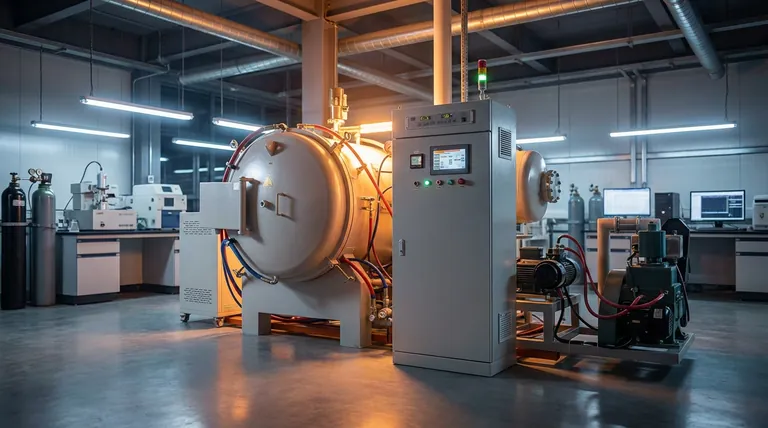
The vacuum furnace is essentially a thermos bottle on steroids. Because the vacuum eliminates convection (heat transfer through air), the heat is purely radiant. The defining factor of the furnace's ceiling is the construction of its hot zone.

This is where the engineer’s romance meets the hard reality of physics. The materials used here determine whether your ceiling is a standard 1300°C or a stratospheric 2200°C.

There are two primary architects of high heat:

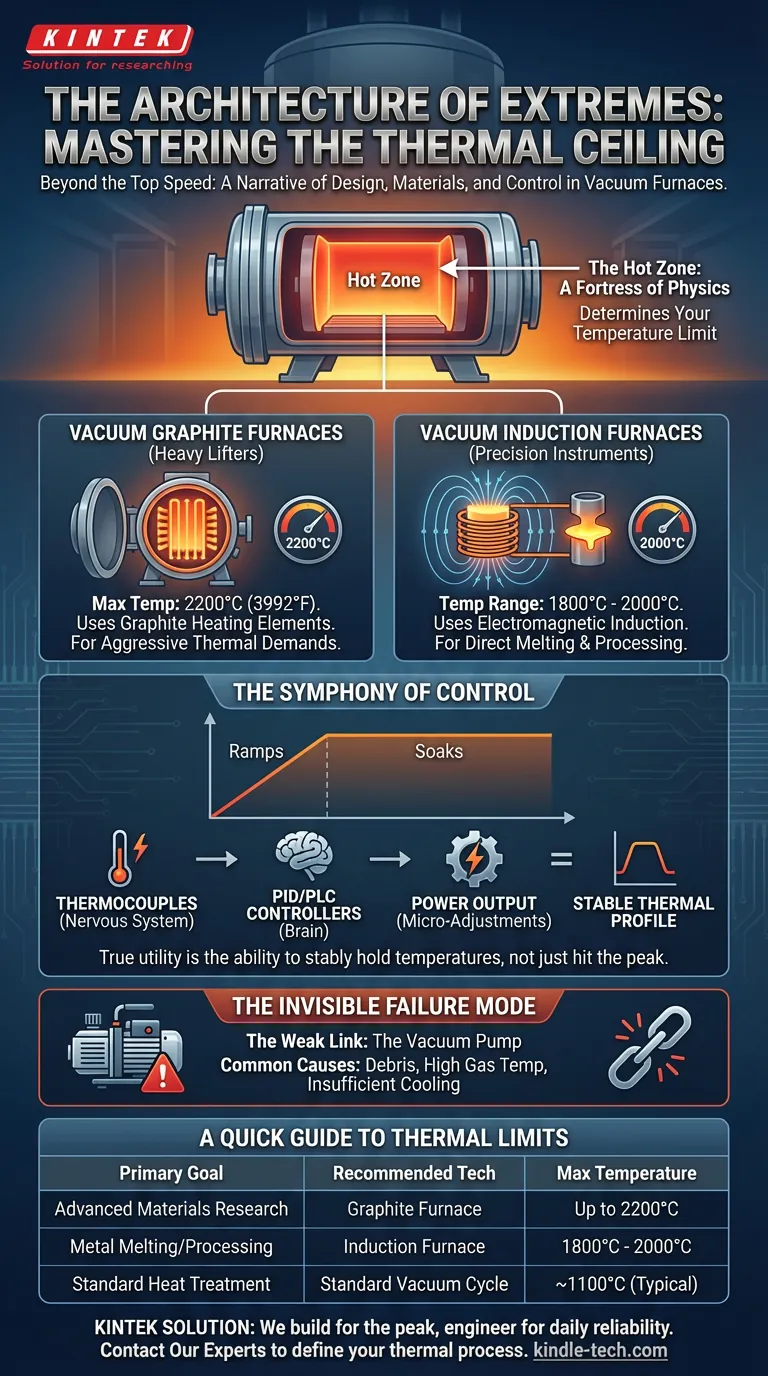
  • Vacuum Graphite Furnaces: These are the heavy lifters. Utilizing graphite heating elements, they are designed to withstand the most aggressive thermal demands, capable of reaching 2200°C (3992°F).
  • Vacuum Induction Furnaces: These systems use electromagnetic induction to heat conductive materials directly. They are precision instruments for melting, typically operating between 1800°C and 2000°C.

The Symphony of Control

However, raw power is useless without discipline.

Reaching 2200°C is an engineering feat, but holding a sample at exactly 1100°C for 60 minutes with less than a degree of variance is an operational triumph.

The true utility of a vacuum furnace isn't the peak temperature; it is the thermal profile.

Most research does not require a continuous blast of maximum heat. It requires a choreography of "ramps" (heating up) and "soaks" (holding steady). This is managed by:

  1. Thermocouples: The nervous system of the furnace, constantly sensing the environment.
  2. PID/PLC Controllers: The brain, making micro-adjustments to power output to ensure the reality matches the programmed curve.

If you have a furnace that can hit 2000°C but cannot stably hold 800°C, you do not have a scientific instrument. You have an expensive toaster.

The Invisible Failure Mode

In complex systems, the thing that breaks is rarely the most expensive component. It is usually the supporting cast.

Atul Gawande often writes about how failure in surgery isn't always about the surgeon's hands, but about the checklist. In vacuum furnaces, the "checklist" failure is almost always the vacuum pump.

The furnace chamber might be happily sitting at 2000°C, but if the pump system overheats, the process dies.

Common causes of pump failure include:

  • Debris: Particulate matter sucked from the chamber.
  • Gas Temperature: Removing gas that is too hot for the pump to handle.
  • Cooling Water: Insufficient flow leading to high oil temperatures.

The limit of your furnace is often not the graphite in the hot zone, but the oil in the pump.

Choosing Your Constraint

Engineering is the art of choosing your constraints. When selecting a vacuum furnace, you are choosing which variables matter most for your specific application.

Are you pushing the boundaries of material science? Or are you looking for repeatability in metal processing?

A Quick Guide to Thermal Limits

Primary Goal Recommended Tech Max Temperature
Advanced Materials Research Graphite Furnace Up to 2200°C
Metal Melting/Processing Induction Furnace 1800°C - 2000°C
Standard Heat Treatment Standard Vacuum Cycle ~1100°C (Typical)

The KINTEK Solution

At KINTEK, we understand that you aren't just buying a box that gets hot. You are buying a solution to a specific physics problem.

Whether you need the brute force of a graphite system to test new ceramics or the electromagnetic precision of an induction furnace for alloy development, our equipment is designed with both the hot zone and the control systems in mind.

We build for the peak temperature, but we engineer for the daily reliability of the pumps and controllers that make that temperature possible.

Ready to define your thermal process?

Contact Our Experts to discuss your specific temperature requirements and find the furnace architecture that fits your lab.

Visual Guide
The Architecture of Extremes: Mastering the Thermal Ceiling Visual Guide

Related Products

Related Articles

Related Products

Molybdenum Vacuum Heat Treat Furnace

Molybdenum Vacuum Heat Treat Furnace

Discover the benefits of a high-configuration molybdenum vacuum furnace with heat shield insulation. Ideal for high-purity, vacuum environments like sapphire crystal growth and heat treatment.

Vacuum Heat Treat Sintering Brazing Furnace

Vacuum Heat Treat Sintering Brazing Furnace

A vacuum brazing furnace is a type of industrial furnace used for brazing, a metalworking process that joins two pieces of metal using a filler metal that melts at a lower temperature than the base metals. Vacuum brazing furnaces are typically used for high-quality applications where a strong, clean joint is required.

Vacuum Heat Treat and Molybdenum Wire Sintering Furnace for Vacuum Sintering

Vacuum Heat Treat and Molybdenum Wire Sintering Furnace for Vacuum Sintering

A vacuum molybdenum wire sintering furnace is a vertical or bedroom structure, which is suitable for withdrawal, brazing, sintering and degassing of metal materials under high vacuum and high temperature conditions. It is also suitable for dehydroxylation treatment of quartz materials.

1400℃ Controlled Atmosphere Furnace with Nitrogen and Inert Atmosphere

1400℃ Controlled Atmosphere Furnace with Nitrogen and Inert Atmosphere

Achieve precise heat treatment with KT-14A controlled atmosphere furnace. Vacuum sealed with a smart controller, it's ideal for lab and industrial use up to 1400℃.

Vacuum Hot Press Furnace Heated Vacuum Press Machine Tube Furnace

Vacuum Hot Press Furnace Heated Vacuum Press Machine Tube Furnace

Reduce forming pressure & shorten sintering time with Vacuum Tube Hot Press Furnace for high-density, fine-grain materials. Ideal for refractory metals.

2200 ℃ Tungsten Vacuum Heat Treat and Sintering Furnace

2200 ℃ Tungsten Vacuum Heat Treat and Sintering Furnace

Experience the ultimate refractory metal furnace with our Tungsten vacuum furnace. Capable of reaching 2200℃, perfect for sintering advanced ceramics and refractory metals. Order now for high-quality results.

Graphite Vacuum Furnace Bottom Discharge Graphitization Furnace for Carbon Materials

Graphite Vacuum Furnace Bottom Discharge Graphitization Furnace for Carbon Materials

Bottom-out graphitization furnace for carbon materials, ultra-high temperature furnace up to 3100°C, suitable for graphitization and sintering of carbon rods and carbon blocks. Vertical design, bottom discharging, convenient feeding and discharging, high temperature uniformity, low energy consumption, good stability, hydraulic lifting system, convenient loading and unloading.

2200 ℃ Graphite Vacuum Heat Treat Furnace

2200 ℃ Graphite Vacuum Heat Treat Furnace

Discover the power of the KT-VG Graphite Vacuum Furnace - with a maximum working temperature of 2200℃, it's perfect for vacuum sintering of various materials. Learn more now.

Vacuum Hot Press Furnace Machine Heated Vacuum Press

Vacuum Hot Press Furnace Machine Heated Vacuum Press

Discover the advantages of Vacuum Hot Press Furnace! Manufacture dense refractory metals & compounds, ceramics, and composites under high temp and pressure.

Vacuum Heat Treat Furnace with Ceramic Fiber Liner

Vacuum Heat Treat Furnace with Ceramic Fiber Liner

Vacuum furnace with polycrystalline ceramic fiber insulation liner for excellent heat insulation and uniform temperature field. Choose from 1200℃ or 1700℃ max. working temperature with high vacuum performance and precise temperature control.

1800℃ Muffle Oven Furnace for Laboratory

1800℃ Muffle Oven Furnace for Laboratory

KT-18 muffle furnace with Japan Al2O3 polycrystalline fibe and Silicon Molybdenum heating element, up to 1900℃, PID temperature control and 7" smart touch screen. Compact design, low heat loss, and high energy efficiency. Safety interlock system and versatile functions.

600T Vacuum Induction Hot Press Furnace for Heat Treat and Sintering

600T Vacuum Induction Hot Press Furnace for Heat Treat and Sintering

Discover the 600T Vacuum Induction Hot Press Furnace, designed for high-temperature sintering experiments in vacuum or protected atmospheres. Its precise temperature and pressure control, adjustable working pressure, and advanced safety features make it ideal for nonmetal materials, carbon composites, ceramics, and metal powders.

Horizontal High Temperature Graphite Vacuum Graphitization Furnace

Horizontal High Temperature Graphite Vacuum Graphitization Furnace

Horizontal Graphitization Furnace: This type of furnace is designed with the heating elements placed horizontally, allowing for uniform heating of the sample. It's well-suited for graphitizing large or bulky samples that require precise temperature control and uniformity.

Graphite Vacuum Furnace High Thermal Conductivity Film Graphitization Furnace

Graphite Vacuum Furnace High Thermal Conductivity Film Graphitization Furnace

The high thermal conductivity film graphitization furnace has uniform temperature, low energy consumption and can operate continuously.

Vertical High Temperature Graphite Vacuum Graphitization Furnace

Vertical High Temperature Graphite Vacuum Graphitization Furnace

Vertical high temperature graphitization furnace for carbonization and graphitization of carbon materials up to 3100℃.Suitable for shaped graphitization of carbon fiber filaments and other materials sintered in a carbon environment.Applications in metallurgy, electronics, and aerospace for producing high-quality graphite products like electrodes and crucibles.

Vacuum Heat Treat and Sintering Furnace with 9MPa Air Pressure

Vacuum Heat Treat and Sintering Furnace with 9MPa Air Pressure

The air pressure sintering furnace is a high-tech equipment commonly used for the sintering of advanced ceramic materials. It combines vacuum sintering and pressure sintering techniques to achieve high-density and high-strength ceramics.

Vacuum Dental Porcelain Sintering Furnace

Vacuum Dental Porcelain Sintering Furnace

Get precise and reliable results with KinTek's Vacuum Porcelain Furnace. Suitable for all porcelain powders, it features hyperbolic ceramic furnace function, voice prompt, and automatic temperature calibration.

Small Vacuum Heat Treat and Tungsten Wire Sintering Furnace

Small Vacuum Heat Treat and Tungsten Wire Sintering Furnace

The small vacuum tungsten wire sintering furnace is a compact experimental vacuum furnace specially designed for universities and scientific research institutes. The furnace features a CNC welded shell and vacuum piping to ensure leak-free operation. Quick-connect electrical connections facilitate relocation and debugging, and the standard electrical control cabinet is safe and convenient to operate.

Ultra-High Temperature Graphite Vacuum Graphitization Furnace

Ultra-High Temperature Graphite Vacuum Graphitization Furnace

The ultra-high temperature graphitization furnace utilizes medium frequency induction heating in a vacuum or inert gas environment. The induction coil generates an alternating magnetic field, inducing eddy currents in the graphite crucible, which heats up and radiates heat to the workpiece, bringing it to the desired temperature. This furnace is primarily used for graphitization and sintering of carbon materials, carbon fiber materials, and other composite materials.

Laboratory Vacuum Tilt Rotary Tube Furnace Rotating Tube Furnace

Laboratory Vacuum Tilt Rotary Tube Furnace Rotating Tube Furnace

Discover the versatility of Laboratory Rotary Furnace: Ideal for calcination, drying, sintering, and high-temperature reactions. Adjustable rotating and tilting functions for optimal heating. Suitable for vacuum and controlled atmosphere environments. Learn more now!


Leave Your Message



















