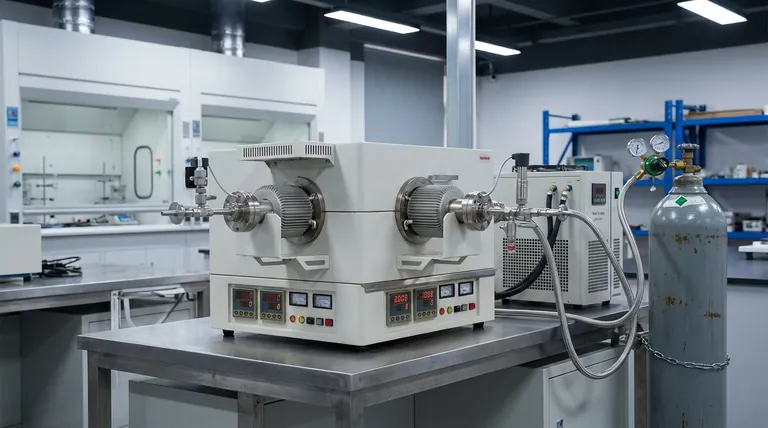
Blog The Thermodynamics of Silence: How Inert Gas Breaks the Vacuum Barrier
The Thermodynamics of Silence: How Inert Gas Breaks the Vacuum Barrier

The Thermodynamics of Silence: How Inert Gas Breaks the Vacuum Barrier

1 week ago

The Paradox of the Thermos

There is a fundamental contradiction in high-temperature processing.

To protect advanced materials, we heat them in a vacuum. By removing air, we remove oxygen, ensuring the metal doesn't burn or tarnish. We create a perfect, silent void.

But a vacuum is also the world’s best insulator. It is a thermos bottle. It is designed to keep heat in.

This creates a physics problem. Once your cycle is finished and your alloy has reached 1,200°C, how do you cool it down?

If you rely on thermal radiation—simply waiting for the heat to drift away in the void—the process is agonizingly slow. It is also uneven. The edges cool while the core stays molten. For sensitive metallurgy, this variance is catastrophic.

To solve this, engineers have to break the vacuum without breaking the chemistry.

They use Inert Gas Technology.

The Conveyor Belt for Heat

We often think of inert gases (like Argon or Nitrogen) merely as shields—a protective blanket to stop oxidation.

But in a modern quenching furnace, the gas is not a shield. It is a vehicle.

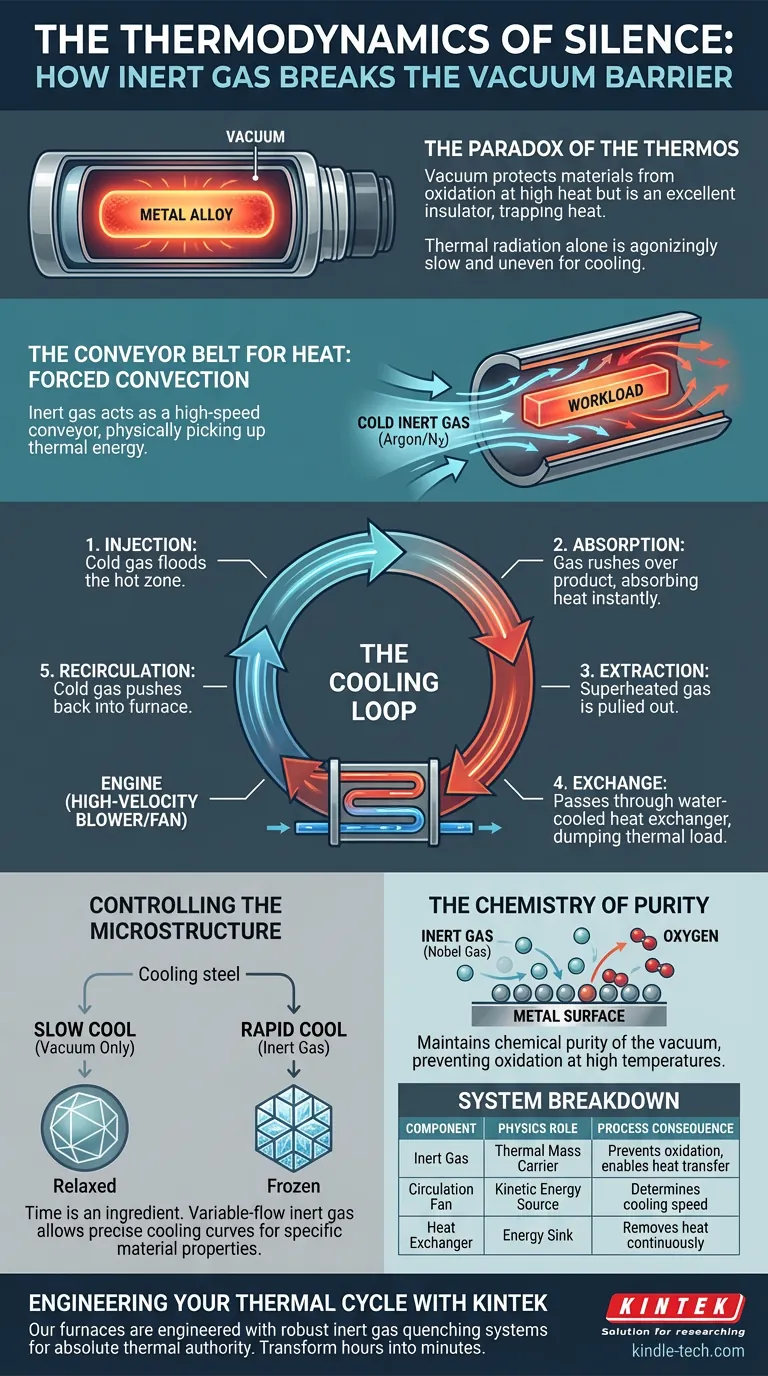
The system works on the principle of Forced Convection. Because a vacuum cannot conduct heat, we introduce a medium that can. The gas acts as a high-speed conveyor belt, physically picking up thermal energy from the workload and carrying it away.

The Cooling Loop

The architecture of this system is circular and aggressive. It relies on three mechanical pillars:

  1. The Medium: High-purity gas enters the chamber. It does not react with the metal; it only touches it.
  2. The Engine: A high-velocity blower or fan drives the gas.
  3. The Sink: A water-cooled heat exchanger strips the energy from the gas.

The cycle happens in seconds:

  • Injection: Cold gas floods the hot zone.
  • Absorption: The gas rushes over the refractory material and the product, absorbing heat instantly.
  • Extraction: The now-superheated gas is pulled out of the chamber.
  • Exchange: It passes through the heat exchanger, dumping its thermal load into cooling water.
  • Recirculation: The gas, now cold again, is pushed back into the furnace to repeat the job.

Controlling the Microstructure

Why go to this trouble? Why is "fast" better than "slow"?

In metallurgy, time is an ingredient.

The physical properties of an alloy—its hardness, its ductility, its strength—are often locked in during the cooling phase. This is known as quenching.

If you cool steel slowly, the crystalline structure relaxes. It becomes soft. If you cool it rapidly, you freeze the structure in a specific state, making it hard.

A vacuum furnace without inert gas cooling is a blunt instrument. It can only heat. It cannot control the descent.

With a variable-flow inert gas system, an operator can dial in the exact cooling curve required by the recipe. You are no longer waiting for physics to happen; you are commanding it.

The Chemistry of Purity

There is a second, equally critical reason for this closed-loop system: Oxidation.

At high temperatures, metals are chemically desperate to bond with oxygen. Even a trace amount of air introduced during cooling would instantly ruin a batch of titanium or aerospace superalloys.

By using noble gases like Argon, we maintain the chemical purity of the vacuum while gaining the thermal conductivity of a fluid.

System Breakdown

Here is how the components translate to process outcomes:

Component Physics Role Process Consequence
Inert Gas (Argon/N2) Thermal Mass Carrier Prevents oxidation; enables heat transfer in a void.
Circulation Fan Kinetic Energy Source Determines the speed of cooling (Quench Rate).
Heat Exchanger Energy Sink Removes heat from the system continuously.

Active vs. Passive Systems

It is important to distinguish this from the furnace's heating control.

The heating elements maintain a "soak" temperature. They pulse on and off to keep the line flat. That is maintenance.

Inert gas cooling is active intervention. It requires heavy hardware—massive fans, complex plumbing, and heat exchangers. It adds cost and complexity.

However, it transforms the furnace from a simple oven into a precision metallurgical instrument. It allows you to turn hours of cooling time into minutes, doubling or tripling production throughput while hitting material specs that passive cooling simply cannot achieve.

Engineering Your Thermal Cycle

The choice to implement inert gas technology is rarely a choice of preference; it is a choice dictated by the physics of your material.

If you need speed, you need gas. If you need specific hardness, you need controlled flow. If you need purity, you need a sealed loop.

At KINTEK, we understand that the cooling phase is just as critical as the heating phase. Our high-temperature vacuum furnaces are engineered with robust inert gas quenching systems designed to give you absolute authority over the thermal environment.

Whether you are developing new alloys or scaling up production, Contact Our Experts to discuss how we can refine your thermal processing strategy.

Visual Guide
The Thermodynamics of Silence: How Inert Gas Breaks the Vacuum Barrier Visual Guide

Related Products

Related Articles

Related Products

High Pressure Laboratory Vacuum Tube Furnace Quartz Tubular Furnace

High Pressure Laboratory Vacuum Tube Furnace Quartz Tubular Furnace

KT-PTF High Pressure Tube Furnace: Compact split tube furnace with strong positive pressure resistance. Working temp up to 1100°C and pressure up to 15Mpa. Also works under controller atmosphere or high vacuum.

Laboratory Rapid Thermal Processing (RTP) Quartz Tube Furnace

Laboratory Rapid Thermal Processing (RTP) Quartz Tube Furnace

Get lightning-fast heating with our RTP Rapid Heating Tube Furnace. Designed for precise, high-speed heating and cooling with convenient sliding rail and TFT touch screen controller. Order now for ideal thermal processing!

Vacuum Heat Treat and Molybdenum Wire Sintering Furnace for Vacuum Sintering

Vacuum Heat Treat and Molybdenum Wire Sintering Furnace for Vacuum Sintering

A vacuum molybdenum wire sintering furnace is a vertical or bedroom structure, which is suitable for withdrawal, brazing, sintering and degassing of metal materials under high vacuum and high temperature conditions. It is also suitable for dehydroxylation treatment of quartz materials.

Vacuum Hot Press Furnace Heated Vacuum Press Machine Tube Furnace

Vacuum Hot Press Furnace Heated Vacuum Press Machine Tube Furnace

Reduce forming pressure & shorten sintering time with Vacuum Tube Hot Press Furnace for high-density, fine-grain materials. Ideal for refractory metals.

1700℃ Laboratory High Temperature Tube Furnace with Alumina Tube

1700℃ Laboratory High Temperature Tube Furnace with Alumina Tube

Looking for a high-temperature tube furnace? Check out our 1700℃ Tube Furnace with Alumina Tube. Perfect for research and industrial applications up to 1700C.

Vacuum Heat Treat Sintering Brazing Furnace

Vacuum Heat Treat Sintering Brazing Furnace

A vacuum brazing furnace is a type of industrial furnace used for brazing, a metalworking process that joins two pieces of metal using a filler metal that melts at a lower temperature than the base metals. Vacuum brazing furnaces are typically used for high-quality applications where a strong, clean joint is required.

2200 ℃ Tungsten Vacuum Heat Treat and Sintering Furnace

2200 ℃ Tungsten Vacuum Heat Treat and Sintering Furnace

Experience the ultimate refractory metal furnace with our Tungsten vacuum furnace. Capable of reaching 2200℃, perfect for sintering advanced ceramics and refractory metals. Order now for high-quality results.

600T Vacuum Induction Hot Press Furnace for Heat Treat and Sintering

600T Vacuum Induction Hot Press Furnace for Heat Treat and Sintering

Discover the 600T Vacuum Induction Hot Press Furnace, designed for high-temperature sintering experiments in vacuum or protected atmospheres. Its precise temperature and pressure control, adjustable working pressure, and advanced safety features make it ideal for nonmetal materials, carbon composites, ceramics, and metal powders.

Graphite Vacuum Furnace IGBT Experimental Graphitization Furnace

Graphite Vacuum Furnace IGBT Experimental Graphitization Furnace

IGBT experimental graphitization furnace, a tailored solution for universities and research institutions, with high heating efficiency, user-friendliness, and precise temperature control.

1400℃ Laboratory High Temperature Tube Furnace with Alumina Tube

1400℃ Laboratory High Temperature Tube Furnace with Alumina Tube

Looking for a tube furnace for high-temperature applications? Our 1400℃ Tube Furnace with Alumina Tube is perfect for research and industrial use.

1200℃ Split Tube Furnace with Quartz Tube Laboratory Tubular Furnace

1200℃ Split Tube Furnace with Quartz Tube Laboratory Tubular Furnace

KT-TF12 split tube furnace: high-purity insulation, embedded heating wire coils, and max. 1200C. Widely used for new materials and chemical vapour deposition.

Vacuum Hot Press Furnace Machine Heated Vacuum Press

Vacuum Hot Press Furnace Machine Heated Vacuum Press

Discover the advantages of Vacuum Hot Press Furnace! Manufacture dense refractory metals & compounds, ceramics, and composites under high temp and pressure.

Horizontal High Temperature Graphite Vacuum Graphitization Furnace

Horizontal High Temperature Graphite Vacuum Graphitization Furnace

Horizontal Graphitization Furnace: This type of furnace is designed with the heating elements placed horizontally, allowing for uniform heating of the sample. It's well-suited for graphitizing large or bulky samples that require precise temperature control and uniformity.

Ultra-High Temperature Graphite Vacuum Graphitization Furnace

Ultra-High Temperature Graphite Vacuum Graphitization Furnace

The ultra-high temperature graphitization furnace utilizes medium frequency induction heating in a vacuum or inert gas environment. The induction coil generates an alternating magnetic field, inducing eddy currents in the graphite crucible, which heats up and radiates heat to the workpiece, bringing it to the desired temperature. This furnace is primarily used for graphitization and sintering of carbon materials, carbon fiber materials, and other composite materials.

Vertical High Temperature Graphite Vacuum Graphitization Furnace

Vertical High Temperature Graphite Vacuum Graphitization Furnace

Vertical high temperature graphitization furnace for carbonization and graphitization of carbon materials up to 3100℃.Suitable for shaped graphitization of carbon fiber filaments and other materials sintered in a carbon environment.Applications in metallurgy, electronics, and aerospace for producing high-quality graphite products like electrodes and crucibles.

Laboratory Muffle Oven Furnace Bottom Lifting Muffle Furnace

Laboratory Muffle Oven Furnace Bottom Lifting Muffle Furnace

Efficiently produce batches with excellent temperature uniformity using our Bottom Lifting Furnace. Features two electric lifting stages and advanced temperature control up to 1600℃.

Vacuum Heat Treat and Sintering Furnace with 9MPa Air Pressure

Vacuum Heat Treat and Sintering Furnace with 9MPa Air Pressure

The air pressure sintering furnace is a high-tech equipment commonly used for the sintering of advanced ceramic materials. It combines vacuum sintering and pressure sintering techniques to achieve high-density and high-strength ceramics.

1700℃ Muffle Oven Furnace for Laboratory

1700℃ Muffle Oven Furnace for Laboratory

Get superior heat control with our 1700℃ Muffle Furnace. Equipped with intelligent temperature microprocessor, TFT touch screen controller & advanced insulation materials for precise heating up to 1700C. Order now!

1800℃ Muffle Oven Furnace for Laboratory

1800℃ Muffle Oven Furnace for Laboratory

KT-18 muffle furnace with Japan Al2O3 polycrystalline fibe and Silicon Molybdenum heating element, up to 1900℃, PID temperature control and 7" smart touch screen. Compact design, low heat loss, and high energy efficiency. Safety interlock system and versatile functions.

Vacuum Dental Porcelain Sintering Furnace

Vacuum Dental Porcelain Sintering Furnace

Get precise and reliable results with KinTek's Vacuum Porcelain Furnace. Suitable for all porcelain powders, it features hyperbolic ceramic furnace function, voice prompt, and automatic temperature calibration.


Leave Your Message



















