Blog The Architecture of Emptiness: How Vacuum Tube Furnaces Defy Entropy
The Architecture of Emptiness: How Vacuum Tube Furnaces Defy Entropy

The Architecture of Emptiness: How Vacuum Tube Furnaces Defy Entropy

2 weeks ago

The Battle Against the Atmosphere

Nature hates purity.

If you leave a piece of iron out, it rusts. If you heat a delicate alloy in the open air, it oxidizes. The atmosphere is a chaotic soup of nitrogen, oxygen, and moisture, all waiting to corrupt your material at the molecular level.

For the materials scientist, oxygen isn't life. It is noise. It is the variable that ruins the experiment.

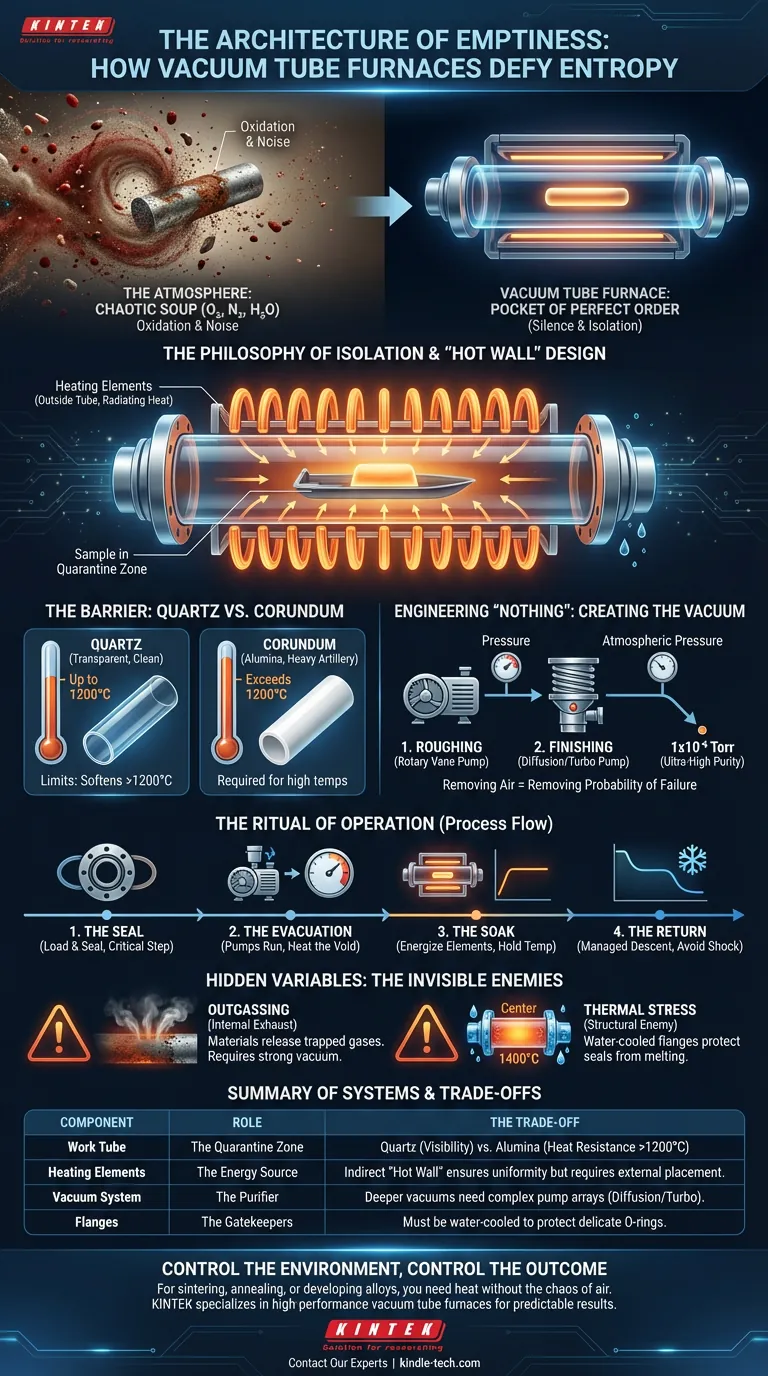
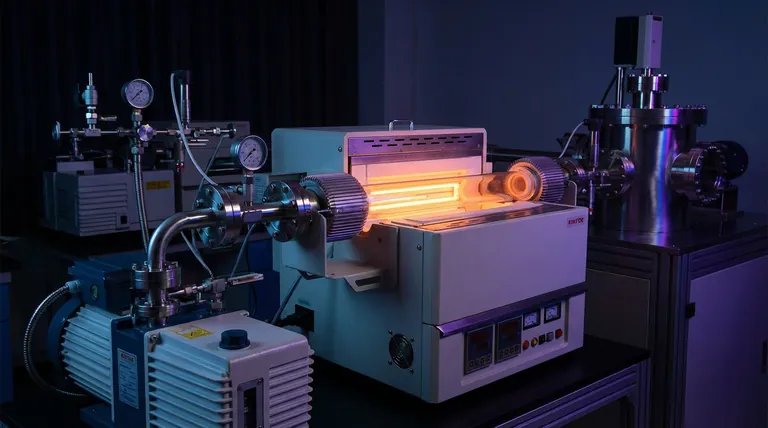
The vacuum tube furnace is the engineer’s answer to this chaos. It is a machine designed to create a pocket of perfect order—a silence amidst the noise—where materials can be processed without the interference of the outside world.

The Philosophy of Isolation

The operation of a vacuum tube furnace is less about heating and more about isolation.

In surgery, a sterile field prevents microbes from entering the wound. In material science, the work tube prevents atmospheric gases from entering the reaction.

The concept is elegant in its simplicity but complex in its execution. The furnace operates on a "hot wall" design. The heating elements never touch your sample. They sit outside the tube, radiating heat inward.

Inside the tube, your sample sits in a quarantine zone.

The Barrier: Quartz vs. Corundum

The integrity of this quarantine depends entirely on the material of the tube itself.

  • Quartz: Used for temperatures up to 1200°C. It is transparent and clean, but it has limits.
  • Corundum (Alumina): The heavy artillery. Required for temperatures exceeding 1200°C, where quartz would soften and fail.

The Vacuum: Engineering "Nothing"

Creating a vacuum is not just about sucking air out. It is about chemically isolating the sample.

When the system activates, it connects to a flange on the tube's end. The goal is to lower the pressure so significantly that the remaining gas molecules are too few to react with your material.

This usually happens in stages:

  1. Roughing: A rotary vane pump clears the bulk of the air.
  2. Finishing: For ultra-high purity, a high-speed diffusion pump takes over, driving the pressure down to levels like 1x10⁻⁶ Torr.

At this level, you aren't just removing air; you are removing the probability of failure.

The Ritual of Operation

Successful operation follows a script that balances thermodynamics with patience. It is a checklist designed to ensure safety and precision.

1. The Seal

The process begins at the flanges. The sample is loaded, and the ends are sealed. This is the most critical mechanical step. If the seal is imperfect, the vacuum is a fantasy.

2. The Evacuation

Before a single degree of heat is applied, the pumps run. We wait. We watch the vacuum gauge. We do not heat air; we heat the void.

3. The Soak

Once the vacuum is established, the heating elements energize. The heat penetrates the tube wall and radiates into the sample. The controller holds the temperature—the "soak"—allowing the chemical changes to settle.

4. The Return

Cooling is not passive. It is a managed descent. Sudden changes in temperature can shock the material or crack the tube.

The Hidden Variables

The best systems account for what you don't see.

Outgassing is the invisible enemy. As materials heat up, they release trapped gases from their own surfaces. A weak vacuum system will be overwhelmed by this internal exhaust, ruining the purity of the environment.

Thermal Stress is the structural enemy. The center of the tube may be 1400°C, but the ends—where the rubber seals are—must remain cool. If the flanges get too hot, the seals melt, and the atmosphere rushes in.

This is why water-cooled flanges are not a luxury; they are a necessity for the survival of the system.

Summary of Systems

Understanding the trade-offs is key to selecting the right equipment.

Component Role The Trade-off
Work Tube The quarantine zone Quartz offers visibility; Alumina offers heat resistance (>1200°C).
Heating Elements The energy source Indirect heating ensures uniformity but requires a "hot wall" architecture.
Vacuum System The purifier Deeper vacuums require complex pump arrays (diffusion/turbomolecular).
Flanges The gatekeepers Must be water-cooled to protect delicate O-rings from the furnace's heat.

Control the Environment, Control the Outcome

We build these machines because we crave predictability. In a world governed by entropy, a vacuum tube furnace is a fortress of control.

Whether you are sintering advanced ceramics, annealing semiconductors, or developing new alloys, the requirement is the same: You need heat without the chaos of air.

At KINTEK, we understand that your research depends on this silence. We specialize in high-performance vacuum tube furnaces designed to handle the rigors of outgassing and the stress of extreme temperatures.

Do not let the atmosphere dictate your results.

Contact Our Experts

Visual Guide

The Architecture of Emptiness: How Vacuum Tube Furnaces Defy Entropy Visual Guide

Related Products

Related Articles

Related Products

Laboratory High Pressure Vacuum Tube Furnace

Laboratory High Pressure Vacuum Tube Furnace

KT-PTF High Pressure Tube Furnace: Compact split tube furnace with strong positive pressure resistance. Working temp up to 1100°C and pressure up to 15Mpa. Also works under controller atmosphere or high vacuum.

1700℃ Laboratory High Temperature Tube Furnace with Alumina Tube

1700℃ Laboratory High Temperature Tube Furnace with Alumina Tube

Looking for a high-temperature tube furnace? Check out our 1700℃ Tube Furnace with Alumina Tube. Perfect for research and industrial applications up to 1700C.

2200 ℃ Graphite Vacuum Heat Treat Furnace

2200 ℃ Graphite Vacuum Heat Treat Furnace

Discover the power of the KT-VG Graphite Vacuum Furnace - with a maximum working temperature of 2200℃, it's perfect for vacuum sintering of various materials. Learn more now.

Laboratory Rapid Thermal Processing (RTP) Quartz Tube Furnace

Laboratory Rapid Thermal Processing (RTP) Quartz Tube Furnace

Get lightning-fast heating with our RTP Rapid Heating Tube Furnace. Designed for precise, high-speed heating and cooling with convenient sliding rail and TFT touch screen controller. Order now for ideal thermal processing!

Vacuum Heat Treat and Molybdenum Wire Sintering Furnace for Vacuum Sintering

Vacuum Heat Treat and Molybdenum Wire Sintering Furnace for Vacuum Sintering

A vacuum molybdenum wire sintering furnace is a vertical or bedroom structure, which is suitable for withdrawal, brazing, sintering and degassing of metal materials under high vacuum and high temperature conditions. It is also suitable for dehydroxylation treatment of quartz materials.

Molybdenum Vacuum Heat Treat Furnace

Molybdenum Vacuum Heat Treat Furnace

Discover the benefits of a high-configuration molybdenum vacuum furnace with heat shield insulation. Ideal for high-purity, vacuum environments like sapphire crystal growth and heat treatment.

2200 ℃ Tungsten Vacuum Heat Treat and Sintering Furnace

2200 ℃ Tungsten Vacuum Heat Treat and Sintering Furnace

Experience the ultimate refractory metal furnace with our Tungsten vacuum furnace. Capable of reaching 2200℃, perfect for sintering advanced ceramics and refractory metals. Order now for high-quality results.

Multi Heating Zones CVD Tube Furnace Machine Chemical Vapor Deposition Chamber System Equipment

Multi Heating Zones CVD Tube Furnace Machine Chemical Vapor Deposition Chamber System Equipment

KT-CTF14 Multi Heating Zones CVD Furnace - Precise Temperature Control and Gas Flow for Advanced Applications. Max temp up to 1200℃, 4 channels MFC mass flow meter, and 7" TFT touch screen controller.

Vacuum Heat Treat Sintering Brazing Furnace

Vacuum Heat Treat Sintering Brazing Furnace

A vacuum brazing furnace is a type of industrial furnace used for brazing, a metalworking process that joins two pieces of metal using a filler metal that melts at a lower temperature than the base metals. Vacuum brazing furnaces are typically used for high-quality applications where a strong, clean joint is required.

1200℃ Controlled Atmosphere Furnace Nitrogen Inert Atmosphere Furnace

1200℃ Controlled Atmosphere Furnace Nitrogen Inert Atmosphere Furnace

Discover our KT-12A Pro Controlled atmosphere furnace - high precision, heavy duty vacuum chamber, versatile smart touch screen controller, and excellent temperature uniformity up to 1200C. Ideal for both laboratory and industrial application.

Graphite Vacuum Furnace High Thermal Conductivity Film Graphitization Furnace

Graphite Vacuum Furnace High Thermal Conductivity Film Graphitization Furnace

The high thermal conductivity film graphitization furnace has uniform temperature, low energy consumption and can operate continuously.

Small Vacuum Heat Treat and Tungsten Wire Sintering Furnace

Small Vacuum Heat Treat and Tungsten Wire Sintering Furnace

The small vacuum tungsten wire sintering furnace is a compact experimental vacuum furnace specially designed for universities and scientific research institutes. The furnace features a CNC welded shell and vacuum piping to ensure leak-free operation. Quick-connect electrical connections facilitate relocation and debugging, and the standard electrical control cabinet is safe and convenient to operate.

Graphite Vacuum Furnace Bottom Discharge Graphitization Furnace for Carbon Materials

Graphite Vacuum Furnace Bottom Discharge Graphitization Furnace for Carbon Materials

Bottom-out graphitization furnace for carbon materials, ultra-high temperature furnace up to 3100°C, suitable for graphitization and sintering of carbon rods and carbon blocks. Vertical design, bottom discharging, convenient feeding and discharging, high temperature uniformity, low energy consumption, good stability, hydraulic lifting system, convenient loading and unloading.

1200℃ Split Tube Furnace with Quartz Tube Laboratory Tubular Furnace

1200℃ Split Tube Furnace with Quartz Tube Laboratory Tubular Furnace

KT-TF12 split tube furnace: high-purity insulation, embedded heating wire coils, and max. 1200C. Widely used for new materials and chemical vapour deposition.

Vacuum Hot Press Furnace Heated Vacuum Press Machine Tube Furnace

Vacuum Hot Press Furnace Heated Vacuum Press Machine Tube Furnace

Reduce forming pressure & shorten sintering time with Vacuum Tube Hot Press Furnace for high-density, fine-grain materials. Ideal for refractory metals.

Vacuum Heat Treat Furnace with Ceramic Fiber Liner

Vacuum Heat Treat Furnace with Ceramic Fiber Liner

Vacuum furnace with polycrystalline ceramic fiber insulation liner for excellent heat insulation and uniform temperature field. Choose from 1200℃ or 1700℃ max. working temperature with high vacuum performance and precise temperature control.

Vacuum Heat Treat and Sintering Furnace with 9MPa Air Pressure

Vacuum Heat Treat and Sintering Furnace with 9MPa Air Pressure

The air pressure sintering furnace is a high-tech equipment commonly used for the sintering of advanced ceramic materials. It combines vacuum sintering and pressure sintering techniques to achieve high-density and high-strength ceramics.

1800℃ Muffle Oven Furnace for Laboratory

1800℃ Muffle Oven Furnace for Laboratory

KT-18 muffle furnace with Japan Al2O3 polycrystalline fibe and Silicon Molybdenum heating element, up to 1900℃, PID temperature control and 7" smart touch screen. Compact design, low heat loss, and high energy efficiency. Safety interlock system and versatile functions.

Vacuum Dental Porcelain Sintering Furnace

Vacuum Dental Porcelain Sintering Furnace

Get precise and reliable results with KinTek's Vacuum Porcelain Furnace. Suitable for all porcelain powders, it features hyperbolic ceramic furnace function, voice prompt, and automatic temperature calibration.

Ultra-High Temperature Graphite Vacuum Graphitization Furnace

Ultra-High Temperature Graphite Vacuum Graphitization Furnace

The ultra-high temperature graphitization furnace utilizes medium frequency induction heating in a vacuum or inert gas environment. The induction coil generates an alternating magnetic field, inducing eddy currents in the graphite crucible, which heats up and radiates heat to the workpiece, bringing it to the desired temperature. This furnace is primarily used for graphitization and sintering of carbon materials, carbon fiber materials, and other composite materials.


Leave Your Message