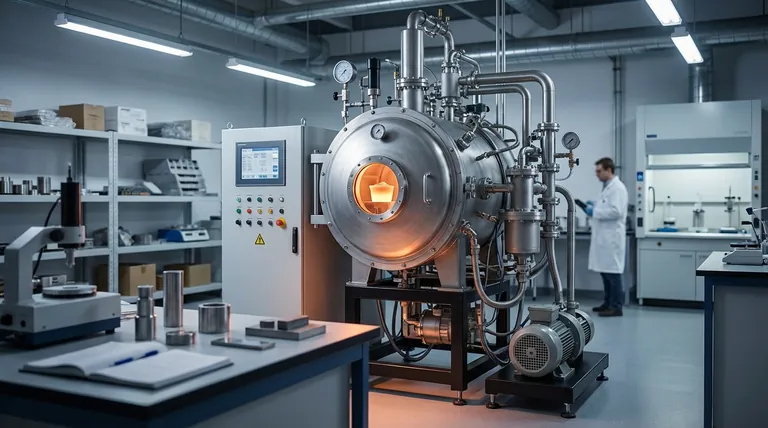
Blog The Architecture of Emptiness: Why the Void is the Ultimate Material Shield
The Architecture of Emptiness: Why the Void is the Ultimate Material Shield

The Architecture of Emptiness: Why the Void is the Ultimate Material Shield

2 weeks ago

The Invisible Variable

The most dangerous thing in your laboratory is invisible.

It surrounds your workbench, flows over your samples, and settles into the microscopic pores of your materials. It is the air itself.

In standard conditions, air is benign. But introduce high heat—the kind required for sintering, brazing, or heat treating—and the atmosphere becomes a chemical aggressor. Oxygen seeks to corrode. Nitrogen alters surface hardness. Water vapor introduces hydrogen embrittlement.

Material science is often a battle against these variables. The goal is to isolate the variables you can control from the chaos you cannot.

This is the engineering romance of the sealed vacuum furnace. It is not merely a machine that gets hot; it is a machine that constructs a fortress of "nothingness." Inside this void, we pause the laws of atmospheric chemistry, allowing materials to become their best selves without interference.

The Physics of "Nothing"

The fundamental advantage of a vacuum furnace is the removal of the atmosphere. But to understand the value, you have to understand the threat.

Normal air contains 78% nitrogen and 21% oxygen. At 1,000°C, these are not passive gases. They are reactants.

The Shield Against Oxidation

When you heat metal in air, it creates an oxide layer—a brittle, discolored skin that ruins conductivity and structural integrity.

A vacuum furnace removes the oxygen. The result is a part that emerges bright, clean, and chemically unaltered. It requires no acid baths, no sandblasting, and no secondary scrubbing.

The Purity Protocol (Degassing)

The vacuum does not just protect the outside of the material; it cleans the inside.

Metals often trap volatile gases and impurities within their crystalline structure. Under the extreme low pressure of a vacuum furnace, these trapped gases are forced out—a process called degassing.

The result is a material with higher density and superior purity than when it entered the chamber.

Convection vs. Radiation: The Geometry of Heat

In a standard oven, heat moves via convection. Air currents swirl around the part. This is chaotic. It relies on the flow of gas, which naturally creates hot spots and cold corners.

A vacuum has no air to move heat. Therefore, it relies on radiation.

Radiant heat travels in straight lines, like light. It is geometric and predictable. This allows for:

  • Unmatched Uniformity: The temperature difference across a workload can be maintained within a few degrees.
  • Precision: Regardless of the shape of the component, the heat transfer is governed by physics, not airflow.

The Investment in Certainty

In engineering, there is a difference between "price" and "cost."

The price of a vacuum furnace is high. It requires complex pumps, double-walled water-cooled chambers, and sophisticated seals. It is a heavy capital investment compared to an atmospheric box furnace.

But the cost of failure in mission-critical applications is higher.

If you are manufacturing aerospace turbine blades, medical implants, or semiconductors, you cannot afford "mostly good." You need absolute repeatability.

Automation as a Standard

Modern vacuum furnaces remove the human element. The cycle—pump down, ramp up, soak, and quench—is executed by a computer.

This guarantees that the batch you run today is metallurgically identical to the batch you ran six months ago. You are buying consistency.

The Trade-offs

A vacuum furnace is a specialized tool, not a universal hammer. It demands respect for its limitations:

  • Time: Creating a vacuum takes time. The "pump down" cycle adds minutes or hours to the process.
  • Vapor Pressure: Some metals, like zinc or magnesium, have high vapor pressures. In a deep vacuum, they don't just melt; they boil away and vanish.
  • Maintenance: A vacuum leak is a process failure. Seals and pumps require diligent care.

Decision Matrix: When to Choose the Void

You do not need a vacuum furnace to bake clay. You need it when the margin for error is zero.

If your priority is... The Vacuum Solution
Reactive Metals Essential for Titanium, Zirconium, and Superalloys that die in oxygen.
Mission-Criticality Required for aerospace and medical parts where fatigue life is paramount.
Joining (Brazing) Creates perfect surface wetting for high-integrity bonds.
Aesthetics Delivers bright, clean parts requiring no post-processing.

Engineering the Future

The vacuum furnace represents a shift in thinking. We stop trying to fight the atmosphere with fluxes and cover gases, and instead, we simply remove it.

At KINTEK, we understand that for high-stakes research and production, control is everything. Our equipment provides the precise, chemically pure environments necessary to push materials to their theoretical limits.

It is an investment in certainty.

Ready to master your material environment? Contact Our Experts to discuss how KINTEK vacuum solutions can bring precision to your laboratory.

Visual Guide
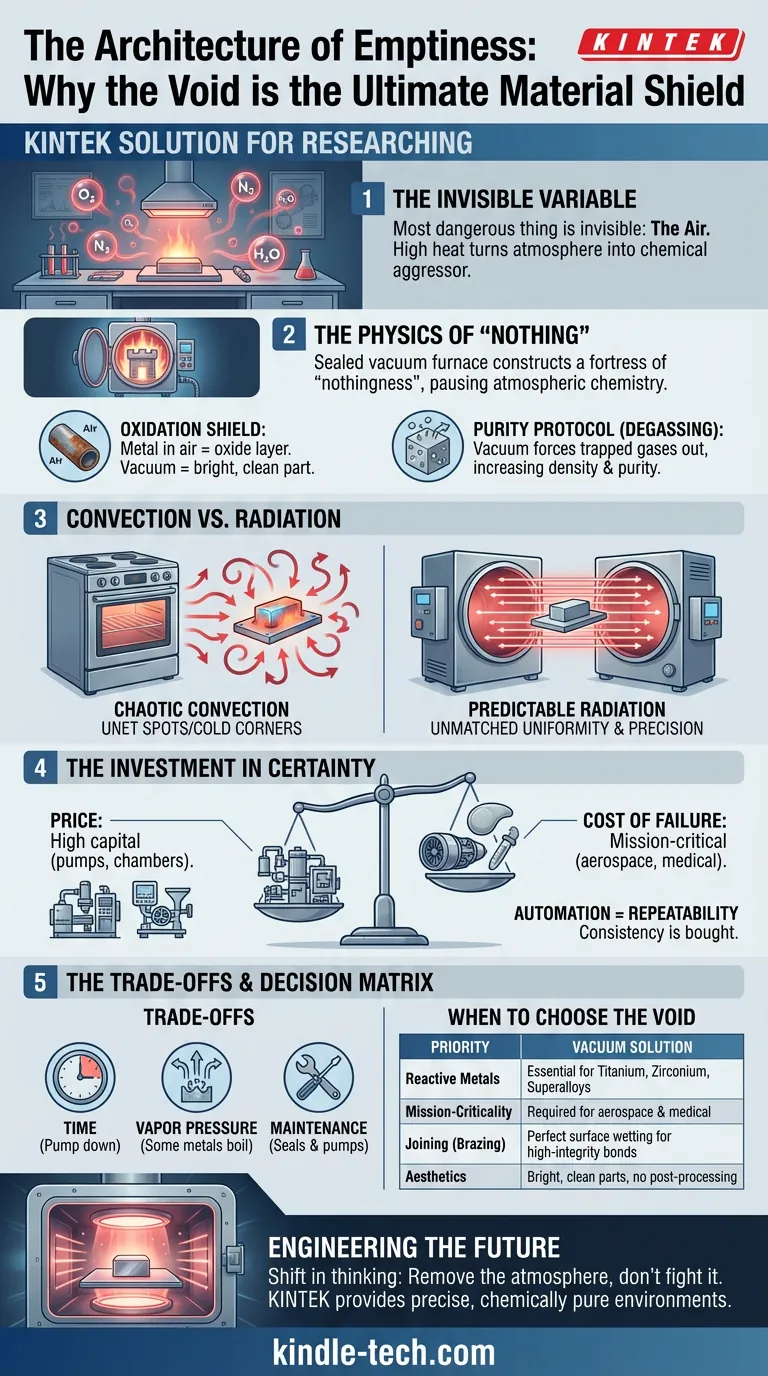
The Architecture of Emptiness: Why the Void is the Ultimate Material Shield Visual Guide

Related Products

Related Articles

Related Products

Small Vacuum Heat Treat and Tungsten Wire Sintering Furnace

Small Vacuum Heat Treat and Tungsten Wire Sintering Furnace

The small vacuum tungsten wire sintering furnace is a compact experimental vacuum furnace specially designed for universities and scientific research institutes. The furnace features a CNC welded shell and vacuum piping to ensure leak-free operation. Quick-connect electrical connections facilitate relocation and debugging, and the standard electrical control cabinet is safe and convenient to operate.

Graphite Vacuum Furnace IGBT Experimental Graphitization Furnace

Graphite Vacuum Furnace IGBT Experimental Graphitization Furnace

IGBT experimental graphitization furnace, a tailored solution for universities and research institutions, with high heating efficiency, user-friendliness, and precise temperature control.

Laboratory Rapid Thermal Processing (RTP) Quartz Tube Furnace

Laboratory Rapid Thermal Processing (RTP) Quartz Tube Furnace

Get lightning-fast heating with our RTP Rapid Heating Tube Furnace. Designed for precise, high-speed heating and cooling with convenient sliding rail and TFT touch screen controller. Order now for ideal thermal processing!

Molybdenum Vacuum Heat Treat Furnace

Molybdenum Vacuum Heat Treat Furnace

Discover the benefits of a high-configuration molybdenum vacuum furnace with heat shield insulation. Ideal for high-purity, vacuum environments like sapphire crystal growth and heat treatment.

Graphite Vacuum Furnace High Thermal Conductivity Film Graphitization Furnace

Graphite Vacuum Furnace High Thermal Conductivity Film Graphitization Furnace

The high thermal conductivity film graphitization furnace has uniform temperature, low energy consumption and can operate continuously.

Vacuum Heat Treat Sintering Brazing Furnace

Vacuum Heat Treat Sintering Brazing Furnace

A vacuum brazing furnace is a type of industrial furnace used for brazing, a metalworking process that joins two pieces of metal using a filler metal that melts at a lower temperature than the base metals. Vacuum brazing furnaces are typically used for high-quality applications where a strong, clean joint is required.

Vacuum Heat Treat Furnace with Ceramic Fiber Liner

Vacuum Heat Treat Furnace with Ceramic Fiber Liner

Vacuum furnace with polycrystalline ceramic fiber insulation liner for excellent heat insulation and uniform temperature field. Choose from 1200℃ or 1700℃ max. working temperature with high vacuum performance and precise temperature control.

Graphite Vacuum Furnace Bottom Discharge Graphitization Furnace for Carbon Materials

Graphite Vacuum Furnace Bottom Discharge Graphitization Furnace for Carbon Materials

Bottom-out graphitization furnace for carbon materials, ultra-high temperature furnace up to 3100°C, suitable for graphitization and sintering of carbon rods and carbon blocks. Vertical design, bottom discharging, convenient feeding and discharging, high temperature uniformity, low energy consumption, good stability, hydraulic lifting system, convenient loading and unloading.

2200 ℃ Tungsten Vacuum Heat Treat and Sintering Furnace

2200 ℃ Tungsten Vacuum Heat Treat and Sintering Furnace

Experience the ultimate refractory metal furnace with our Tungsten vacuum furnace. Capable of reaching 2200℃, perfect for sintering advanced ceramics and refractory metals. Order now for high-quality results.

2200 ℃ Graphite Vacuum Heat Treat Furnace

2200 ℃ Graphite Vacuum Heat Treat Furnace

Discover the power of the KT-VG Graphite Vacuum Furnace - with a maximum working temperature of 2200℃, it's perfect for vacuum sintering of various materials. Learn more now.

Laboratory Vacuum Tilt Rotary Tube Furnace Rotating Tube Furnace

Laboratory Vacuum Tilt Rotary Tube Furnace Rotating Tube Furnace

Discover the versatility of Laboratory Rotary Furnace: Ideal for calcination, drying, sintering, and high-temperature reactions. Adjustable rotating and tilting functions for optimal heating. Suitable for vacuum and controlled atmosphere environments. Learn more now!

Ultra-High Temperature Graphite Vacuum Graphitization Furnace

Ultra-High Temperature Graphite Vacuum Graphitization Furnace

The ultra-high temperature graphitization furnace utilizes medium frequency induction heating in a vacuum or inert gas environment. The induction coil generates an alternating magnetic field, inducing eddy currents in the graphite crucible, which heats up and radiates heat to the workpiece, bringing it to the desired temperature. This furnace is primarily used for graphitization and sintering of carbon materials, carbon fiber materials, and other composite materials.

Vacuum Dental Porcelain Sintering Furnace

Vacuum Dental Porcelain Sintering Furnace

Get precise and reliable results with KinTek's Vacuum Porcelain Furnace. Suitable for all porcelain powders, it features hyperbolic ceramic furnace function, voice prompt, and automatic temperature calibration.

Vacuum Heat Treat and Sintering Furnace with 9MPa Air Pressure

Vacuum Heat Treat and Sintering Furnace with 9MPa Air Pressure

The air pressure sintering furnace is a high-tech equipment commonly used for the sintering of advanced ceramic materials. It combines vacuum sintering and pressure sintering techniques to achieve high-density and high-strength ceramics.

Horizontal High Temperature Graphite Vacuum Graphitization Furnace

Horizontal High Temperature Graphite Vacuum Graphitization Furnace

Horizontal Graphitization Furnace: This type of furnace is designed with the heating elements placed horizontally, allowing for uniform heating of the sample. It's well-suited for graphitizing large or bulky samples that require precise temperature control and uniformity.

Vertical High Temperature Graphite Vacuum Graphitization Furnace

Vertical High Temperature Graphite Vacuum Graphitization Furnace

Vertical high temperature graphitization furnace for carbonization and graphitization of carbon materials up to 3100℃.Suitable for shaped graphitization of carbon fiber filaments and other materials sintered in a carbon environment.Applications in metallurgy, electronics, and aerospace for producing high-quality graphite products like electrodes and crucibles.

1400℃ Controlled Atmosphere Furnace with Nitrogen and Inert Atmosphere

1400℃ Controlled Atmosphere Furnace with Nitrogen and Inert Atmosphere

Achieve precise heat treatment with KT-14A controlled atmosphere furnace. Vacuum sealed with a smart controller, it's ideal for lab and industrial use up to 1400℃.

Graphite Vacuum Continuous Graphitization Furnace

Graphite Vacuum Continuous Graphitization Furnace

High-temperature graphitization furnace is a professional equipment for graphitization treatment of carbon materials. It is a key equipment for the production of high-quality graphite products. It has high temperature, high efficiency and uniform heating. It is suitable for various high-temperature treatments and graphitization treatments. It is widely used in metallurgy, electronics, aerospace, etc. industry.

1200℃ Controlled Atmosphere Furnace Nitrogen Inert Atmosphere Furnace

1200℃ Controlled Atmosphere Furnace Nitrogen Inert Atmosphere Furnace

Discover our KT-12A Pro Controlled atmosphere furnace - high precision, heavy duty vacuum chamber, versatile smart touch screen controller, and excellent temperature uniformity up to 1200C. Ideal for both laboratory and industrial application.

1200℃ Split Tube Furnace with Quartz Tube Laboratory Tubular Furnace

1200℃ Split Tube Furnace with Quartz Tube Laboratory Tubular Furnace

KT-TF12 split tube furnace: high-purity insulation, embedded heating wire coils, and max. 1200C. Widely used for new materials and chemical vapour deposition.


Leave Your Message



















