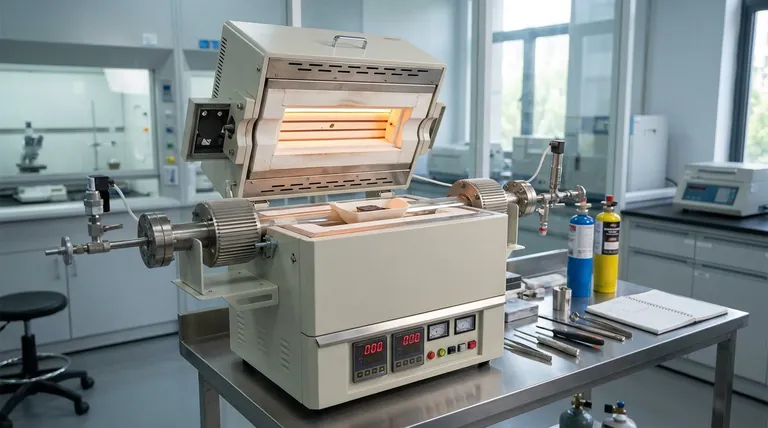
The Struggle Against Entropy
In the laboratory, the enemy is rarely a lack of ideas. The enemy is variables.
The physical world is messy, chaotic, and governed by entropy. If you leave a material sample on a benchtop, it interacts with oxygen, moisture, and fluctuating room temperatures. For a materials scientist, this randomness is fatal.
To synthesize a new graphene composite or analyze the stress points of an aerospace alloy, you don't just need heat. You need the absence of the outside world.
This is the engineer's romance of the tube furnace.
At its core, a tube furnace is a high-precision oven. But functionally, it is an isolation chamber. It carves out a small, cylindrical space in the universe where the rules of physics are strictly dictated by you, the operator.
The Feedback Loop
The brilliance of a tube furnace isn't that it gets hot. A $20 toaster gets hot. The brilliance lies in how it listens.
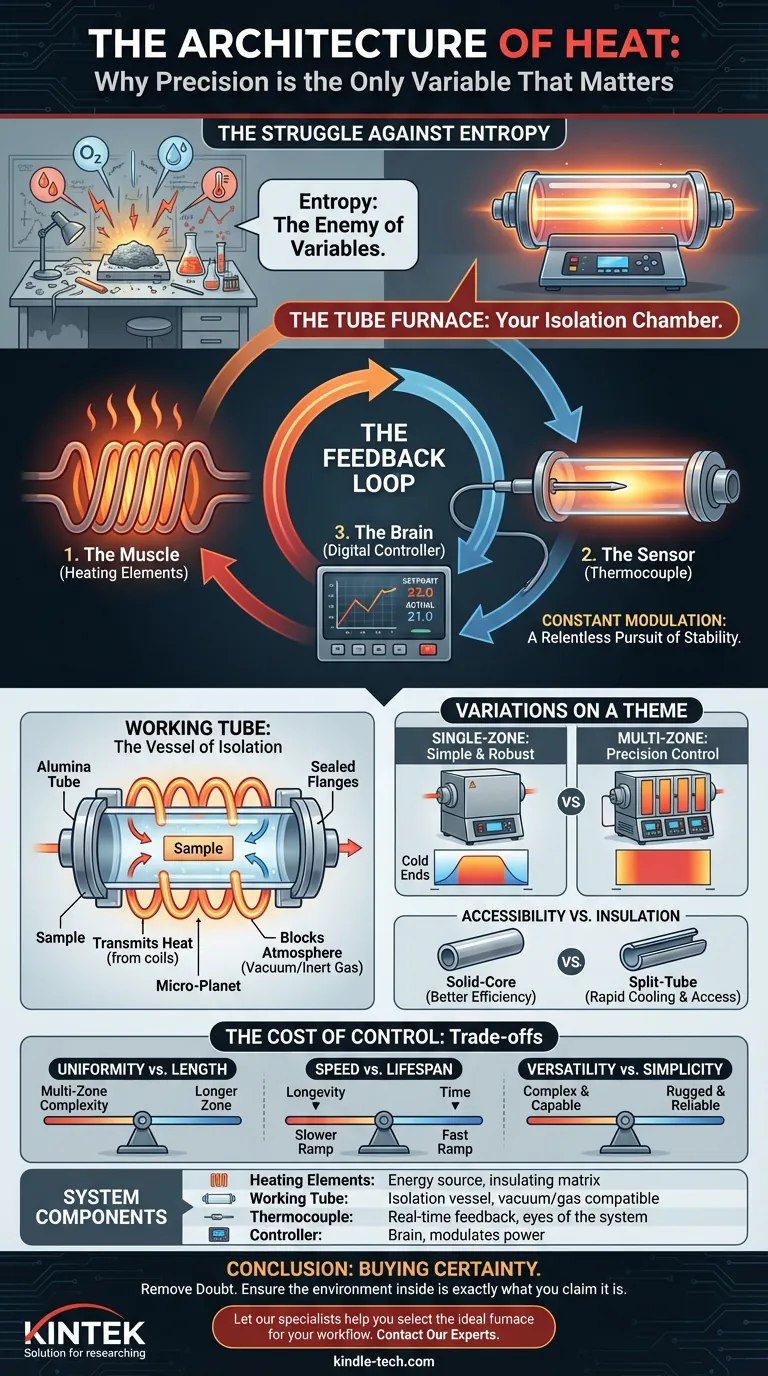
The system relies on a continuous conversation between three components:
- The Muscle (Heating Elements): Coils wrapped around a ceramic cavity that generate intense thermal energy.
- The Sensor (Thermocouple): A probe inserted near the sample that reports the actual reality inside the tube.
- The Brain (Digital Controller): It compares the actual reality to your desired reality.
If the temperature drops even a fraction of a degree, the controller modulates the power to the coils. This happens constantly. It is a relentless pursuit of stability.
The Vessel of Isolation
The "working tube" is the defining feature of this machinery. Usually made of alumina, quartz, or ceramic, it passes through the center of the heating chamber.
This tube does two things:
- It transmits heat from the coils to the sample.
- It blocks the atmosphere.
By sealing the ends of the tube, you can evacuate the air to create a vacuum, or pump in inert gases like argon. You are essentially creating a micro-planet with its own atmosphere, allowing for processes like sintering or brazing that would be impossible in open air.
Variations on a Theme
Engineering is the art of managing trade-offs. No single furnace design is perfect for every scenario, which is why the architecture varies based on the goal.
The Problem of the "Cold End"
In a Single-Zone furnace, there is one controller and one heating element. It is simple and robust.
However, physics dictates that the ends of the tube—where it meets the outside world—will be cooler than the center. If you have a long sample, this gradient is a problem.
The solution is the Multi-Zone furnace. These units act like several furnaces linked together, each with its own thermocouple and controller. They can compensate for heat loss at the ends to create a perfectly flat thermal profile, or intentionally create a temperature gradient to watch how a material changes across different thermal states.
Accessibility vs. Insulation
- Solid-Core: A single cylinder. Excellent insulation, better efficiency.
- Split-Tube: The furnace opens on a hinge like a clam.
The split-tube design acknowledges a human reality: we are impatient. It allows for rapid cooling and easier sample manipulation. It sacrifices a small amount of thermal efficiency for a massive gain in workflow speed.
The Cost of Control
When selecting a thermal processing system, you are navigating a series of compromises.
Uniformity vs. Length The longer the heated zone, the harder it is to maintain uniformity. You can buy length, but you must pay for it with multi-zone complexity.
Speed vs. Lifespan High-performance furnaces can ramp up temperature rapidly. But thermal shock is the enemy of ceramic and metallic heating elements. A slower ramp rate buys you longevity; a fast ramp rate buys you time. You must decide which currency is more valuable to your lab.
Versatility vs. Simplicity A vacuum-compatible, three-zone, vertical split-tube furnace is a marvel of engineering. It is also complex to operate and expensive to maintain. Often, a rugged, single-zone workhorse is the smarter choice for routine annealing.
Quick Reference: System Components
| Component | Role in the System |
|---|---|
| Heating Elements | The energy source; wrapped in a thermally insulating matrix for efficiency. |
| Working Tube | The isolation vessel; allows for vacuum or inert gas environments. |
| Thermocouple | The eyes of the system; provides real-time feedback. |
| Controller | The brain; modulates power to eliminate deviation from the setpoint. |
Conclusion: Buying Certainty
We tend to think of lab equipment as hardware. But in high-stakes research, you aren't buying metal and ceramic. You are buying the removal of doubt.
When you place a sample into the tube and seal the flange, you need to know that the environment inside is exactly what you claim it is.
KINTEK understands this nuance. We don't just supply furnaces; we supply the architecture of heat. Whether you need the rugged simplicity of a solid-core model for routine testing or the nuanced control of a multi-zone split-tube system for advanced synthesis, our equipment is built to handle the chaos so you don't have to.
Precision is not a luxury. It is the baseline.
Let our specialists help you select the ideal furnace for your workflow. Contact Our Experts
Visual Guide
Related Products
- Rotary Tube Furnace Split Multi Heating Zone Rotating Tube Furnace
- Laboratory Vacuum Tilt Rotary Tube Furnace Rotating Tube Furnace
- 1200℃ Split Tube Furnace with Quartz Tube Laboratory Tubular Furnace
- 1400℃ Laboratory High Temperature Tube Furnace with Alumina Tube
- 1700℃ Laboratory High Temperature Tube Furnace with Alumina Tube
Related Articles
- The Geometry of Heat: Why Motion Matters in Material Synthesis
- Exploring Rotary Tube Furnaces: A Comprehensive Guide
- Exploring the Functions and Advantages of Rotary Tube Furnaces
- Exploring the Benefits and Applications of Rotary Furnaces: A Comprehensive Guide
- The Physics of Perfection: How Rotary Furnaces Eliminate Randomness in Material Processing



















