Blog The Silent Boundary: Engineering the Heart of the Tube Furnace
The Silent Boundary: Engineering the Heart of the Tube Furnace

The Silent Boundary: Engineering the Heart of the Tube Furnace

4 weeks ago

The Invisible Wall

In the architecture of a laboratory, we often obsess over the active components. We look at the controller’s precision, the heating element’s ramp rate, or the vacuum pump’s ultimate pressure.

We tend to ignore the tube itself.

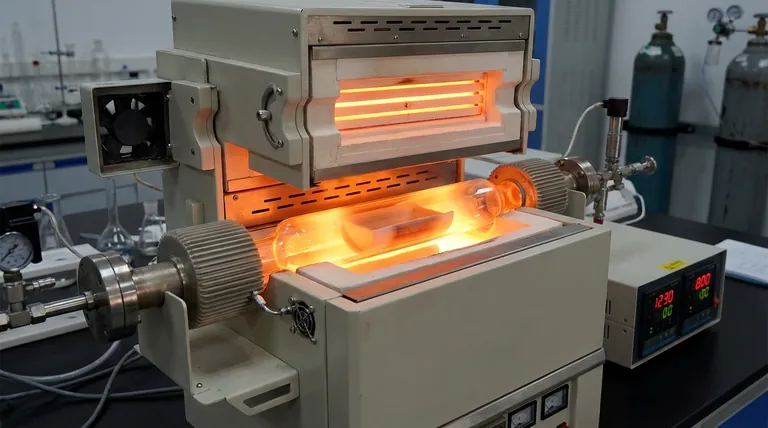
It seems like a passive vessel—a simple cylinder of glass or ceramic. But in the high-stakes environment of thermal processing, the tube is the most critical variable. It is the invisible wall between a successful synthesis and a contaminated failure.

The material of your furnace tube defines the ceiling of your capabilities. It dictates how fast you can heat, how hot you can go, and what chemistry you can explore.

Choosing the wrong material isn't just an inefficiency. It is an engineering error that guarantees compromised data.

The 1200°C Divide

The first decision gate is thermal. There is a distinct line in the sand at 1200°C.

Below this line, physics allows for flexibility. Above it, physics demands rigidity.

Fused Quartz: The Master of Shock

For processes running up to 1200°C, fused quartz is the standard. It is the "resilient" choice.

Its molecular structure offers a specific kind of magic: exceptional thermal shock resistance. You can heat quartz rapidly and cool it down just as fast without it shattering. It is forgiving.

For laboratories running cyclical tests or rapid heating protocols, quartz is not just a container; it is a safety net.

High-Purity Alumina: The Heat Shield

Once you cross the 1200°C threshold, quartz begins to soften and devitrify. It fails.

Here, High-Purity Alumina becomes the non-negotiable standard. It is built for the extremes, capable of operating at 1400°C, 1700°C, and even 1800°C.

But this performance comes with a psychological cost: patience.

Alumina is a ceramic. It is brittle. Unlike quartz, it despises thermal shock. It demands slow, controlled ramp rates. If you rush alumina, it will crack. It trades flexibility for raw thermal endurance.

The Chemistry of Purity

Heat is only half the battle. The second half is chemical compatibility.

A tube furnace is often a closed ecosystem. At high temperatures, materials that are inert at room temperature can become aggressively reactive.

The Corrosive Threat

If your sample off-gasses corrosive byproducts, a standard ceramic tube is a sitting duck. It will degrade. The tube wall will thin, or worse, it will react with your sample, altering its stoichiometry.

In these hostile environments, you must leave ceramics behind.

The Metallic Solution

This is where specialized metals enter the narrative. Materials like Tungsten, Molybdenum, or high-temperature alloys (Inconel) serve as the fortress walls.

They offer mechanical durability that ceramics cannot match. However, they are not universally inert. They require a deep understanding of the atmosphere inside the tube to prevent oxidation or alloy embrittlement.

The Trade-off Matrix

There is no "perfect" material. There are only trade-offs.

Engineering is the art of managing these trade-offs to fit the specific constraints of reality.

  • Quartz gives you speed and shock resistance, but caps your temperature.
  • Alumina gives you extreme heat, but demands careful handling.
  • Metals give you toughness, but introduce chemical complexity and cost.

Quick Reference Guide

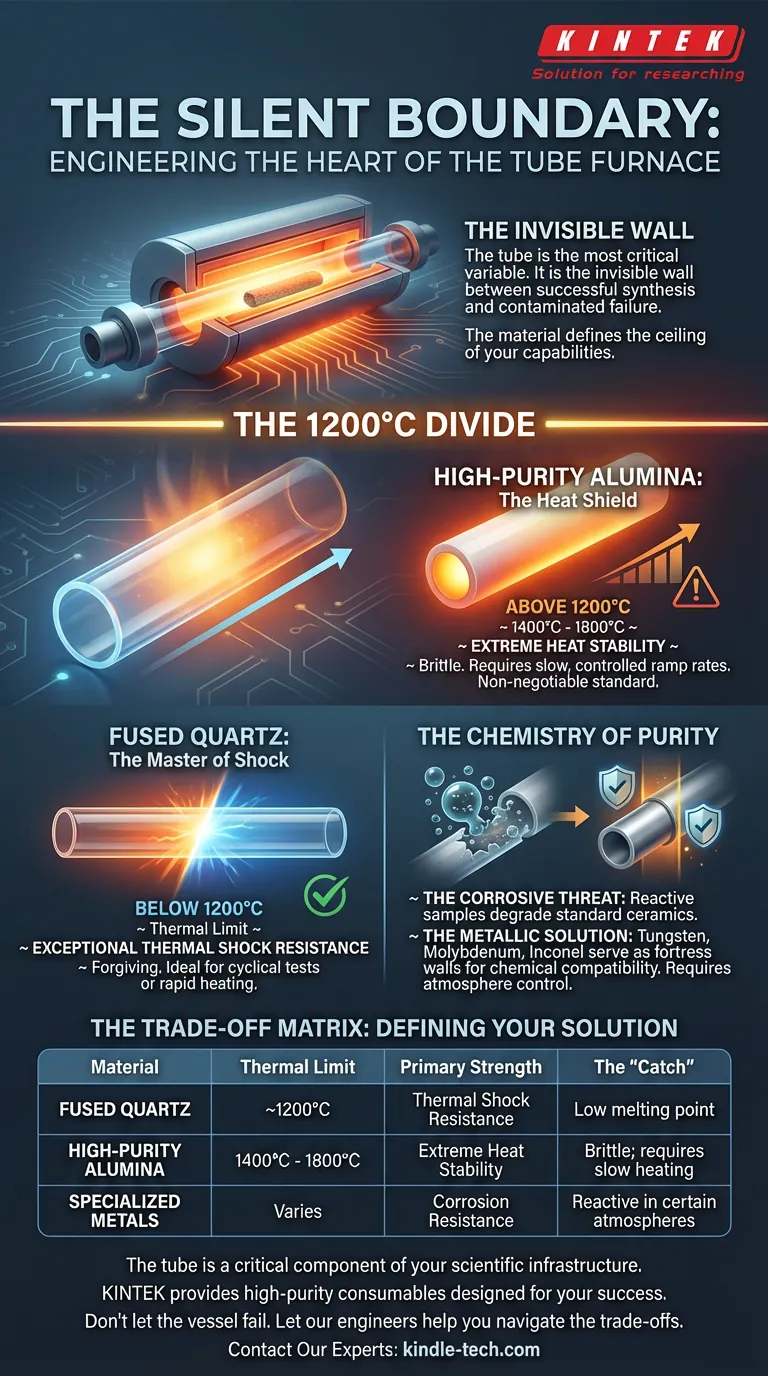
| Material | Thermal Limit | Primary Strength | The "Catch" | | :--- | :--- | :--- | :--- | | **Fused Quartz** | ~1200°C | Thermal Shock Resistance | Low melting point | | **High-Purity Alumina** | 1400°C - 1800°C | Extreme Heat Stability | Brittle; requires slow heating | | **Specialized Metals** | Varies | Corrosion Resistance | Reactive in certain atmospheres |

Defining Your Solution

The tube is the boundary condition of your experiment.

If you are running routine ash analysis or annealing below 1200°C, choose Quartz. It is robust and forgiving.

If you are synthesizing advanced ceramics or sintering materials above 1200°C, you must choose Alumina. It is the only material that holds the line against the heat.

If you are processing aggressive chemicals, you must look toward Specialized Metals.

At KINTEK, we understand that a tube is not a commodity. It is a critical component of your scientific infrastructure. We provide high-purity consumables designed to ensure that the only variable in your experiment is the one you intend to test.

Don't let the vessel be the reason your process fails.

Let our engineers help you navigate the trade-offs. Contact Our Experts

Visual Guide
The Silent Boundary: Engineering the Heart of the Tube Furnace Visual Guide

Related Products

Related Articles

Related Products

High Pressure Laboratory Vacuum Tube Furnace Quartz Tubular Furnace

High Pressure Laboratory Vacuum Tube Furnace Quartz Tubular Furnace

KT-PTF High Pressure Tube Furnace: Compact split tube furnace with strong positive pressure resistance. Working temp up to 1100°C and pressure up to 15Mpa. Also works under controller atmosphere or high vacuum.

1200℃ Split Tube Furnace with Quartz Tube Laboratory Tubular Furnace

1200℃ Split Tube Furnace with Quartz Tube Laboratory Tubular Furnace

KT-TF12 split tube furnace: high-purity insulation, embedded heating wire coils, and max. 1200C. Widely used for new materials and chemical vapour deposition.

Laboratory Rapid Thermal Processing (RTP) Quartz Tube Furnace

Laboratory Rapid Thermal Processing (RTP) Quartz Tube Furnace

Get lightning-fast heating with our RTP Rapid Heating Tube Furnace. Designed for precise, high-speed heating and cooling with convenient sliding rail and TFT touch screen controller. Order now for ideal thermal processing!

1700℃ Laboratory High Temperature Tube Furnace with Alumina Tube

1700℃ Laboratory High Temperature Tube Furnace with Alumina Tube

Looking for a high-temperature tube furnace? Check out our 1700℃ Tube Furnace with Alumina Tube. Perfect for research and industrial applications up to 1700C.

Multi-zone Laboratory Tube Furnace

Multi-zone Laboratory Tube Furnace

Experience precise, efficient thermal testing with our Multi Zone Tube Furnace. Independent heating zones and temperature sensors allow for controlled high-temperature gradient heating fields. Order now for advanced thermal analysis!

1800℃ Muffle Oven Furnace for Laboratory

1800℃ Muffle Oven Furnace for Laboratory

KT-18 muffle furnace with Japan Al2O3 polycrystalline fibe and Silicon Molybdenum heating element, up to 1900℃, PID temperature control and 7" smart touch screen. Compact design, low heat loss, and high energy efficiency. Safety interlock system and versatile functions.

Laboratory Vacuum Tilt Rotary Tube Furnace Rotating Tube Furnace

Laboratory Vacuum Tilt Rotary Tube Furnace Rotating Tube Furnace

Discover the versatility of Laboratory Rotary Furnace: Ideal for calcination, drying, sintering, and high-temperature reactions. Adjustable rotating and tilting functions for optimal heating. Suitable for vacuum and controlled atmosphere environments. Learn more now!

1400℃ Laboratory High Temperature Tube Furnace with Alumina Tube

1400℃ Laboratory High Temperature Tube Furnace with Alumina Tube

Looking for a tube furnace for high-temperature applications? Our 1400℃ Tube Furnace with Alumina Tube is perfect for research and industrial use.

Multi Heating Zones CVD Tube Furnace Machine Chemical Vapor Deposition Chamber System Equipment

Multi Heating Zones CVD Tube Furnace Machine Chemical Vapor Deposition Chamber System Equipment

KT-CTF14 Multi Heating Zones CVD Furnace - Precise Temperature Control and Gas Flow for Advanced Applications. Max temp up to 1200℃, 4 channels MFC mass flow meter, and 7" TFT touch screen controller.

1700℃ Muffle Oven Furnace for Laboratory

1700℃ Muffle Oven Furnace for Laboratory

Get superior heat control with our 1700℃ Muffle Furnace. Equipped with intelligent temperature microprocessor, TFT touch screen controller & advanced insulation materials for precise heating up to 1700C. Order now!

1700℃ Controlled Atmosphere Furnace Nitrogen Inert Atmosphere Furnace

1700℃ Controlled Atmosphere Furnace Nitrogen Inert Atmosphere Furnace

KT-17A Controlled atmosphere furnace: 1700℃ heating, vacuum sealing technology, PID temperature control, and versatile TFT smart touch screen controller for laboratory and industrial use.

1400℃ Muffle Oven Furnace for Laboratory

1400℃ Muffle Oven Furnace for Laboratory

Get precise high-temperature control up to 1500℃ with KT-14M Muffle furnace. Equipped with a smart touch screen controller and advanced insulation materials.

1200℃ Controlled Atmosphere Furnace Nitrogen Inert Atmosphere Furnace

1200℃ Controlled Atmosphere Furnace Nitrogen Inert Atmosphere Furnace

Discover our KT-12A Pro Controlled atmosphere furnace - high precision, heavy duty vacuum chamber, versatile smart touch screen controller, and excellent temperature uniformity up to 1200C. Ideal for both laboratory and industrial application.

Vacuum Sealed Continuous Working Rotary Tube Furnace Rotating Tube Furnace

Vacuum Sealed Continuous Working Rotary Tube Furnace Rotating Tube Furnace

Experience efficient material processing with our vacuum-sealed rotary tube furnace. Perfect for experiments or industrial production, equipped with optional features for controlled feeding and optimized results. Order now.

Laboratory Muffle Oven Furnace Bottom Lifting Muffle Furnace

Laboratory Muffle Oven Furnace Bottom Lifting Muffle Furnace

Efficiently produce batches with excellent temperature uniformity using our Bottom Lifting Furnace. Features two electric lifting stages and advanced temperature control up to 1600℃.

Vacuum Heat Treat and Molybdenum Wire Sintering Furnace for Vacuum Sintering

Vacuum Heat Treat and Molybdenum Wire Sintering Furnace for Vacuum Sintering

A vacuum molybdenum wire sintering furnace is a vertical or bedroom structure, which is suitable for withdrawal, brazing, sintering and degassing of metal materials under high vacuum and high temperature conditions. It is also suitable for dehydroxylation treatment of quartz materials.

Molybdenum Vacuum Heat Treat Furnace

Molybdenum Vacuum Heat Treat Furnace

Discover the benefits of a high-configuration molybdenum vacuum furnace with heat shield insulation. Ideal for high-purity, vacuum environments like sapphire crystal growth and heat treatment.

Ultra-High Temperature Graphite Vacuum Graphitization Furnace

Ultra-High Temperature Graphite Vacuum Graphitization Furnace

The ultra-high temperature graphitization furnace utilizes medium frequency induction heating in a vacuum or inert gas environment. The induction coil generates an alternating magnetic field, inducing eddy currents in the graphite crucible, which heats up and radiates heat to the workpiece, bringing it to the desired temperature. This furnace is primarily used for graphitization and sintering of carbon materials, carbon fiber materials, and other composite materials.

Controlled Nitrogen Inert Hydrogen Atmosphere Furnace

Controlled Nitrogen Inert Hydrogen Atmosphere Furnace

KT-AH Hydrogen atmosphere furnace - induction gas furnace for sintering/annealing with built-in safety features, dual housing design, and energy-saving efficiency. Ideal for lab and industrial use.

2200 ℃ Tungsten Vacuum Heat Treat and Sintering Furnace

2200 ℃ Tungsten Vacuum Heat Treat and Sintering Furnace

Experience the ultimate refractory metal furnace with our Tungsten vacuum furnace. Capable of reaching 2200℃, perfect for sintering advanced ceramics and refractory metals. Order now for high-quality results.


Leave Your Message



















