Blog The Engineering of Nothingness: Why Perfection Requires a Vacuum
The Engineering of Nothingness: Why Perfection Requires a Vacuum

The Engineering of Nothingness: Why Perfection Requires a Vacuum

3 days ago

The Invisible Enemy

In the world of metallurgy, the air around us is not a friend. It is a contaminant.

When you heat metal in the open atmosphere, you are inviting a chemical riot. Oxygen creates rust and scale. Nitrogen reacts unpredictably. Water vapor introduces hydrogen embrittlement.

The standard furnace is a chaotic environment. It is a loud, messy battle between thermal energy and atmospheric chemistry.

But the vacuum furnace is different. It is a sanctuary.

It is a machine built on a paradox: to create the strongest materials on earth, you must first create a space containing absolutely nothing.

The Mechanics of Absence

A vacuum furnace is not defined by what it puts in, but by what it takes out.

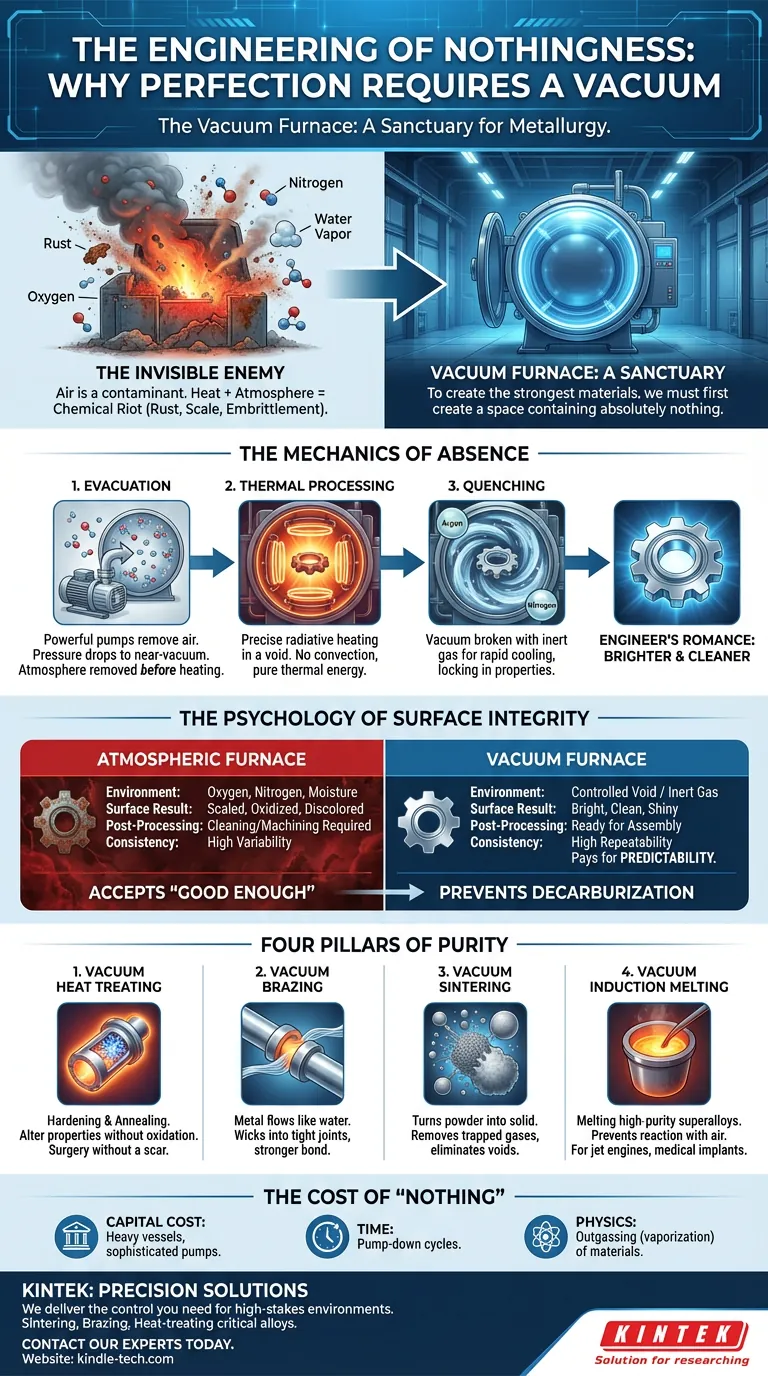
Before a single degree of heat is applied, the system engages in a rigorous act of subtraction. Powerful pumps evacuate the chamber, removing air until the internal pressure drops to a near-vacuum.

Only then does the heating begin.

This sequence is critical. By removing the atmosphere before increasing the temperature, we strip the environment of oxygen.

The result is a process defined by Engineer’s Romance: the ability to blast a component with intense thermal energy, yet have it emerge brighter and cleaner than when it went in.

How It Works

The architecture of this system relies on three distinct phases:

  1. Evacuation: The chamber is sealed and pumped down. The chaos of the atmosphere is removed.
  2. Thermal Processing: Resistance heaters or induction coils raise the temperature. Because there is no air to transfer heat via convection, the heat transfer is purely radiative and incredibly precise.
  3. Quenching: To lock in material properties, the vacuum is broken by backfilling the chamber with an inert gas (like argon or nitrogen), which is circulated rapidly to cool the parts.

The Psychology of Surface Integrity

Why go to this trouble? Why pay the premium for complex vacuum systems?

Because certainty is valuable.

In a conventional furnace, you often have to accept "good enough." You accept that parts will come out discolored or covered in oxide scale. You accept that you will need to pay for secondary cleaning or machining to remove the damaged surface layer.

In a vacuum furnace, you are paying for predictability.

You prevent decarburization—the silent thief that steals carbon from steel surfaces, leaving them soft and weak. You ensure that the hardness you engineered into the core extends all the way to the surface.

The Comparison

Feature Atmospheric Furnace Vacuum Furnace
Environment Oxygen, Nitrogen, Moisture Controlled Void / Inert Gas
Surface Result Scaled, Oxidized, Discolored Bright, Clean, Shiny
Post-Processing Cleaning/Machining required Ready for assembly
Consistency High variability High repeatability

Four Pillars of Purity

The vacuum environment is not a one-trick pony. It allows for distinct metallurgical processes that would be impossible in the open air.

1. Vacuum Heat Treating

This includes hardening and annealing. By manipulating temperature without the threat of oxidation, we can alter the mechanical properties—making a part harder or more ductile—without degrading its surface. It is surgery without a scar.

2. Vacuum Brazing

Brazing joins two metals using a filler. In the presence of air, oxides form barriers that stop the flow of the filler metal. In a vacuum, the metal flows like water. It wicks into the tightest joints, creating a bond that is often stronger than the parent material.

3. Vacuum Sintering

Sintering turns metal powder into solid parts. If you do this in air, gas gets trapped between the particles, creating weak points (voids). A vacuum pulls those gases out, pulling the particles tighter together for a dense, solid final product.

4. Vacuum Induction Melting

This is used for high-purity superalloys. By melting metal in a vacuum, you prevent the melt from reacting with the air. It is the only way to produce the ultra-clean alloys required for jet engines and medical implants.

The Cost of "Nothing"

Atul Gawande often writes about how complex systems require trade-offs. The vacuum furnace is no exception.

Achieving a perfect void is expensive.

  • Capital Cost: You are buying heavy pressure vessels and sophisticated pumping systems.
  • Time: You cannot just open the door and throw parts in. You must wait for the pump-down cycle.
  • Physics: You must account for outgassing. Some materials, when heated in a vacuum, will release trapped gases or even vaporize. If you put brass in a high-vacuum furnace, the zinc will boil out and contaminate the entire chamber.

Making the Decision

The choice to use a vacuum furnace is a choice for integrity.

If you are making garden fence posts, a little oxidation is fine. But if you are making aerospace components, medical tools, or precision dies, the surface chemistry cannot be compromised.

  • For Strength: Use it to prevent surface carbon loss.
  • For Cleanliness: Use it to eliminate post-process cleaning.
  • For Density: Use it to remove internal voids in sintered parts.

Precision Solutions

At KINTEK, we understand that in high-stakes laboratory and industrial environments, the "atmosphere" is often the variable you need to eliminate.

Whether you are sintering advanced ceramics, brazing complex assemblies, or heat-treating critical alloys, our equipment is designed to deliver the control you need. We build the systems that create the perfect nothingness, so your results can be everything you expect.

Contact our experts today to discuss which vacuum furnace configuration fits your specific metallurgical requirements.

Visual Guide
The Engineering of Nothingness: Why Perfection Requires a Vacuum Visual Guide

Related Products

Related Articles

Related Products

Vacuum Heat Treat Furnace with Ceramic Fiber Liner

Vacuum Heat Treat Furnace with Ceramic Fiber Liner

Vacuum furnace with polycrystalline ceramic fiber insulation liner for excellent heat insulation and uniform temperature field. Choose from 1200℃ or 1700℃ max. working temperature with high vacuum performance and precise temperature control.

2200 ℃ Tungsten Vacuum Heat Treat and Sintering Furnace

2200 ℃ Tungsten Vacuum Heat Treat and Sintering Furnace

Experience the ultimate refractory metal furnace with our Tungsten vacuum furnace. Capable of reaching 2200℃, perfect for sintering advanced ceramics and refractory metals. Order now for high-quality results.

Vacuum Heat Treat Sintering Brazing Furnace

Vacuum Heat Treat Sintering Brazing Furnace

A vacuum brazing furnace is a type of industrial furnace used for brazing, a metalworking process that joins two pieces of metal using a filler metal that melts at a lower temperature than the base metals. Vacuum brazing furnaces are typically used for high-quality applications where a strong, clean joint is required.

Molybdenum Vacuum Heat Treat Furnace

Molybdenum Vacuum Heat Treat Furnace

Discover the benefits of a high-configuration molybdenum vacuum furnace with heat shield insulation. Ideal for high-purity, vacuum environments like sapphire crystal growth and heat treatment.

2200 ℃ Graphite Vacuum Heat Treat Furnace

2200 ℃ Graphite Vacuum Heat Treat Furnace

Discover the power of the KT-VG Graphite Vacuum Furnace - with a maximum working temperature of 2200℃, it's perfect for vacuum sintering of various materials. Learn more now.

Vacuum Hot Press Furnace Heated Vacuum Press Machine Tube Furnace

Vacuum Hot Press Furnace Heated Vacuum Press Machine Tube Furnace

Reduce forming pressure & shorten sintering time with Vacuum Tube Hot Press Furnace for high-density, fine-grain materials. Ideal for refractory metals.

Vacuum Hot Press Furnace Machine Heated Vacuum Press

Vacuum Hot Press Furnace Machine Heated Vacuum Press

Discover the advantages of Vacuum Hot Press Furnace! Manufacture dense refractory metals & compounds, ceramics, and composites under high temp and pressure.

Laboratory High Pressure Vacuum Tube Furnace

Laboratory High Pressure Vacuum Tube Furnace

KT-PTF High Pressure Tube Furnace: Compact split tube furnace with strong positive pressure resistance. Working temp up to 1100°C and pressure up to 15Mpa. Also works under controller atmosphere or high vacuum.

Vacuum Heat Treat and Sintering Furnace with 9MPa Air Pressure

Vacuum Heat Treat and Sintering Furnace with 9MPa Air Pressure

The air pressure sintering furnace is a high-tech equipment commonly used for the sintering of advanced ceramic materials. It combines vacuum sintering and pressure sintering techniques to achieve high-density and high-strength ceramics.

1400℃ Controlled Atmosphere Furnace with Nitrogen and Inert Atmosphere

1400℃ Controlled Atmosphere Furnace with Nitrogen and Inert Atmosphere

Achieve precise heat treatment with KT-14A controlled atmosphere furnace. Vacuum sealed with a smart controller, it's ideal for lab and industrial use up to 1400℃.

600T Vacuum Induction Hot Press Furnace for Heat Treat and Sintering

600T Vacuum Induction Hot Press Furnace for Heat Treat and Sintering

Discover the 600T Vacuum Induction Hot Press Furnace, designed for high-temperature sintering experiments in vacuum or protected atmospheres. Its precise temperature and pressure control, adjustable working pressure, and advanced safety features make it ideal for nonmetal materials, carbon composites, ceramics, and metal powders.

Graphite Vacuum Furnace Bottom Discharge Graphitization Furnace for Carbon Materials

Graphite Vacuum Furnace Bottom Discharge Graphitization Furnace for Carbon Materials

Bottom-out graphitization furnace for carbon materials, ultra-high temperature furnace up to 3100°C, suitable for graphitization and sintering of carbon rods and carbon blocks. Vertical design, bottom discharging, convenient feeding and discharging, high temperature uniformity, low energy consumption, good stability, hydraulic lifting system, convenient loading and unloading.

Ultra-High Temperature Graphite Vacuum Graphitization Furnace

Ultra-High Temperature Graphite Vacuum Graphitization Furnace

The ultra-high temperature graphitization furnace utilizes medium frequency induction heating in a vacuum or inert gas environment. The induction coil generates an alternating magnetic field, inducing eddy currents in the graphite crucible, which heats up and radiates heat to the workpiece, bringing it to the desired temperature. This furnace is primarily used for graphitization and sintering of carbon materials, carbon fiber materials, and other composite materials.

Vacuum Dental Porcelain Sintering Furnace

Vacuum Dental Porcelain Sintering Furnace

Get precise and reliable results with KinTek's Vacuum Porcelain Furnace. Suitable for all porcelain powders, it features hyperbolic ceramic furnace function, voice prompt, and automatic temperature calibration.

Graphite Vacuum Furnace High Thermal Conductivity Film Graphitization Furnace

Graphite Vacuum Furnace High Thermal Conductivity Film Graphitization Furnace

The high thermal conductivity film graphitization furnace has uniform temperature, low energy consumption and can operate continuously.

1200℃ Controlled Atmosphere Furnace Nitrogen Inert Atmosphere Furnace

1200℃ Controlled Atmosphere Furnace Nitrogen Inert Atmosphere Furnace

Discover our KT-12A Pro Controlled atmosphere furnace - high precision, heavy duty vacuum chamber, versatile smart touch screen controller, and excellent temperature uniformity up to 1200C. Ideal for both laboratory and industrial application.

Small Vacuum Heat Treat and Tungsten Wire Sintering Furnace

Small Vacuum Heat Treat and Tungsten Wire Sintering Furnace

The small vacuum tungsten wire sintering furnace is a compact experimental vacuum furnace specially designed for universities and scientific research institutes. The furnace features a CNC welded shell and vacuum piping to ensure leak-free operation. Quick-connect electrical connections facilitate relocation and debugging, and the standard electrical control cabinet is safe and convenient to operate.

Horizontal High Temperature Graphite Vacuum Graphitization Furnace

Horizontal High Temperature Graphite Vacuum Graphitization Furnace

Horizontal Graphitization Furnace: This type of furnace is designed with the heating elements placed horizontally, allowing for uniform heating of the sample. It's well-suited for graphitizing large or bulky samples that require precise temperature control and uniformity.

Laboratory Vacuum Tilt Rotary Tube Furnace Rotating Tube Furnace

Laboratory Vacuum Tilt Rotary Tube Furnace Rotating Tube Furnace

Discover the versatility of Laboratory Rotary Furnace: Ideal for calcination, drying, sintering, and high-temperature reactions. Adjustable rotating and tilting functions for optimal heating. Suitable for vacuum and controlled atmosphere environments. Learn more now!

Dental Porcelain Zirconia Sintering Ceramic Vacuum Press Furnace

Dental Porcelain Zirconia Sintering Ceramic Vacuum Press Furnace

Get precise dental results with Dental Vacuum Press Furnace. Automatic temperature calibration, low noise tray, and touch screen operation. Order now!


Leave Your Message