Blog Why Your Heat Treatment Fails: Beyond the Maximum Temperature of Your Vacuum Furnace
Why Your Heat Treatment Fails: Beyond the Maximum Temperature of Your Vacuum Furnace

Why Your Heat Treatment Fails: Beyond the Maximum Temperature of Your Vacuum Furnace

2 weeks ago

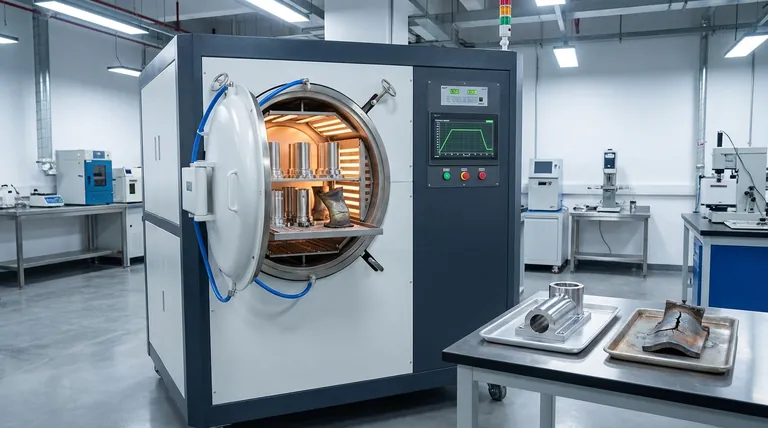
It’s a scenario familiar to many materials scientists and lab managers. After days of meticulous preparation, you open your vacuum furnace, anticipating a perfectly treated component. Instead of the strong, refined part you expected, you find a piece of expensive scrap—warped, brittle, or with a completely flawed microstructure. You followed the temperature guidelines, so what went wrong?

The Frustrating Cycle of Trial and Error

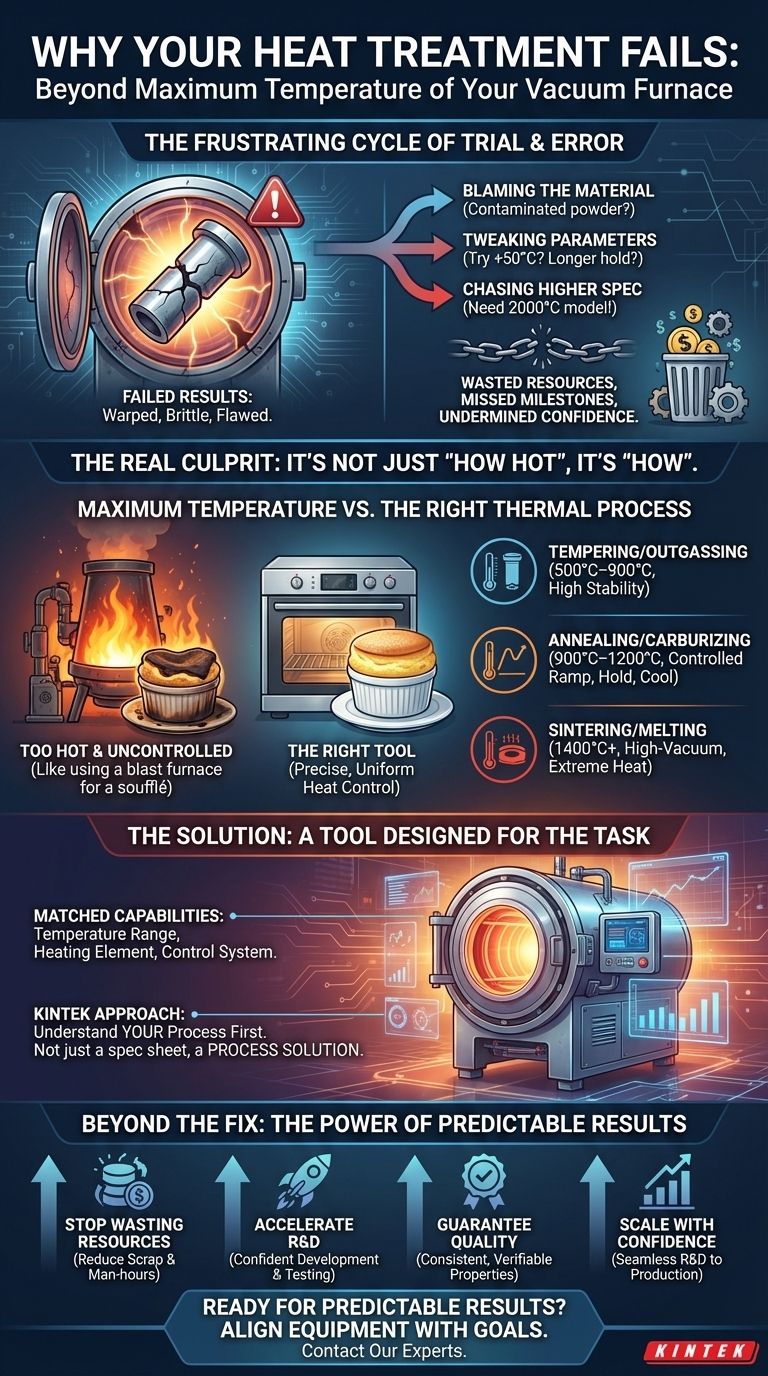
If this scene feels personal, you are not alone. Across countless advanced laboratories, teams are stuck in a frustrating loop of guesswork when their thermal processes fail. The common reactions are predictable:

  • Blaming the Material: "Maybe this batch of alloy powder was contaminated."
  • Tweaking the Parameters: "Let's try running it 50°C hotter next time," or "Maybe we held it at temperature for too long."
  • Chasing a Higher Spec: "Our current furnace only reaches 1400°C. We must need a 2000°C model to get this right."

These are not just academic exercises; they have severe business consequences. Each failed run translates directly into wasted high-value materials, from custom alloys to advanced ceramics. It means missed R&D milestones that delay product launches and erode competitive advantage. Most importantly, it undermines confidence. How can you guarantee product quality when your most critical manufacturing step is unpredictable?

This cycle of failure continues because these "solutions" only address the symptoms, not the underlying cause.

The Real Culprit: It's Not Just 'How Hot,' It's 'How'

The turning point comes when you shift your core question from "How hot can my furnace get?" to "What thermal process does my material need?" A vacuum furnace is not just an oven; it's a precision instrument for executing a specific metallurgical recipe.

The fundamental mistake is assuming that a higher maximum temperature is always better. The truth is that different processes are activated by entirely different thermal profiles.

Maximum Temperature vs. The Right Thermal Process

Think of it like cooking. You wouldn't use a blast furnace designed for smelting iron to bake a delicate soufflé. Even though the blast furnace is "hotter," it lacks the precise, gentle, and uniform heat control required for the task. The same principle applies to materials science:

  • Tempering or Outgassing: These processes require lower, sustained temperatures (e.g., 500°C - 900°C) with high stability to relieve internal stresses or remove trapped gases without altering the material's core structure. A furnace designed for extreme heat might struggle to maintain precise control in this lower range.
  • Annealing or Carburizing: These rely on a carefully controlled ramp-up, a long hold at a precise mid-range temperature (e.g., 900°C - 1200°C), and often a specific cooling rate to achieve the desired grain structure and hardness.
  • Sintering or Melting: These advanced applications truly require high temperatures (1400°C to over 2000°C) to fuse powdered metals or melt high-performance alloys.

The common "solutions" fail because they ignore this principle. Randomly tweaking the temperature is like guessing the baking time for a cake. And buying a furnace with excessive temperature capability for a low-temperature process is a costly mismatch of tool to task, often sacrificing the fine control you actually need.

The Solution: A Tool Designed for the Task, Not Just the Spec Sheet

To break this cycle of failure, you need a furnace whose capabilities—its temperature range, heating element material, and control system—are precisely matched to your application. This is where the right equipment, guided by expertise, becomes transformative.

A furnace is not just a commodity; it is the embodiment of a process solution. A truly effective furnace is designed with a deep understanding of these thermal principles.

  • For annealing standard alloys, the ideal tool is a furnace that offers exceptional temperature uniformity and stability in the 500°C to 1400°C range, governed by a sophisticated PID or PLC controller.
  • For sintering advanced ceramics, the solution is a specialized high-temperature furnace, likely with graphite heating elements and insulation, capable of reaching 2200°C while maintaining a clean, high-vacuum environment.

At KINTEK, we don't just sell lab equipment; we provide access to the right tools for the job. Our approach is built on understanding your process first. We help you navigate the specifications to find a furnace that delivers not just heat, but the precise, repeatable thermal control your application demands.

Beyond the Fix: The Power of Predictable Results

When you finally have the right tool for the job, everything changes. The nagging uncertainty that plagued your work disappears, replaced by the confidence that comes with predictability.

This is where true innovation begins. With a reliable and repeatable thermal process, you can:

  • Stop Wasting Resources: Drastically reduce material scrap and wasted man-hours, freeing up your budget and your team for more valuable work.
  • Accelerate R&D: Confidently develop new materials and push the boundaries of performance, knowing your equipment is a stable constant, not a frustrating variable.
  • Guarantee Quality: Deliver components with consistent, verifiable properties every single time, building trust with your clients and stakeholders.
  • Scale with Confidence: Seamlessly transition from a successful R&D process to pilot production, knowing the results are transferable.

Solving this old, frustrating problem doesn't just fix a technical issue; it unlocks your lab's full potential for discovery and growth.

Your work is too important for guesswork. If you're tired of unpredictable results and ready to implement a thermal process you can trust, it's time to align your equipment with your goals. Let our team help you move beyond the spec sheet and achieve the predictable, high-quality outcomes your work demands. Contact Our Experts.

Visual Guide
Why Your Heat Treatment Fails: Beyond the Maximum Temperature of Your Vacuum Furnace Visual Guide

Related Products

Related Articles

Related Products

Vacuum Heat Treat Furnace with Ceramic Fiber Liner

Vacuum Heat Treat Furnace with Ceramic Fiber Liner

Vacuum furnace with polycrystalline ceramic fiber insulation liner for excellent heat insulation and uniform temperature field. Choose from 1200℃ or 1700℃ max. working temperature with high vacuum performance and precise temperature control.

Molybdenum Vacuum Heat Treat Furnace

Molybdenum Vacuum Heat Treat Furnace

Discover the benefits of a high-configuration molybdenum vacuum furnace with heat shield insulation. Ideal for high-purity, vacuum environments like sapphire crystal growth and heat treatment.

2200 ℃ Graphite Vacuum Heat Treat Furnace

2200 ℃ Graphite Vacuum Heat Treat Furnace

Discover the power of the KT-VG Graphite Vacuum Furnace - with a maximum working temperature of 2200℃, it's perfect for vacuum sintering of various materials. Learn more now.

2200 ℃ Tungsten Vacuum Heat Treat and Sintering Furnace

2200 ℃ Tungsten Vacuum Heat Treat and Sintering Furnace

Experience the ultimate refractory metal furnace with our Tungsten vacuum furnace. Capable of reaching 2200℃, perfect for sintering advanced ceramics and refractory metals. Order now for high-quality results.

Vacuum Heat Treat Sintering Brazing Furnace

Vacuum Heat Treat Sintering Brazing Furnace

A vacuum brazing furnace is a type of industrial furnace used for brazing, a metalworking process that joins two pieces of metal using a filler metal that melts at a lower temperature than the base metals. Vacuum brazing furnaces are typically used for high-quality applications where a strong, clean joint is required.

Vacuum Heat Treat and Molybdenum Wire Sintering Furnace for Vacuum Sintering

Vacuum Heat Treat and Molybdenum Wire Sintering Furnace for Vacuum Sintering

A vacuum molybdenum wire sintering furnace is a vertical or bedroom structure, which is suitable for withdrawal, brazing, sintering and degassing of metal materials under high vacuum and high temperature conditions. It is also suitable for dehydroxylation treatment of quartz materials.

Graphite Vacuum Furnace High Thermal Conductivity Film Graphitization Furnace

Graphite Vacuum Furnace High Thermal Conductivity Film Graphitization Furnace

The high thermal conductivity film graphitization furnace has uniform temperature, low energy consumption and can operate continuously.

Vacuum Heat Treat and Sintering Furnace with 9MPa Air Pressure

Vacuum Heat Treat and Sintering Furnace with 9MPa Air Pressure

The air pressure sintering furnace is a high-tech equipment commonly used for the sintering of advanced ceramic materials. It combines vacuum sintering and pressure sintering techniques to achieve high-density and high-strength ceramics.

600T Vacuum Induction Hot Press Furnace for Heat Treat and Sintering

600T Vacuum Induction Hot Press Furnace for Heat Treat and Sintering

Discover the 600T Vacuum Induction Hot Press Furnace, designed for high-temperature sintering experiments in vacuum or protected atmospheres. Its precise temperature and pressure control, adjustable working pressure, and advanced safety features make it ideal for nonmetal materials, carbon composites, ceramics, and metal powders.

Small Vacuum Heat Treat and Tungsten Wire Sintering Furnace

Small Vacuum Heat Treat and Tungsten Wire Sintering Furnace

The small vacuum tungsten wire sintering furnace is a compact experimental vacuum furnace specially designed for universities and scientific research institutes. The furnace features a CNC welded shell and vacuum piping to ensure leak-free operation. Quick-connect electrical connections facilitate relocation and debugging, and the standard electrical control cabinet is safe and convenient to operate.

Vacuum Dental Porcelain Sintering Furnace

Vacuum Dental Porcelain Sintering Furnace

Get precise and reliable results with KinTek's Vacuum Porcelain Furnace. Suitable for all porcelain powders, it features hyperbolic ceramic furnace function, voice prompt, and automatic temperature calibration.

1700℃ Laboratory High Temperature Tube Furnace with Alumina Tube

1700℃ Laboratory High Temperature Tube Furnace with Alumina Tube

Looking for a high-temperature tube furnace? Check out our 1700℃ Tube Furnace with Alumina Tube. Perfect for research and industrial applications up to 1700C.

Vacuum Sealed Continuous Working Rotary Tube Furnace Rotating Tube Furnace

Vacuum Sealed Continuous Working Rotary Tube Furnace Rotating Tube Furnace

Experience efficient material processing with our vacuum-sealed rotary tube furnace. Perfect for experiments or industrial production, equipped with optional features for controlled feeding and optimized results. Order now.

Ultra-High Temperature Graphite Vacuum Graphitization Furnace

Ultra-High Temperature Graphite Vacuum Graphitization Furnace

The ultra-high temperature graphitization furnace utilizes medium frequency induction heating in a vacuum or inert gas environment. The induction coil generates an alternating magnetic field, inducing eddy currents in the graphite crucible, which heats up and radiates heat to the workpiece, bringing it to the desired temperature. This furnace is primarily used for graphitization and sintering of carbon materials, carbon fiber materials, and other composite materials.

Graphite Vacuum Furnace IGBT Experimental Graphitization Furnace

Graphite Vacuum Furnace IGBT Experimental Graphitization Furnace

IGBT experimental graphitization furnace, a tailored solution for universities and research institutions, with high heating efficiency, user-friendliness, and precise temperature control.

Vacuum Hot Press Furnace Machine for Lamination and Heating

Vacuum Hot Press Furnace Machine for Lamination and Heating

Experience clean and precise lamination with Vacuum Lamination Press. Perfect for wafer bonding, thin-film transformations, and LCP lamination. Order now!

High Temperature Muffle Oven Furnace for Laboratory Debinding and Pre Sintering

High Temperature Muffle Oven Furnace for Laboratory Debinding and Pre Sintering

KT-MD High temperature debinding and pre-sintering furnace for ceramic materials with various molding processes. Ideal for electronic components such as MLCC and NFC.

1700℃ Muffle Oven Furnace for Laboratory

1700℃ Muffle Oven Furnace for Laboratory

Get superior heat control with our 1700℃ Muffle Furnace. Equipped with intelligent temperature microprocessor, TFT touch screen controller & advanced insulation materials for precise heating up to 1700C. Order now!

Laboratory Sterilizer Lab Autoclave Pulse Vacuum Lifting Sterilizer

Laboratory Sterilizer Lab Autoclave Pulse Vacuum Lifting Sterilizer

The pulse vacuum lifting sterilizer is a state-of-the-art equipment for efficient and precise sterilization. It uses pulsating vacuum technology, customizable cycles, and a user-friendly design for easy operation and safety.

Benchtop Laboratory Vacuum Freeze Dryer

Benchtop Laboratory Vacuum Freeze Dryer

Benchtop laboratory freeze dryer for efficient lyophilization of biological, pharmaceutical, and food samples. Features intuitive touchscreen, high-performance refrigeration, and durable design. Preserve sample integrity—consult now!


Leave Your Message



















