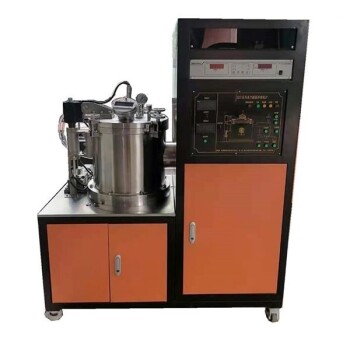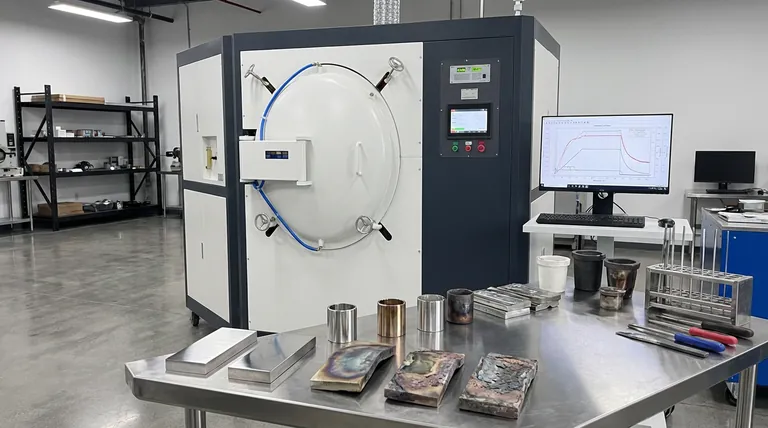
It’s a moment every metallurgist and lab technician dreads. After hours of a carefully executed heat treatment cycle, you open the furnace. But instead of the strong, bright, and dimensionally perfect component you need, you find a discolored, brittle, or warped part. It's not just a single failed component; it's a setback that costs time, expensive materials, and confidence in your process. That one failed part can delay an entire project.
If this scenario sounds painfully familiar, you are not alone.
The Endless Loop of Trial and Error
When faced with these failures—oxidation, scaling, or poor structural properties—the natural instinct is to blame the recipe. This kicks off a frustrating and expensive cycle of troubleshooting:
- "Maybe the temperature was off?" You spend days recalibrating controllers and running test cycles at slightly different temperatures.
- "Was the soak time wrong?" You experiment with shorter and longer hold times, meticulously documenting every minor change.
- "Did the gas purge fail?" You question your inert gas flow rates, suspecting a leak or insufficient purity.
Each iteration consumes valuable resources. For industries working with superalloys, titanium, or medical-grade steel, the cost of a single scrapped part can be thousands of dollars. More damaging, however, is the erosion of predictability. When you can't guarantee the outcome of a fundamental process like heat treatment, project timelines become unreliable, production yields drop, and your ability to innovate is crippled by the need to constantly fight fires.
But what if the problem isn't your recipe at all?
The Hidden Enemy: It's Not the Heat, It's the Air
The crucial turning point in understanding these failures is recognizing that for many metals, the true enemy isn't the heat itself—it's the environment in which they are heated.
When you raise the temperature of a metal, its surface atoms become incredibly energetic and chemically reactive. In a standard furnace, even one purged with inert gas, trace amounts of oxygen and nitrogen from our atmosphere remain. To a hot metal surface, these normally harmless gases are aggressive contaminants.
- Oxygen causes oxidation, creating the familiar scale or discoloration that can ruin a part's surface finish and dimensions.
- Nitrogen can be absorbed by certain alloys, forming nitrides that make the metal brittle and compromise its structural integrity.
This is why your endless adjustments to time and temperature often fail. You are perfecting a world-class recipe in a contaminated kitchen. No matter how precise your cooking instructions are, the final dish is spoiled because you never removed the invisible ingredients that ruin it. The "common solutions" only address the symptoms, not the root cause: atmospheric contamination.
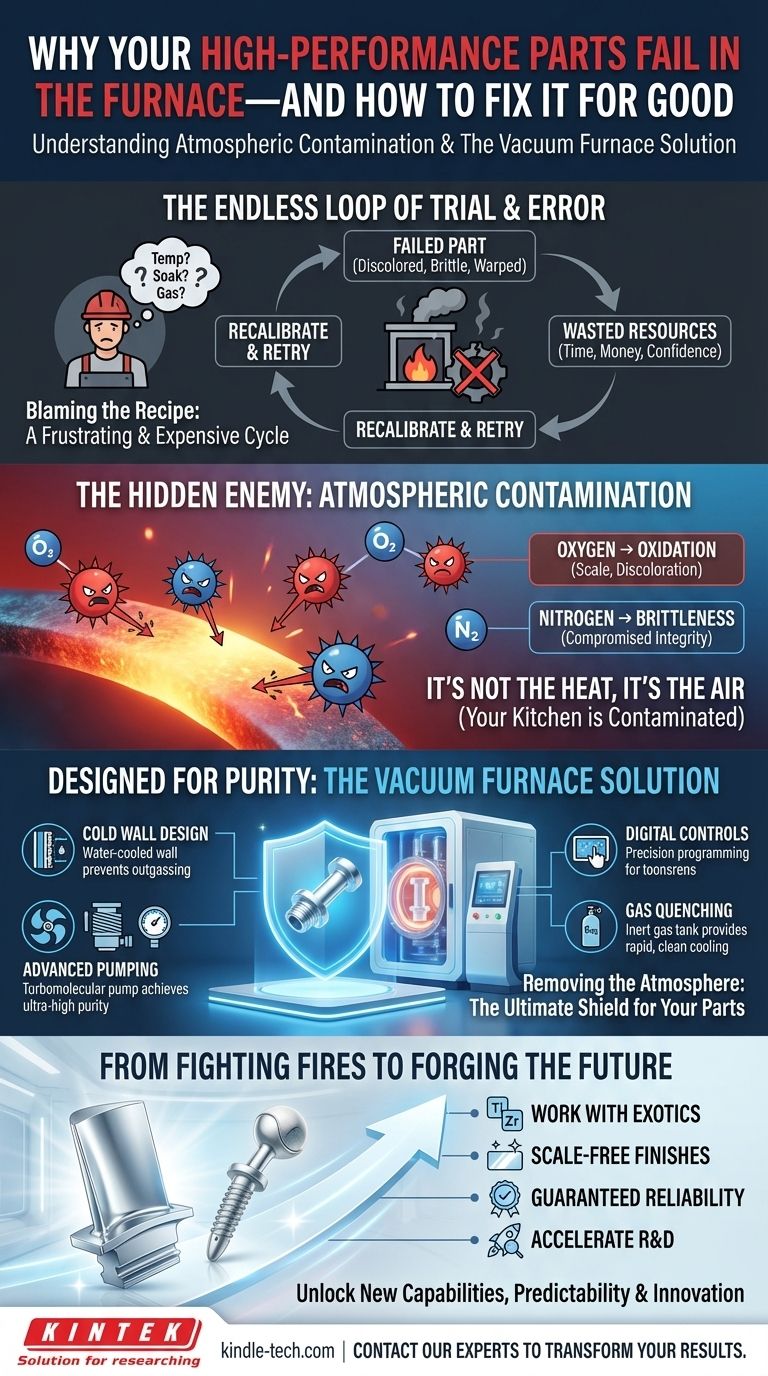
Designed for Purity: How a Vacuum Furnace Solves the Problem at its Core
If the atmosphere is the problem, the only logical solution is to remove it completely. This is the fundamental principle behind the vacuum furnace. It is not just another type of oven; it is a sophisticated tool designed specifically to solve the problem of contamination.
By placing a part inside a sealed chamber and using powerful pumps to evacuate the air, you create an ultra-pure environment. This vacuum acts as a perfect, invisible shield, protecting the part during its most vulnerable, high-temperature state.
A modern vacuum furnace is the culmination of a century of engineering designed to perfect this environment:
- The "Cold Wall" Design: The heating elements are inside a water-cooled chamber. This prevents the chamber walls themselves from getting hot and releasing trapped gases (outgassing), which would compromise the vacuum and re-contaminate your part.
- Advanced Pumping Systems: High-speed turbomolecular and cryogenic pumps achieve deeper vacuum levels faster than ever before, ensuring maximum purity and shorter cycle times.
- Programmable Digital Controls: Once you have a pure environment, precision matters. Modern controllers allow you to execute complex, multi-stage heating and cooling profiles with perfect, computer-driven repeatability.
- High-Pressure Gas Quenching: To cool the part down quickly without contamination, the furnace is backfilled at high pressure with an inert gas like nitrogen or argon. This provides rapid, uniform cooling without the mess, fire risk, and environmental issues of oil quenching.
A KINTEK vacuum furnace isn't just a piece of equipment; it is the embodiment of this solution. It is an engineered system designed from the ground up to give you total control over the one variable that matters most: the purity of the processing environment.
From Fighting Fires to Forging the Future: What Becomes Possible
Once you eliminate the fundamental problem of atmospheric contamination, your focus shifts entirely. You are no longer wasting weeks troubleshooting basic process failures. You are free to innovate.
With the predictable, clean environment of a vacuum furnace, you can:
- Confidently work with reactive and exotic materials like titanium, zirconium, and niobium, which are impossible to process cleanly in a conventional furnace.
- Achieve bright, scale-free finishes on tool steels and stainless steels, often eliminating the need for costly and time-consuming post-process cleaning or machining.
- Guarantee the metallurgical properties of critical components for aerospace, medical, or high-performance applications, ensuring 100% reliability and repeatability from batch to batch.
- Drastically accelerate your R&D cycles. Instead of wondering if your process will work, you can focus on developing the next generation of materials and products.
Solving this foundational challenge isn't just about making better parts; it's about unlocking a new level of capability, predictability, and innovation for your entire laboratory or production line. It's time to stop re-running failed experiments and start building the future.
Your materials have unique requirements, and your projects have specific goals. We believe the solution should be just as specific. Let's discuss the challenges you're facing and explore how the right processing environment can transform your results. Contact Our Experts to start the conversation.
Visual Guide
Related Products
- Vacuum Hot Press Furnace Heated Vacuum Press Machine Tube Furnace
- 600T Vacuum Induction Hot Press Furnace for Heat Treat and Sintering
- Vacuum Hot Press Furnace Machine Heated Vacuum Press
- Vacuum Heat Treat Furnace and Levitation Induction Melting Furnace
- 2200 ℃ Tungsten Vacuum Heat Treat and Sintering Furnace
Related Articles
- The Purity Paradox: Choosing the Heart of Your Vacuum Hot Press Furnace
- Comprehensive Guide to Vacuum Hot Press Furnace Application
- Vacuum Hot Press Furnace: A Comprehensive Guide
- Forging Perfection in a Void: The Physics of Ultra-Dense Materials
- Defeating the Void: The Quiet Power of Vacuum Hot Pressing