The Psychology of a Billion-Dollar Niche
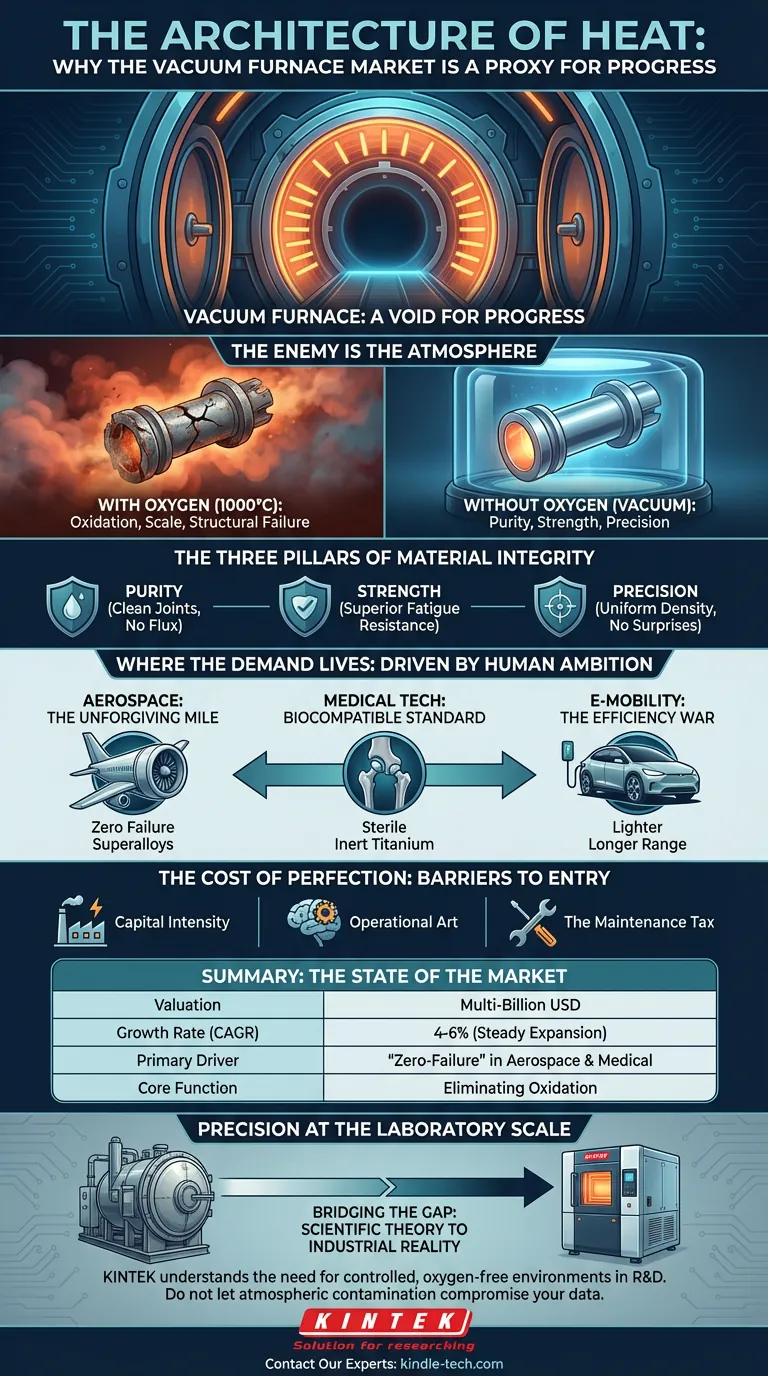
If you look at the numbers, the global vacuum furnace market is a multi-billion dollar industry growing at a steady clip of 4-6% annually.
But numbers are often just a distraction from the story.
In finance, we often say that the specific stock price matters less than the behavior driving the market. In material science, the specific dollar value of the furnace market matters less than the forces guaranteeing its survival.
The market isn't growing because furnaces are trendy. It is growing because the margin for error in modern technology has vanished.
The engines that carry us across oceans, the implants that repair our bones, and the batteries that power our cars all share a common trait: they require materials that defy nature. They need to be forged without the interference of the air we breathe.
The Enemy is the Atmosphere
To understand the value of this equipment, you have to appreciate the hostility of oxygen.
At room temperature, oxygen is life-giving. At 1,000°C, oxygen is a contaminant. It is an agent of chaos.
When metals are heated in the presence of air, they oxidize. They develop scale. Their chemical structure alters. For a cast iron skillet, this is an annoyance. For a jet engine turbine blade made of a nickel superalloy, it is a catastrophic structural failure waiting to happen.
The Physics of Absence
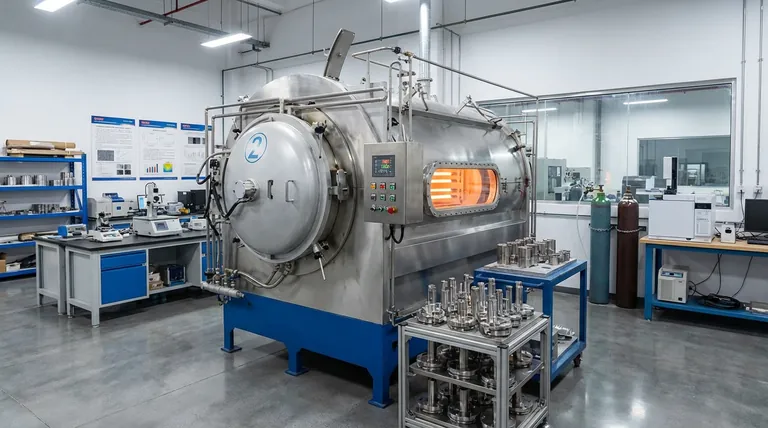
A vacuum furnace is not merely an oven; it is a specialized vessel designed to create a void. By removing the atmosphere before introducing heat, we achieve The Three Pillars of Material Integrity:
- Purity: Processes like brazing and diffusion bonding occur without flux. There are no chemical byproducts, only clean, atomic-level joints.
- Strength: Specialty steels gain superior fatigue resistance. They become harder, tougher, and more resilient.
- Precision: Sintering (fusing powders) and annealing (softening) happen with uniform density. There are no surprises in the microstructure.
Where the Demand Lives
The growth of this market is a derivative of human ambition. We want to fly faster, live longer, and drive farther.
Aerospace: The Unforgiving Mile
In aerospace, redundancy is safety, but material failure is not an option. Superalloys and titanium components must withstand extreme stress and heat. They can only attain these properties through vacuum heat treatment. The furnace is the womb of the modern jet engine.
Medical Technology: The Biocompatible Standard
The human body is an aggressive environment for foreign objects. Hip implants and surgical tools must be chemically inert and sterile. Vacuum processing ensures that titanium and stainless steel medical devices are free from surface contaminants that could cause rejection or infection.
E-Mobility: The Efficiency War
Electric vehicles are fighting a war against weight. Vacuum furnaces allow for the brazing of intricate battery cooling plates and the sintering of high-strength, lightweight transmission gears. The lighter the car, the longer the range.
The Cost of Perfection
If the technology is so vital, why isn't it everywhere?
Because perfection is expensive. The barriers to entry in this market act as a filter, separating the serious players from the rest.
- Capital Intensity: These are massive machines requiring significant infrastructure—power, cooling water, and inert gases.
- Operational Art: You cannot simply plug it in. Operating a vacuum furnace requires a nuanced understanding of metallurgy and thermodynamics.
- The Maintenance Tax: Keeping a vacuum system leak-free and efficient is a constant battle against entropy.
Summary: The State of the Market
The following table breaks down the current landscape of the industry:
| Metric | Insight |
|---|---|
| Valuation | Multi-Billion USD |
| Growth Rate (CAGR) | 4-6% (Steady, reliable expansion) |
| Primary Driver | The "Zero-Failure" requirement in Aerospace & Medical |
| Core Function | Eliminating oxidation to ensure material purity |
Precision at the Laboratory Scale
There is a gap between the massive industrial furnaces used by Boeing and the needs of a research laboratory.
Innovation often starts small. The breakdown of a new alloy or the prototype of a new medical sensor happens long before mass production.
This is where KINTEK steps in.
We understand that the need for a controlled, oxygen-free environment is just as critical in the R&D phase as it is on the production line. We specialize in high-performance lab equipment that bridges the gap between scientific theory and industrial reality.
Whether you are testing the fatigue limits of a new superalloy or sintering a prototype component, the quality of your heat treatment dictates the validity of your results.
Do not let atmospheric contamination compromise your data.
Contact Our Experts at KINTEK today. Let’s discuss how we can bring the precision of vacuum furnace technology to your laboratory.
Visual Guide
Related Products
- Vacuum Hot Press Furnace Heated Vacuum Press Machine Tube Furnace
- 600T Vacuum Induction Hot Press Furnace for Heat Treat and Sintering
- Vacuum Hot Press Furnace Machine Heated Vacuum Press
- Vacuum Heat Treat Furnace and Levitation Induction Melting Furnace
- Vacuum Heat Treat and Pressure Sintering Furnace for High Temperature Applications
Related Articles
- The Purity Paradox: Choosing the Heart of Your Vacuum Hot Press Furnace
- Comprehensive Guide to Vacuum Hot Press Furnace Application
- Vacuum Hot Press Furnace: A Comprehensive Guide
- Forging Perfection in a Void: The Physics of Ultra-Dense Materials
- Defeating the Void: The Quiet Power of Vacuum Hot Pressing