The Unseen Saboteur in Your Lab
Imagine spending weeks developing a new metal alloy. The chemistry is perfect, the structure is sound. You place it in a furnace for the final, critical heat treatment. When you pull it out, the surface is discolored, brittle, and the part fails under stress.
The problem wasn't the alloy or the temperature. The saboteur was something we take for granted: the air itself.
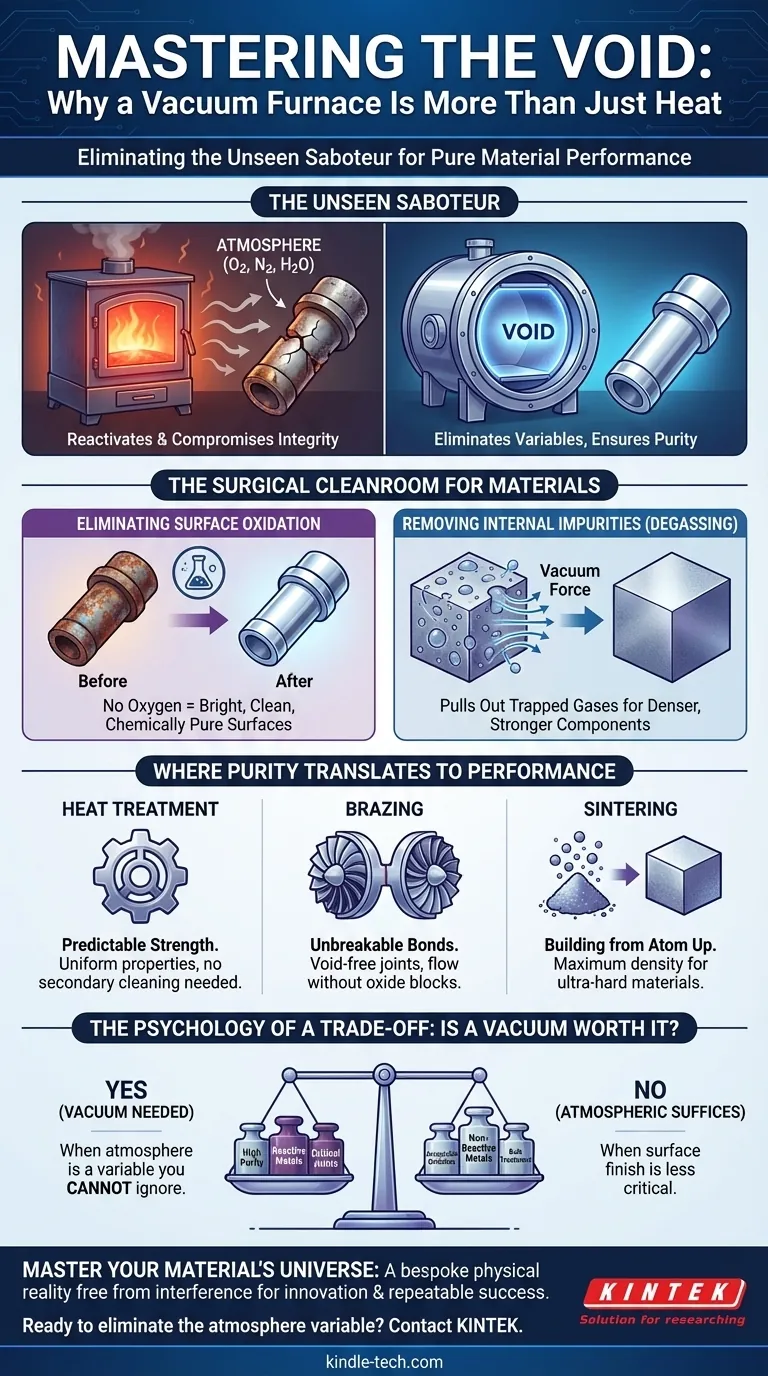
At high temperatures, the seemingly benign atmosphere becomes an aggressive reactant. Oxygen, nitrogen, and water vapor eagerly attack hot surfaces, forming oxides and nitrides that compromise a material's integrity. The true purpose of a vacuum furnace is not just to get things hot; it's to first eliminate this unseen enemy.
The Surgical Cleanroom for Materials
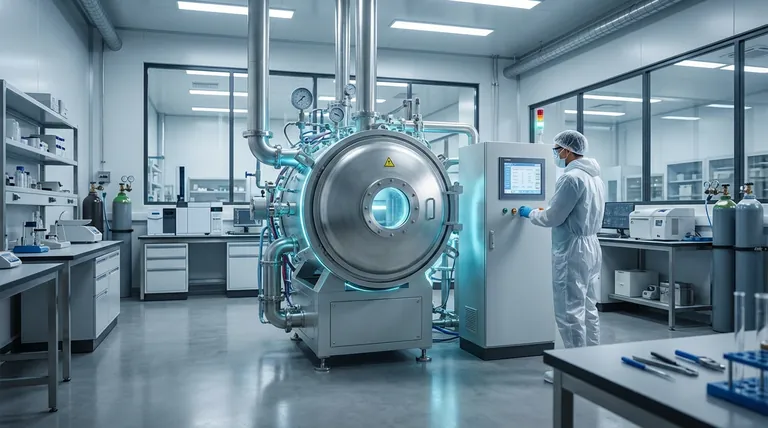
Think of a conventional furnace as heating an object on a workbench. A vacuum furnace is like performing a delicate operation in a surgical cleanroom. By first removing the environment, you remove countless variables that can lead to failure.
This control manifests in two critical ways.
Eliminating Surface Oxidation
At its most basic level, a vacuum removes the oxygen that causes rust and scale. This is more than just a cosmetic fix. An oxide layer is a form of contamination that can prevent strong bonds in processes like brazing or alter the material's electrical and mechanical properties.
By processing in a vacuum, materials emerge from the heat bright, clean, and chemically pure, exactly as you designed them.
Removing Internal Impurities
The power of a vacuum goes deeper than the surface. Many materials contain trapped gases—like hydrogen—left over from their initial manufacturing. When heated, these gases can create microscopic voids, leading to porosity and weakness.
A vacuum doesn't just protect the outside; it actively pulls these trapped gases out of the material's core. This process, called degassing, results in denser, stronger, and more reliable components with superior performance characteristics.
Where Purity Translates to Performance
This obsession with a clean environment isn't academic. In high-stakes industries, it's the difference between success and failure. The applications of a vacuum furnace are a direct reflection of processes where purity is non-negotiable.
Heat Treatment: Forging Predictable Strength
Processes like annealing, hardening, and tempering are done to achieve specific material properties. Performing them in a vacuum ensures that the results are due to the thermal cycle alone, not a random chemical reaction with the atmosphere. You get a clean, bright part with predictable strength, not a brittle component that requires secondary cleaning.
Brazing: Creating Unbreakable Bonds
Vacuum brazing is the gold standard for joining critical components, from aerospace turbine blades to medical implants. In the void, the brazing alloy flows perfectly into the joint, drawn by capillary action without any oxides to block its path. The result is a bond that is often stronger than the parent materials themselves—strong, clean, and completely void-free.
Sintering: Building from the Atom Up
Sintering fuses powdered materials—like advanced ceramics or tungsten carbide—into a solid mass. A vacuum is essential to ensure that no atmospheric gases get trapped between the tiny particles. This allows the material to reach its maximum theoretical density and strength, creating ultra-hard materials for cutting tools and high-wear components.
The Psychology of a Trade-Off: Is a Vacuum Worth It?
A vacuum furnace represents a significant investment in cost, complexity, and process time. The pump-down cycle alone adds time compared to a simple atmospheric furnace. The decision to use one is therefore a strategic trade-off.
It's not about which furnace is "better," but about what you are trying to achieve. The choice hinges on one question: is the atmosphere a variable you can afford to ignore?
| You Need a Vacuum Furnace If... | An Atmospheric Furnace May Suffice If... |
|---|---|
| Material purity and surface finish are non-negotiable. | Surface oxidation is acceptable or easily removed. |
| You are working with highly reactive metals like titanium. | You are processing low-cost, non-reactive metals. |
| The absolute strength and reliability of a joint is critical. | Simple, bulk heat treatment is the primary goal. |
| You must degas a material to achieve peak properties. | Low operational cost and high throughput are key drivers. |
Mastering Your Material's Universe
Ultimately, a vacuum furnace is more than just an oven. It’s a tool for creating a bespoke physical reality for your materials—a universe free from atmospheric interference. For researchers and engineers, this level of control is not a luxury; it is the foundation of innovation and repeatable success.
In the laboratory setting, where every experiment aims to push the boundaries of material science, controlling these variables is paramount. For those who understand that mastering the environment is the first step to mastering the material, KINTEK offers precision vacuum furnaces designed for these exacting demands. If you're ready to eliminate the atmosphere as a variable in your work, Contact Our Experts.
Visual Guide
Related Products
- Vacuum Hot Press Furnace Heated Vacuum Press Machine Tube Furnace
- 600T Vacuum Induction Hot Press Furnace for Heat Treat and Sintering
- Vacuum Hot Press Furnace Machine Heated Vacuum Press
- Vacuum Heat Treat Furnace and Levitation Induction Melting Furnace
- 2200 ℃ Tungsten Vacuum Heat Treat and Sintering Furnace
Related Articles
- The Purity Paradox: Choosing the Heart of Your Vacuum Hot Press Furnace
- Comprehensive Guide to Vacuum Hot Press Furnace Application
- Vacuum Hot Press Furnace: A Comprehensive Guide
- Forging Perfection in a Void: The Physics of Ultra-Dense Materials
- Defeating the Void: The Quiet Power of Vacuum Hot Pressing