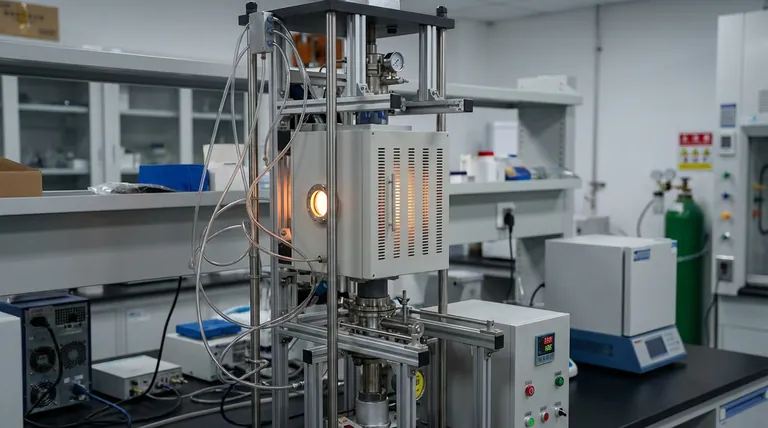
The Illusion of an Empty Room
Imagine designing a flawless advanced alloy on a computer. Every property is perfect, every calculation is sound. But when you process it in a standard high-temperature furnace, the final component is brittle and fails inspection.
What went wrong? The culprit is often invisible: the air itself.
Our intuition deceives us. We think of air as empty space, but at the temperatures required for material processing, it's a volatile chemical bath. The oxygen and nitrogen we breathe become aggressive agents of chaos, reacting with sensitive materials to form brittle oxide layers, fundamentally compromising their integrity. This single, overlooked variable is the quiet failure point of countless projects.
Redefining the Environment, Not Just the Temperature
A vacuum hot press operates on a profoundly different principle. Its primary function isn't just to add heat and pressure; it's to first subtract the environment.
By creating a vacuum, the machine removes the reactive gases that stand in the way of material perfection. The vacuum isn't an accessory; it is the enabling factor that creates a pristine, predictable stage for thermal processing.
The Three Pillars of Control
A vacuum hot press orchestrates three systems to achieve what's impossible in open air. Understanding them is understanding the basis of modern material science.
1. The Vacuum System: Engineering Purity
The process begins by removing the atmosphere from a sealed chamber. This step eliminates the risk of oxidation and purges moisture and other volatile contaminants. It’s like giving a surgeon a sterile operating theater—it ensures that the only interactions happening are the ones you intend.
2. The Heating System: Sculpting with Temperature
Once the inert environment is established, precision heating elements—often graphite or refractory metals—raise the temperature, sometimes beyond 2000°C. These systems follow exact thermal "recipes," allowing engineers to guide a material through precise phase changes and atomic realignments.
3. The Pressing Mechanism: Forging Density
Simultaneously, a hydraulic or electromechanical press applies immense, uniform force. This pressure physically compacts the material, squeezing out microscopic voids (porosity) and encouraging atoms to diffuse across boundaries, forming powerful, seamless bonds.
The Capabilities Unlocked by a Vacuum
By mastering the environment, a vacuum hot press unlocks processing techniques that are otherwise unattainable.
Achieving True Material Integrity
For materials like titanium, superalloys, and advanced ceramics, this is the most critical advantage. The vacuum prevents the formation of performance-killing oxide layers, ensuring the final part possesses the pure chemical and structural properties it was designed to have. The integrity is real, not just theoretical.
The Art of Diffusion Bonding
This is a solid-state joining process that feels like science fiction. Two different materials, even those that cannot be welded, are pressed together at high temperature. In the clean vacuum environment, the atoms from each surface intermingle and form a single, powerful bond without ever melting. It's the key to creating unique composite materials.
The Pursuit of Theoretical Density
In powders and sintered parts, porosity is the enemy of strength. The combination of heat and pressure within a vacuum hot press eliminates these internal gaps, creating components that are exceptionally dense, strong, and reliable—crucial for aerospace, medical, and defense applications.
| Feature | Primary Benefit |
|---|---|
| Vacuum Environment | Prevents oxidation and contamination |
| High Temperature | Enables processing up to and beyond 2000°C |
| Mechanical Pressure | Achieves maximum density, reduces porosity |
| Diffusion Bonding | Joins dissimilar materials without melting |
The Psychology of Investment: Cost vs. Certainty
The complexity of a vacuum hot press comes with higher equipment costs and longer cycle times. This can feel like a significant barrier.
However, the more relevant psychological framing is cost versus certainty. A conventional furnace might be cheaper, but it introduces variables that can lead to component failure, wasted materials, and stalled R&D. The investment in a vacuum hot press is an investment in a predictable, repeatable, and successful outcome. The cost of failure is almost always higher than the cost of the right tool.
Choosing the right equipment is about aligning your tools with your goals:
- For reactive and refractory materials, where purity is non-negotiable, a vacuum hot press is the only viable path.
- For joining dissimilar materials where welding isn't an option, diffusion bonding in a vacuum is the industry standard.
- For high-performance components, where every microscopic void is a potential point of failure, the densification provided by a hot press is essential.
In a field where precision determines success, having equipment that delivers uncompromising control is paramount. KINTEK specializes in laboratory equipment, including advanced vacuum hot press systems engineered for superior densification and bonding. Our solutions give researchers and engineers the control they need to turn theoretical designs into physical realities.
If you're ready to eliminate the invisible variables holding your materials back, Contact Our Experts.
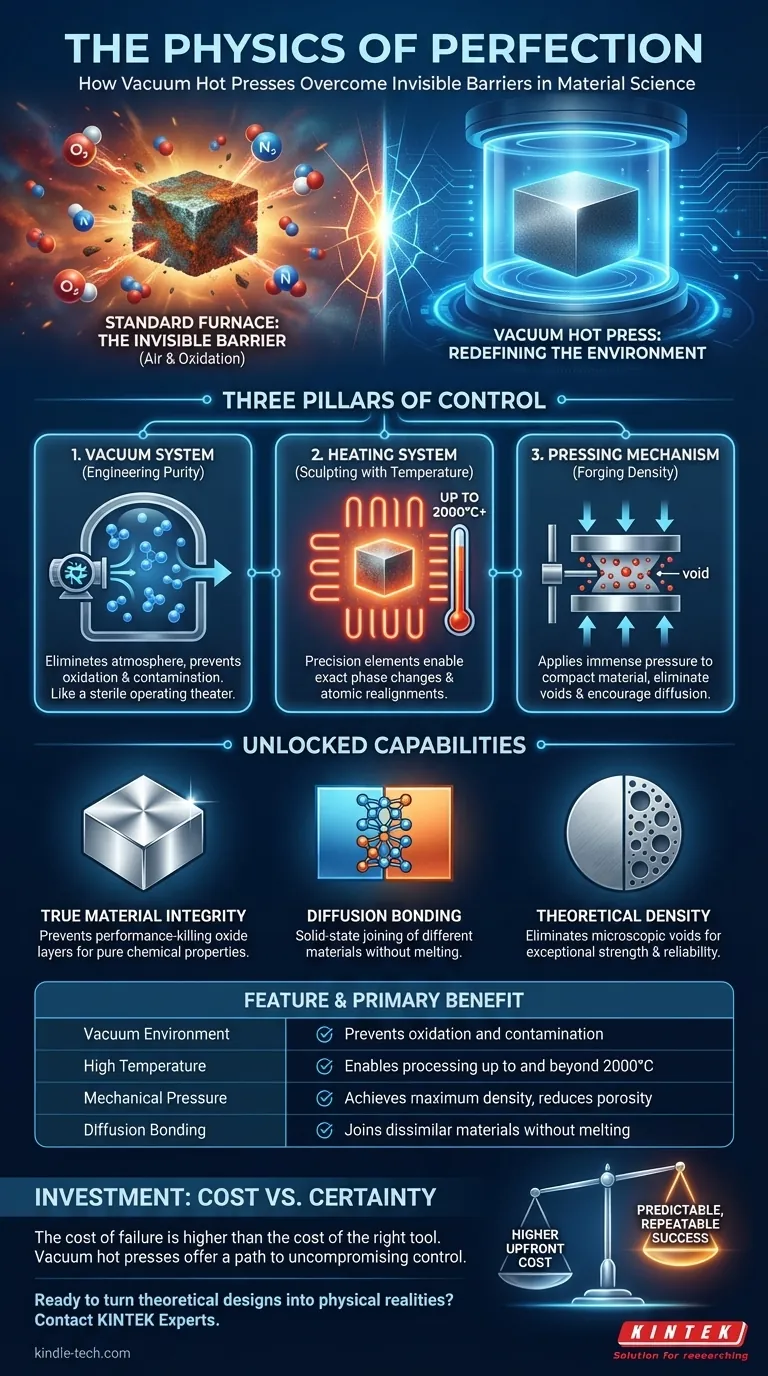
Visual Guide
Related Products
- Vacuum Hot Press Furnace Machine Heated Vacuum Press
- Vacuum Hot Press Furnace Machine for Lamination and Heating
- Vacuum Hot Press Furnace Heated Vacuum Press Machine Tube Furnace
- 600T Vacuum Induction Hot Press Furnace for Heat Treat and Sintering
- Touchscreen Automatic Vacuum Heat Press
Related Articles
- The Purity Paradox: Choosing the Heart of Your Vacuum Hot Press Furnace
- Comprehensive Guide to Vacuum Hot Press Furnace Application
- Vacuum Hot Press Furnace: A Comprehensive Guide
- Forging Perfection in a Void: The Physics of Ultra-Dense Materials
- Defeating the Void: The Quiet Power of Vacuum Hot Pressing



















