The Silent Failure
Imagine this: a materials scientist inspects a newly forged component for a satellite thruster. It’s a marvel of engineering, pressed into its final shape under immense pressure in the sterile void of a vacuum furnace. The dimensions are perfect. The density is correct.
But under a microscope, the story changes. Microscopic carbon inclusions dot the alloy's grain boundaries—a hidden flaw, a point of future failure. The entire batch is compromised.
The problem wasn't the vacuum or the pressure. It was a more fundamental choice, made weeks earlier: the selection of the furnace's heating element.
The Heart of the Furnace
A vacuum hot press is a controlled universe. It manages a delicate dance between crushing force and intense, uniform heat in an airless environment. At the center of this universe is the heating element.
It is not merely a component; it is the heart of the thermal system. Its design philosophy dictates the furnace's capabilities and, ultimately, the integrity of the material you create. This choice is less about hardware and more about understanding the fundamental trade-offs between temperature, purity, and speed.
Three Philosophies of Heat
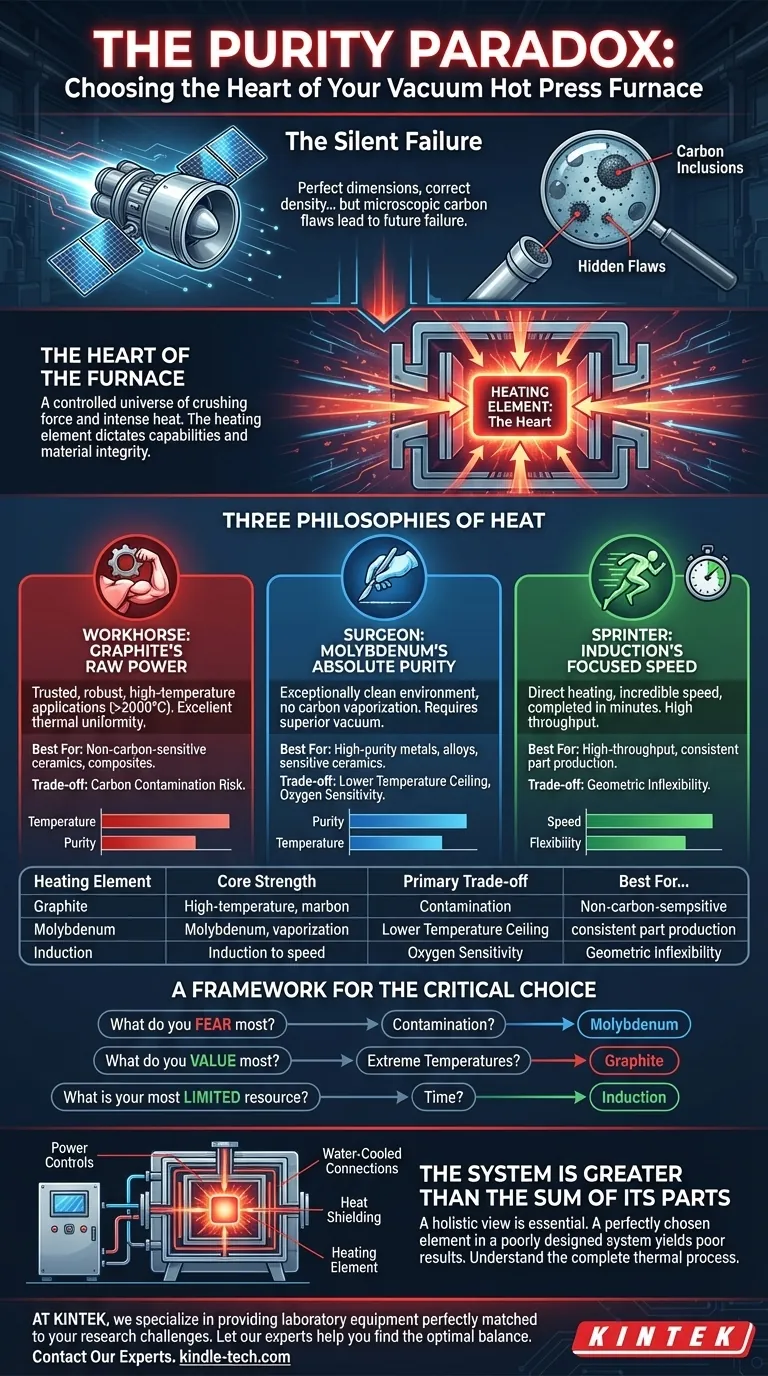
In the demanding world of vacuum furnaces, three heating technologies dominate. Each represents a different approach to solving the same problem: how to generate incredible heat with precision and control.
H3: The Workhorse: Graphite's Raw Power
Graphite is the default, the trusted workhorse of high-temperature applications. It’s robust, relatively inexpensive, and can be machined into large, intricate shapes that provide excellent thermal uniformity.
When your primary goal is to push past 2000°C for sintering advanced ceramics or composites, graphite is often the only pragmatic choice. It embraces the heat, offering unmatched performance when raw temperature is the singular objective.
H3: The Surgeon: Molybdenum's Absolute Purity
For applications where the slightest contamination is a critical failure, a different philosophy is required. This is the realm of refractory metals like molybdenum.
Molybdenum heaters provide an exceptionally clean environment. There is no risk of carbon vaporizing and embedding itself into your metal alloys or sensitive ceramics. This is the choice driven by the fear of invisible flaws. The trade-off? A lower maximum temperature and a heightened sensitivity to any residual oxygen, demanding a superior vacuum to protect the element itself.
H3: The Sprinter: Induction's Focused Speed
Induction heating doesn't play by the same rules. Instead of a resistive element radiating heat from the outside in, an induction coil generates a powerful electromagnetic field that heats the conductive workpiece directly.
The result is incredible speed. Heating cycles that take hours with resistive elements can be completed in minutes. This is the philosophy of efficiency and throughput. However, this speed comes with a cost: inflexibility. The induction coil is often tailored to a specific part geometry, making it ideal for consistent production runs but less versatile for a dynamic research lab.
A Framework for the Critical Choice
Selecting a heating element is a psychological exercise as much as an engineering one. It forces you to define what you fear most and what you value most in your process.
- Is your greatest fear contamination? If you are developing medical implants or aerospace alloys, where purity is paramount, the choice is clear. You need the surgical precision of a molybdenum heater.
- Is your greatest ambition reaching extreme temperatures? If your work with technical ceramics demands a thermal environment that would vaporize lesser materials, you accept the trade-offs and rely on the raw power of graphite.
- Is your most limited resource time? If you need to iterate quickly or meet production quotas, the unmatched velocity of an induction system is the logical path forward.
| Heating Element | Core Strength | Primary Trade-off | Best For... |
|---|---|---|---|
| Graphite | Extreme Temperature (>2000°C) | Carbon Contamination Risk | Non-carbon-sensitive ceramics, composites. |
| Molybdenum | Exceptional Purity | Lower Temperature Ceiling | High-purity metals, alloys, sensitive ceramics. |
| Induction | Unmatched Speed | Geometric Inflexibility | High-throughput, consistent part production. |
The System is Greater Than the Sum of its Parts
The heating element, while critical, does not operate in isolation. It is part of a complex system including power controls, water-cooled connections, and layers of heat shielding. A perfectly chosen element in a poorly designed system will still yield poor results.
This is why understanding the complete thermal process is essential. The right choice depends on a holistic view of your material, your goals, and your equipment's capabilities. Navigating these interconnected variables requires expertise that goes beyond a simple spec sheet.
At KINTEK, we specialize in providing laboratory equipment that is perfectly matched to the unique challenges of your research. We understand that the heart of your furnace defines the potential of your work.
If you are navigating the critical choice of a heating system for your application, we can help you find the optimal balance between performance, purity, and efficiency. Contact Our Experts
Visual Guide
Related Products
- Vacuum Hot Press Furnace Heated Vacuum Press Machine Tube Furnace
- 600T Vacuum Induction Hot Press Furnace for Heat Treat and Sintering
- Vacuum Hot Press Furnace Machine Heated Vacuum Press
- Vacuum Hot Press Furnace Machine for Lamination and Heating
- Vacuum Heat Treat and Pressure Sintering Furnace for High Temperature Applications
Related Articles
- Comprehensive Guide to Vacuum Hot Press Furnace Application
- Vacuum Hot Press Furnace: A Comprehensive Guide
- Forging Perfection in a Void: The Physics of Ultra-Dense Materials
- Defeating the Void: The Quiet Power of Vacuum Hot Pressing
- The Physics of Perfection: How Vacuum Hot Presses Overcome the Invisible Barriers in Material Science