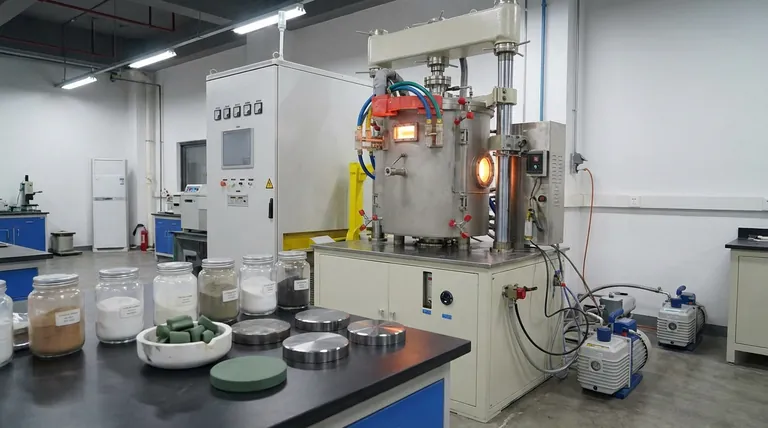
The Pursuit of the Perfect Solid
In material science, the ultimate goal is often control. Not just shaping a material, but dictating its internal architecture down to the atomic level.
When you start with a fine powder, you're faced with a fundamental problem: the empty space. The gaps between individual particles are points of weakness, tiny voids that can become catastrophic failures under stress.
Simply melting and casting isn't always an option, especially for advanced ceramics or refractory metals. The solution is more elegant. It’s a process of persuasion and force, transforming a loose collection of dust into a monolithic, theoretically dense solid. This is the world of vacuum hot pressing.
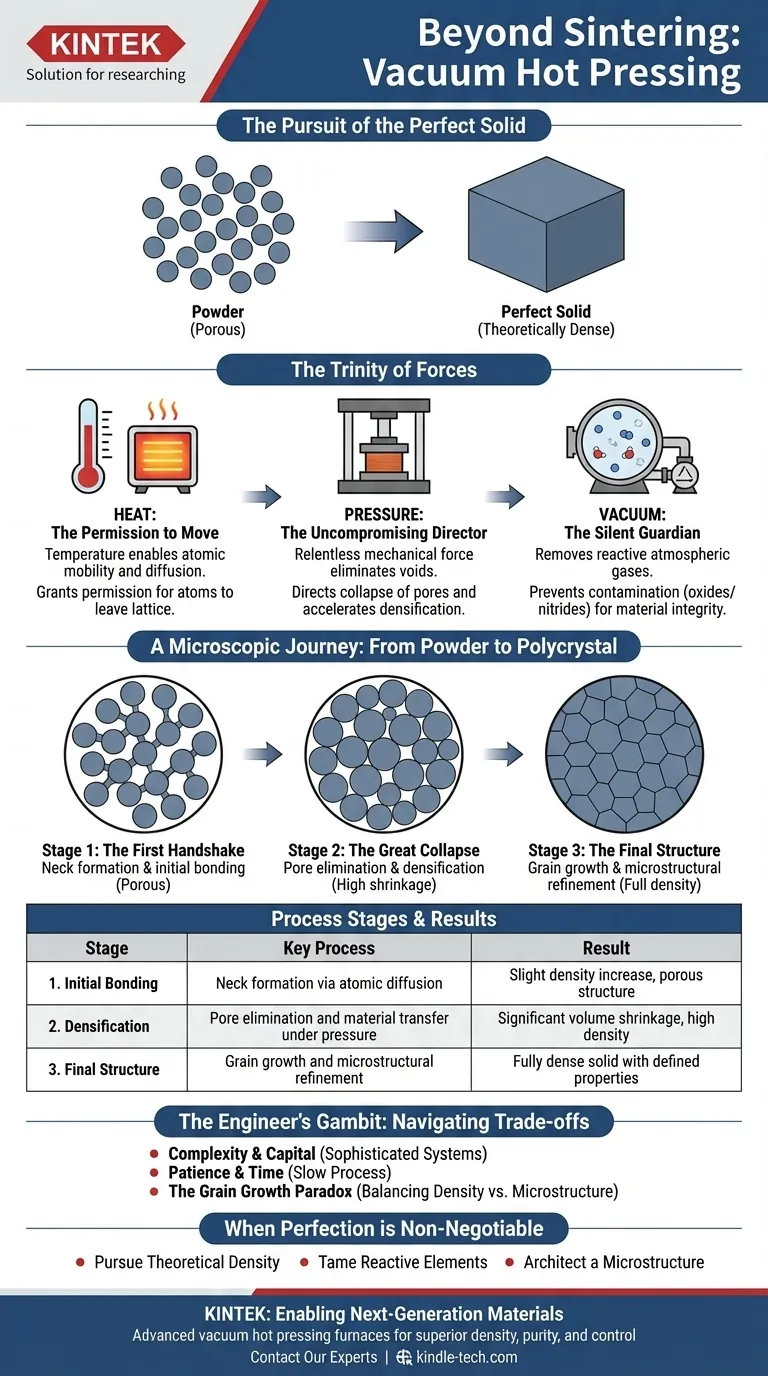
The Trinity of Forces
Inside a vacuum hot pressing furnace, a material isn't just heated; it's remade under the influence of three synergistic forces. Each plays a distinct psychological role in coercing the particles to abandon their individuality and merge into a unified whole.
Heat: The Permission to Move
Temperature is the enabler. It provides the vibrational energy that unlocks atoms from their rigid lattice positions, making them mobile. Think of it as granting permission for atoms to leave their homes.
This atomic mobility allows for diffusion—the slow, deliberate migration of atoms across the boundaries where particles touch. Without heat, nothing happens. With it, the foundation for bonding is laid.
Pressure: The Uncompromising Director
If heat gives permission, pressure gives the command. The external mechanical force is relentless. It physically shoves particles together, eliminating the gross voids between them and maximizing contact points.
Pressure accelerates the entire process. It drives the collapse of pores and speeds up the transfer of material, achieving a level of density in minutes or hours that might be impossible with heat alone. It transforms a gentle persuasion into an irresistible mandate for consolidation.
Vacuum: The Silent Guardian
The third element is the environment itself. A vacuum is not an active force, but a protective one. It removes atmospheric gases like oxygen and nitrogen, which are profoundly reactive at high temperatures.
This pristine environment prevents the formation of brittle oxides or nitrides that would contaminate the material. It acts as a silent guardian, ensuring the integrity of the process and allowing the material's true potential to be realized without unwanted chemical interference.
A Microscopic Journey: From Powder to Polycrystal
The transformation from a loose powder to a dense solid is a dramatic, multi-stage journey.
Stage 1: The First Handshake
As the temperature rises, the first connections are made. At the points where particles touch, tiny bridges of atoms, or "necks," begin to form. This is the initial stage of bonding, a tentative handshake between neighbors. The overall structure is still highly porous, but the component has begun to gain a fragile coherence.
Stage 2: The Great Collapse
As temperature and pressure are sustained, the process becomes aggressive. Atoms migrate from the boundaries between grains to fill the remaining voids. The pores, once an interconnected network, shrink, become isolated, and are systematically annihilated.
This is where the most significant densification occurs. The volume of the component shrinks noticeably as the empty space is squeezed out of existence.
Stage 3: The Final Architecture
In the final stage, almost all porosity is gone. The primary activity shifts to grain growth, where larger, more energetically stable grains expand by consuming smaller ones.
This is the most delicate phase. The engineer must carefully control time and temperature to achieve the desired grain size, which directly dictates mechanical properties like strength, hardness, and fracture toughness. Too much grain growth can undo the benefits of full density.
The Engineer's Gambit: Navigating the Trade-offs
This level of control doesn't come without its costs. Choosing vacuum hot pressing is a strategic decision that involves accepting a unique set of challenges.
-
Complexity & Capital: These furnaces are sophisticated systems requiring robust vacuum pumps, precise hydraulic presses, and advanced thermal controls. They represent a significant investment in both capital and operational expertise.
-
Patience & Time: The process is inherently slow. Careful heating, soaking under pressure, and controlled cooling cycles take time. This is not a method for high-volume manufacturing but for high-value components.
-
The Grain Growth Paradox: The same conditions that promote perfect density—high temperature and time—also encourage unwanted grain growth. The engineer is in a constant balancing act, pushing for densification while reining in the microstructure. It's a game of optimization where success is measured in microns.
| Stage | Key Process | Result |
|---|---|---|
| 1. Initial Bonding | Neck formation between particles via atomic diffusion | Slight density increase, porous structure |
| 2. Densification | Pore elimination and material transfer under pressure | Significant volume shrinkage, high density |
| 3. Final Structure | Grain growth and microstructural refinement | Fully dense solid with defined mechanical properties |
When Perfection is Non-Negotiable
So why embrace this complexity? Because for certain applications, there is no alternative. You choose vacuum hot pressing when the material's performance is paramount.
- To Pursue Theoretical Density: When you need to eliminate the last fraction of a percent of porosity in high-performance ceramics or powder metallurgy components.
- To Tame Reactive Elements: When working with materials like titanium, niobium, or advanced alloys that would be ruined by exposure to oxygen at high temperatures.
- To Architect a Microstructure: When the goal is to create a fully dense part while keeping the grain size exceptionally fine to maximize strength and toughness.
At KINTEK, we understand the pursuit of material perfection. We specialize in providing the advanced vacuum hot pressing furnaces that give researchers and engineers the control they need. Our systems are designed to manage the delicate interplay of heat, pressure, and vacuum, enabling the creation of next-generation materials.
If your work demands superior density, purity, and microstructural control, we provide the tools to forge solids from dust. Contact Our Experts
Visual Guide
Related Products
- Vacuum Hot Press Furnace Machine Heated Vacuum Press
- Vacuum Hot Press Furnace Heated Vacuum Press Machine Tube Furnace
- Vacuum Hot Press Furnace Machine for Lamination and Heating
- Electric Heated Hydraulic Vacuum Heat Press for Lab
- 600T Vacuum Induction Hot Press Furnace for Heat Treat and Sintering
Related Articles
- The Purity Paradox: Choosing the Heart of Your Vacuum Hot Press Furnace
- Comprehensive Guide to Vacuum Hot Press Furnace Application
- Vacuum Hot Press Furnace: A Comprehensive Guide
- Forging Perfection in a Void: The Physics of Ultra-Dense Materials
- Defeating the Void: The Quiet Power of Vacuum Hot Pressing