Blog Forging Perfection in a Void: The Physics of Ultra-Dense Materials
Forging Perfection in a Void: The Physics of Ultra-Dense Materials

Forging Perfection in a Void: The Physics of Ultra-Dense Materials

1 hour ago

The Invisible Barrier to Perfection

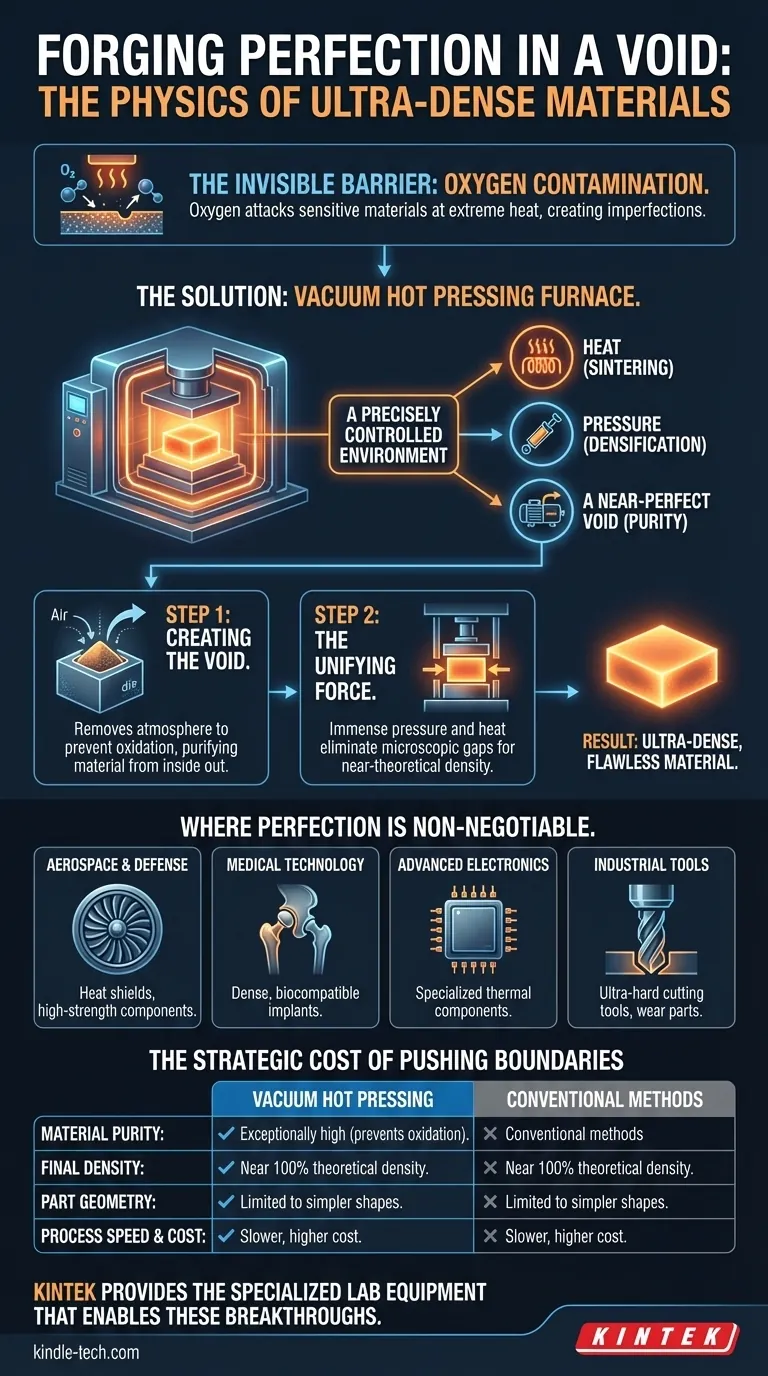
In the world of advanced materials, the enemy is often invisible. At the extreme temperatures required to forge next-generation ceramics and metal alloys, the very air we breathe becomes a contaminant. Oxygen, a life-giving gas, aggressively attacks and degrades sensitive materials, creating imperfections that can lead to catastrophic failure in a jet engine turbine blade or a medical implant.

Engineers and scientists face a fundamental paradox: they need immense heat to create these materials, but that same heat makes them vulnerable. The solution is not to fight the atmosphere, but to remove it entirely. This is the world of the vacuum hot pressing furnace.

The Alchemy of Pressure, Heat, and Nothingness

A vacuum hot press furnace isn't just a powerful oven. It's a precisely controlled environment designed to manipulate the laws of physics and chemistry. It masters three variables to achieve what seems impossible: heat, pressure, and a near-perfect void.

Step 1: Creating the Void

The process begins by placing a material—often a fine powder—into a die and sealing it within the furnace chamber. Powerful pumps then begin the arduous task of removing the atmosphere.

This isn't just about preventing rust. It's about creating a state of absolute purity. By eliminating oxygen and other gases, the furnace ensures that the only reactions that occur are the ones we intend. It pulls out trapped gaseous byproducts from the material itself, purifying it from the inside out.

Step 2: The Unifying Force of Pressure

While the vacuum creates a pristine environment, heat begins to excite the material's particles, preparing them to bond. This is where sintering starts. But heat alone is often not enough to eliminate every microscopic gap.

A hydraulic system then applies immense mechanical pressure. This is a form of persuasion on a molecular level. The pressure physically forces particles together, collapsing the tiny voids that would otherwise become weak points in the final structure. The result is a material with near-theoretical density—a solid, flawless whole.

Where Perfection is Non-Negotiable

This combination of purity, pressure, and heat is expensive and time-consuming. It is reserved for applications where material performance is not just a goal, but a requirement for safety and function.

  • Aerospace & Defense: Creating ceramic-metal composites for heat shields and high-strength components that are both light and incredibly durable.
  • Medical Technology: Fabricating dense, biocompatible ceramic implants that can withstand decades of use inside the human body.
  • Advanced Electronics: Sintering specialized powders for unique electronic and thermal management components.
  • Industrial Tools: Densifying oxygen-sensitive compounds like carbides, nitrides, and borides into ultra-hard cutting tools and wear-resistant parts.

The Strategic Cost of Pushing Boundaries

Choosing a vacuum hot press is a strategic decision, not just a technical one. The complexity of the system carries inherent trade-offs that one must weigh against the final goal.

Consideration Vacuum Hot Pressing Conventional Methods (e.g., Casting, Atmospheric Sintering)
Material Purity Exceptionally high; prevents all oxidation. Susceptible to atmospheric contamination.
Final Density Near 100% theoretical density. Lower density with residual porosity.
Part Geometry Limited to simpler shapes that fit in a die. Can produce more complex geometries.
Process Speed & Cost Slower cycle times; higher equipment and operational cost. Faster and more cost-effective for high-volume production.

This isn't a list of pros and cons. It's a map for ambition. If your goal is to mass-produce a simple metal part, conventional methods are the logical choice. But if you are aiming to bond dissimilar materials at an atomic level or achieve a level of density and purity that standard furnaces cannot reach, the vacuum hot press becomes an indispensable tool.

It represents a commitment to achieving the absolute peak of material performance, where the high cost is justified by properties that are simply unattainable otherwise. For the laboratories and researchers building the future, this control is everything.

At KINTEK, we provide the specialized lab equipment that enables these breakthroughs. Our vacuum hot pressing furnaces are engineered for the demanding applications where material integrity is paramount. To explore how this technology can help you overcome your material challenges, Contact Our Experts.

Visual Guide
Forging Perfection in a Void: The Physics of Ultra-Dense Materials Visual Guide

Related Products

Related Articles

Related Products

600T Vacuum Induction Hot Press Furnace for Heat Treat and Sintering

600T Vacuum Induction Hot Press Furnace for Heat Treat and Sintering

Discover the 600T Vacuum Induction Hot Press Furnace, designed for high-temperature sintering experiments in vacuum or protected atmospheres. Its precise temperature and pressure control, adjustable working pressure, and advanced safety features make it ideal for nonmetal materials, carbon composites, ceramics, and metal powders.

Vacuum Hot Press Furnace Heated Vacuum Press Machine Tube Furnace

Vacuum Hot Press Furnace Heated Vacuum Press Machine Tube Furnace

Reduce forming pressure & shorten sintering time with Vacuum Tube Hot Press Furnace for high-density, fine-grain materials. Ideal for refractory metals.

Vacuum Hot Press Furnace Machine for Lamination and Heating

Vacuum Hot Press Furnace Machine for Lamination and Heating

Experience clean and precise lamination with Vacuum Lamination Press. Perfect for wafer bonding, thin-film transformations, and LCP lamination. Order now!

Vacuum Hot Press Furnace Machine Heated Vacuum Press

Vacuum Hot Press Furnace Machine Heated Vacuum Press

Discover the advantages of Vacuum Hot Press Furnace! Manufacture dense refractory metals & compounds, ceramics, and composites under high temp and pressure.

Vacuum Heat Treat and Pressure Sintering Furnace for High Temperature Applications

Vacuum Heat Treat and Pressure Sintering Furnace for High Temperature Applications

Vacuum pressure sintering furnaces are designed for high temperature hot pressing applications in metal and ceramic sintering. Its advanced features ensure precise temperature control, reliable pressure maintenance, and a robust design for seamless operation.

Vacuum Heat Treat Furnace with Ceramic Fiber Liner

Vacuum Heat Treat Furnace with Ceramic Fiber Liner

Vacuum furnace with polycrystalline ceramic fiber insulation liner for excellent heat insulation and uniform temperature field. Choose from 1200℃ or 1700℃ max. working temperature with high vacuum performance and precise temperature control.

Vacuum Heat Treat and Sintering Furnace with 9MPa Air Pressure

Vacuum Heat Treat and Sintering Furnace with 9MPa Air Pressure

The air pressure sintering furnace is a high-tech equipment commonly used for the sintering of advanced ceramic materials. It combines vacuum sintering and pressure sintering techniques to achieve high-density and high-strength ceramics.

Laboratory High Pressure Vacuum Tube Furnace

Laboratory High Pressure Vacuum Tube Furnace

KT-PTF High Pressure Tube Furnace: Compact split tube furnace with strong positive pressure resistance. Working temp up to 1100°C and pressure up to 15Mpa. Also works under controller atmosphere or high vacuum.

Electric Heated Hydraulic Vacuum Heat Press for Lab

Electric Heated Hydraulic Vacuum Heat Press for Lab

The Electric Vacuum Heat Press is a specialized heat press equipment that operates in a vacuum environment, utilizing advanced infrared heating and precise temperature control for high quality, rugged and reliable performance.

Vacuum Heat Treat Sintering Brazing Furnace

Vacuum Heat Treat Sintering Brazing Furnace

A vacuum brazing furnace is a type of industrial furnace used for brazing, a metalworking process that joins two pieces of metal using a filler metal that melts at a lower temperature than the base metals. Vacuum brazing furnaces are typically used for high-quality applications where a strong, clean joint is required.

Molybdenum Vacuum Heat Treat Furnace

Molybdenum Vacuum Heat Treat Furnace

Discover the benefits of a high-configuration molybdenum vacuum furnace with heat shield insulation. Ideal for high-purity, vacuum environments like sapphire crystal growth and heat treatment.

2200 ℃ Graphite Vacuum Heat Treat Furnace

2200 ℃ Graphite Vacuum Heat Treat Furnace

Discover the power of the KT-VG Graphite Vacuum Furnace - with a maximum working temperature of 2200℃, it's perfect for vacuum sintering of various materials. Learn more now.

2200 ℃ Tungsten Vacuum Heat Treat and Sintering Furnace

2200 ℃ Tungsten Vacuum Heat Treat and Sintering Furnace

Experience the ultimate refractory metal furnace with our Tungsten vacuum furnace. Capable of reaching 2200℃, perfect for sintering advanced ceramics and refractory metals. Order now for high-quality results.

Touchscreen Automatic Vacuum Heat Press

Touchscreen Automatic Vacuum Heat Press

Precision vacuum heat press for labs: 800°C, 5-ton pressure, 0.1MPa vacuum. Ideal for composites, solar cells, aerospace.

Small Vacuum Heat Treat and Tungsten Wire Sintering Furnace

Small Vacuum Heat Treat and Tungsten Wire Sintering Furnace

The small vacuum tungsten wire sintering furnace is a compact experimental vacuum furnace specially designed for universities and scientific research institutes. The furnace features a CNC welded shell and vacuum piping to ensure leak-free operation. Quick-connect electrical connections facilitate relocation and debugging, and the standard electrical control cabinet is safe and convenient to operate.

Vacuum Heat Treat and Molybdenum Wire Sintering Furnace for Vacuum Sintering

Vacuum Heat Treat and Molybdenum Wire Sintering Furnace for Vacuum Sintering

A vacuum molybdenum wire sintering furnace is a vertical or bedroom structure, which is suitable for withdrawal, brazing, sintering and degassing of metal materials under high vacuum and high temperature conditions. It is also suitable for dehydroxylation treatment of quartz materials.

Heated Hydraulic Press Machine with Heated Plates for Vacuum Box Laboratory Hot Press

Heated Hydraulic Press Machine with Heated Plates for Vacuum Box Laboratory Hot Press

Enhance your lab's precision with our lab press for vacuum box. Press pills and powders with ease and precision in a vacuum environment, reducing oxidation and improving consistency. Compact and easy to use with a digital pressure gauge.

Heated Hydraulic Press Machine with Heated Plates for Vacuum Box Laboratory Hot Press

Heated Hydraulic Press Machine with Heated Plates for Vacuum Box Laboratory Hot Press

The lab press for vacuum box is a specialized piece of equipment designed for laboratory use. Its main purpose is to press pills and powders according to specific requirements.

Ultra-High Temperature Graphite Vacuum Graphitization Furnace

Ultra-High Temperature Graphite Vacuum Graphitization Furnace

The ultra-high temperature graphitization furnace utilizes medium frequency induction heating in a vacuum or inert gas environment. The induction coil generates an alternating magnetic field, inducing eddy currents in the graphite crucible, which heats up and radiates heat to the workpiece, bringing it to the desired temperature. This furnace is primarily used for graphitization and sintering of carbon materials, carbon fiber materials, and other composite materials.

Horizontal High Temperature Graphite Vacuum Graphitization Furnace

Horizontal High Temperature Graphite Vacuum Graphitization Furnace

Horizontal Graphitization Furnace: This type of furnace is designed with the heating elements placed horizontally, allowing for uniform heating of the sample. It's well-suited for graphitizing large or bulky samples that require precise temperature control and uniformity.


Leave Your Message