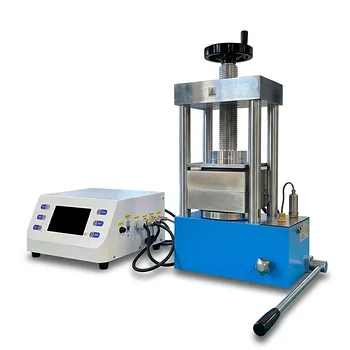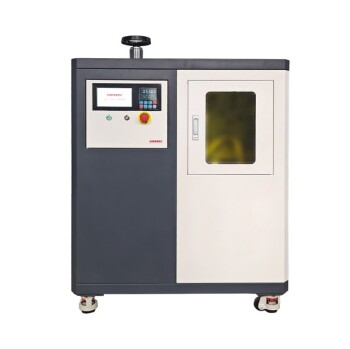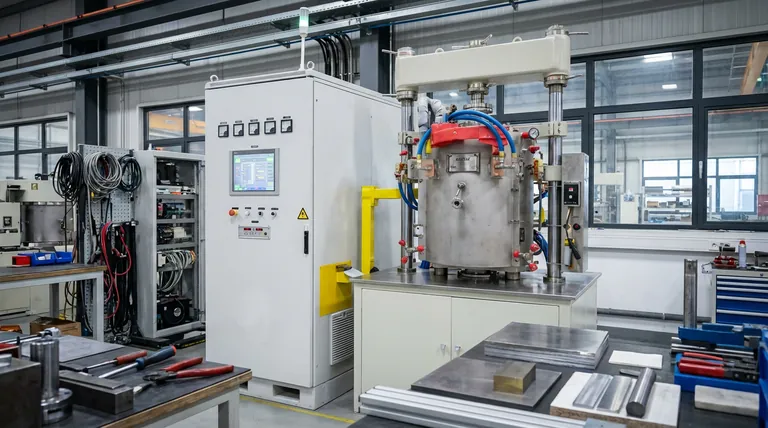
The Margin Between Success and Failure
A pristine laminate panel, free of bubbles. A circuit board where every solder joint is flawless. A ceramic mug with a design so sharp it seems printed on the material itself.
These outcomes feel like the default. The expected result.
But in a nearby workshop, another panel is delaminating at the edges. Another circuit board suffers from intermittent failures due to a single weak connection. Another mug shows a faded, ghostly image.
The difference between these two worlds is not luck. It is the mastery of a controlled, physical transformation. It is the difference between a simple heater and a precision system.
This system is the hot press, and its job is to manage the delicate physics of change.
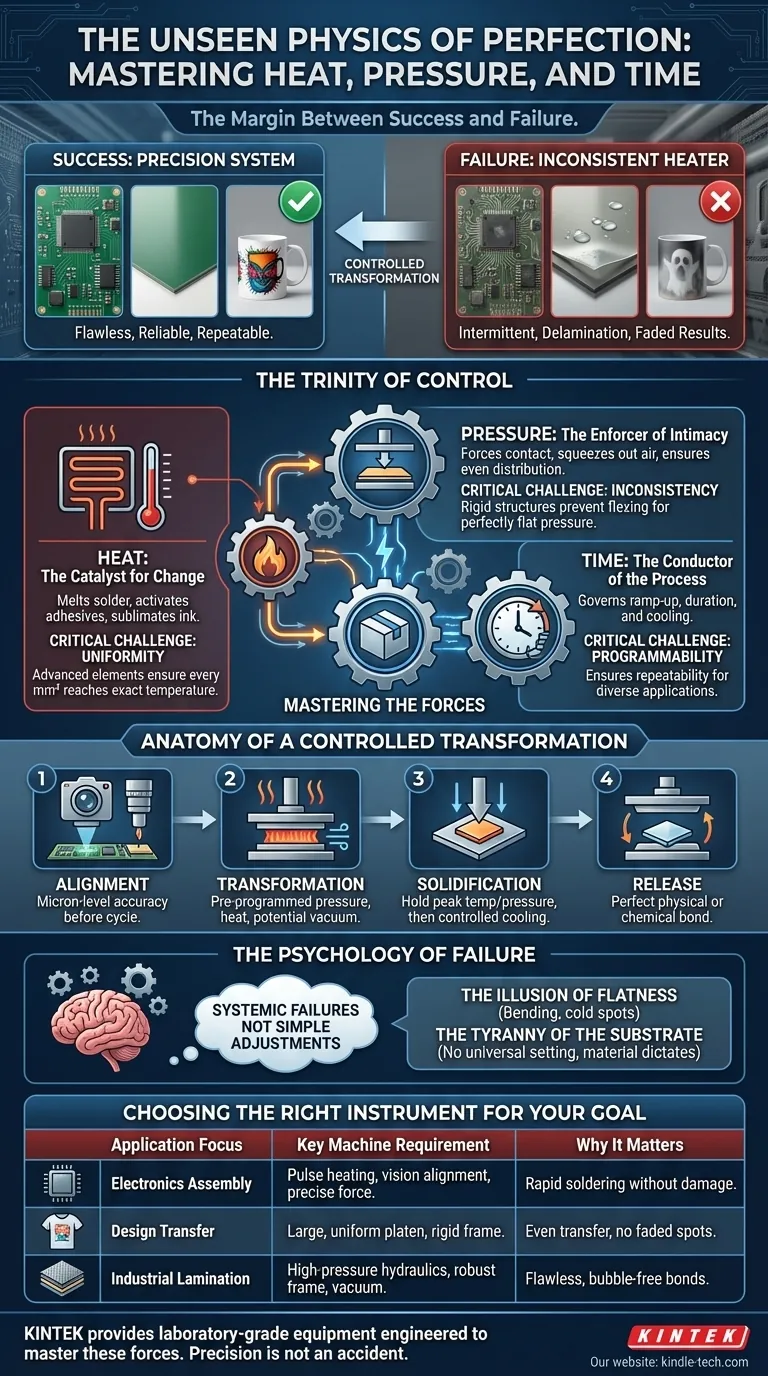
The Trinity of Control
A hot press is not just a clamp that gets hot. It is an instrument designed to orchestrate a material’s transformation by precisely governing three fundamental forces: heat, pressure, and time. The elegance of the machine is in how it synchronizes them.
Heat: The Catalyst for Change
Heat provides the energy to alter a material’s state. It melts solder, activates thermal adhesives, or turns solid ink into gas for sublimation.
But simply applying heat isn't enough. The critical challenge is uniformity.
A cheap press might have hot spots, causing one area to burn while another remains under-activated. High-performance systems use advanced heating elements and indenters made from materials like titanium alloys to ensure every square millimeter of the surface reaches the exact same temperature. This isn't a luxury; it's a non-negotiable requirement for a reliable bond or a perfect transfer.
Pressure: The Enforcer of Intimacy
Pressure forces materials into intimate contact. It squeezes out air and moisture, ensures a thin adhesive layer spreads evenly, and presses transfer paper against a substrate with uncompromising force.
Like heat, the enemy is inconsistency.
If a press frame flexes even slightly under load, more pressure will be applied to the center than the edges. This is why robust industrial presses are often built with massive "four-column, three-plate" structures. They are engineered to resist the immense forces they generate, ensuring pressure is distributed as a perfectly flat, uniform plane.
Time: The Conductor of the Process
Time governs the entire sequence. It dictates the ramp-up speed of the heat, the duration of the peak temperature hold, and the controlled cooling phase.
This programmability is what makes a single machine so versatile. A quick, high-heat cycle might be perfect for a polyester t-shirt, while a complex, multi-stage ramp with a long curing period is necessary for bonding aerospace composites.
Time is the recipe that ensures the process is not just successful, but repeatable.
Anatomy of a Controlled Transformation
While applications vary, the core process unfolds as a meticulously controlled sequence.
1. Alignment: The Moment of Precision
The workpiece is loaded. For consumer products, this might be by hand. For high-stakes electronics, a CCD vision system ensures components are aligned with micron-level accuracy before the cycle even begins.
2. Transformation: The Application of Force
The press closes, applying pre-programmed pressure. Simultaneously, the heating elements activate. In advanced applications like lamination, the machine might first pull a vacuum to eliminate any trapped air—the primary cause of bubbles and imperfections.
3. Solidification: The Final Form
The machine holds the peak temperature and pressure for a set duration. This is where the magic happens: solder flows, adhesives cure, or ink transfers. The system then begins cooling, often while still maintaining pressure, to lock the new structure in place.
4. Release: The Unveiling
Once cooled to a safe temperature, the pressure is released, the press opens, and the finished part is removed. The result is a perfect physical or chemical bond.
The Psychology of Failure
We tend to think in simple cause-and-effect terms. "The print is faded, so I need more heat." "The bond is weak, so I need more pressure."
But the most common failures are systemic, rooted in flawed assumptions about uniformity.
- The Illusion of Flatness: We see a platen as a flat surface, but under tons of force, it wants to bend. We assume heat spreads evenly, but thermodynamics creates cold spots at the edges.
- The Tyranny of the Substrate: There is no universal setting. The ideal combination of heat, pressure, and time is dictated entirely by the material itself. Using the settings for a thin fabric on a thick ceramic tile will always lead to failure. The machine is only as good as the operator's understanding of the material's properties.
Success requires moving past simple adjustments and thinking about the entire system.
Choosing the Right Instrument for Your Goal
To achieve consistent results, you must match the machine's capabilities to your specific application. The requirements are fundamentally different.
| Application Focus | Key Machine Requirement | Why It Matters |
|---|---|---|
| Electronics Assembly | Pulse heating, vision alignment, precise force control. | For rapid, targeted soldering without damaging sensitive components. |
| Design Transfer | Large, uniformly heated platen, rigid frame. | Ensures the entire design transfers evenly without faded spots or blurring. |
| Industrial Lamination | High-pressure hydraulics, robust frame, vacuum capability. | Creates flawless, bubble-free bonds by eliminating all air and ensuring contact. |
Understanding these distinctions is the first step toward building a reliable process.
At KINTEK, we provide laboratory-grade equipment engineered to master these forces. Our hot press machines are designed for professionals who understand that precision is not an accident. They deliver the uniform heating, consistent pressure, and programmable control needed to move from unpredictable results to repeatable perfection.
Whether you are soldering delicate electronics or forming advanced materials, we have an instrument to match your ambition. Contact Our Experts
Visual Guide
Related Products
- Automatic Heated Hydraulic Press Machine with Heated Plates for Laboratory Hot Press 25T 30T 50T
- 30T 40T Split Automatic Heated Hydraulic Press Machine with Heated Plates for Laboratory Hot Press
- Automatic Heated Hydraulic Press Machine with Heated Plates for Laboratory Hot Press
- Automatic High Temperature Heated Hydraulic Press Machine with Heated Plates for Lab
- 24T 30T 60T Heated Hydraulic Press Machine with Heated Plates for Laboratory Hot Press
Related Articles
- Why Your Composite and Polymer Parts Keep Failing: The Secret Is Simultaneous Heat and Pressure
- The Physics of Flawless Materials: Deconstructing the Hydraulic Hot Press
- Precision Under Pressure: The Physics and Psychology of the Hydraulic Hot Press
- Hydraulic Hot Press: Principles, Components, Features, Advantages, and Applications
- Comprehensive Guide to Hydraulic Hot Press: Function, Features and Applications