The Anatomy of an Invisible Flaw
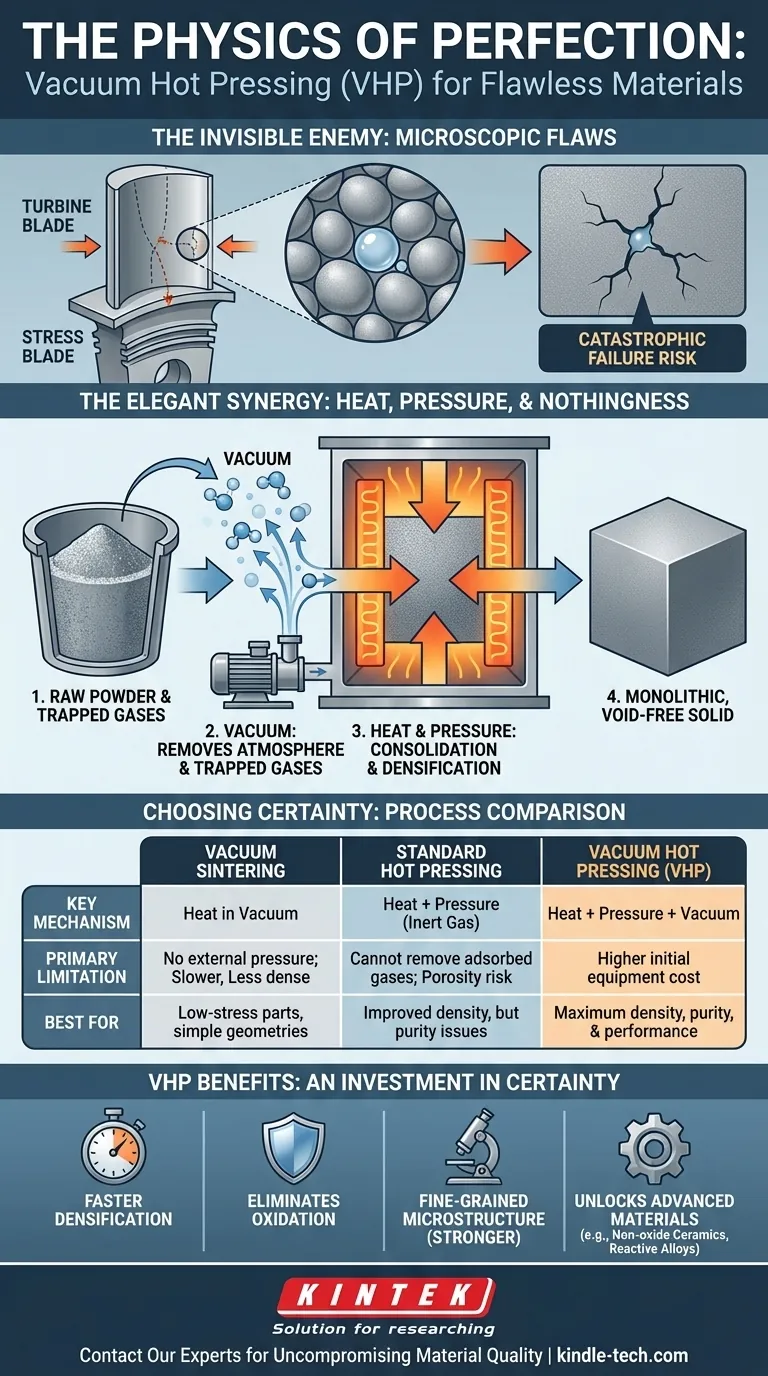
Imagine an engineer designing a turbine blade for a jet engine or a load-bearing medical implant. The design is flawless, the geometry perfect. But the greatest risk lies in something you cannot see: a microscopic bubble of air, trapped between grains of metal powder during manufacturing.
Under immense stress, this tiny void becomes the origin of a crack. It is a catastrophic failure waiting to happen, born from an enemy that was always there, hiding in plain sight.
In the world of advanced materials, success is often a battle against these invisible flaws. The pursuit is not just for strength or heat resistance, but for absolute structural integrity. It's a psychological as well as a technical challenge—how do you eliminate a threat you can't even see?
An Elegant Synergy: Heat, Pressure, and Nothingness
The solution is a process of beautiful simplicity and technical sophistication: vacuum hot pressing. It doesn't just form a material; it perfects it by creating an environment where flaws have nowhere to hide.
The process is a carefully choreographed dance of three forces.
Heat and Pressure: The Foundation of Form
First, heat makes the raw powder material malleable, like clay on a potter's wheel. Simultaneously, immense mechanical pressure forces these softened particles together, squeezing out the space between them. This is the brute-force element of consolidation, the powerful act of creating a solid from a powder.
But by itself, it's not enough. Air and other gases adsorbed to the powder's surface are now trapped, creating the very voids we seek to eliminate.
The Power of Absence: The Role of the Vacuum
This is where the elegance lies. Before the full force is applied, a powerful vacuum is drawn in the chamber. This act of creating "nothing" is the most critical step.
The vacuum does two things:
- It removes the atmosphere, preventing oxidation that could compromise sensitive materials at high temperatures.
- It extracts the trapped gases from between the powder particles, pulling the invisible enemy out of its hiding place.
By removing the medium for flaws to exist, the vacuum ensures that when the particles are pressed together, they form a truly monolithic, void-free solid. It is an act of controlling the variables to achieve a predictable, perfect outcome.
The Psychology of the Right Tool
Choosing a manufacturing process is a statement about your tolerance for risk. Are you optimizing for cost, or are you engineering to eliminate every conceivable point of failure?
| Process | Key Mechanism | Primary Limitation | Best For |
|---|---|---|---|
| Vacuum Sintering | Heat in a vacuum | No external pressure; slower, less dense | Low-stress parts, simple geometries |
| Standard Hot Pressing | Heat + Pressure (in inert gas) | Cannot remove adsorbed gases; risk of porosity | Improved density, but purity can be an issue |
| Vacuum Hot Pressing | Heat + Pressure + Vacuum | Higher initial equipment cost | Maximum density, purity, and performance |
An Investment in Certainty
Simpler methods like conventional sintering are less expensive, but they leave the final density and purity partially to chance. They rely on atomic diffusion, a slow and sometimes incomplete process.
Vacuum hot pressing is an investment in certainty. The external pressure actively accelerates densification, achieving in minutes what might take hours in a standard furnace. It allows for lower temperatures, which is critical for one key reason: it prevents the material’s grains from growing too large.
A fine-grained microstructure is almost always a stronger, harder microstructure. By keeping the process short and cool, you are not just creating a dense part; you are preserving the internal architecture that gives the material its superior properties.
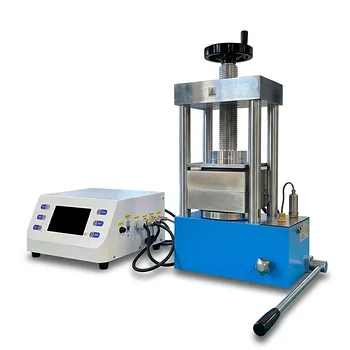
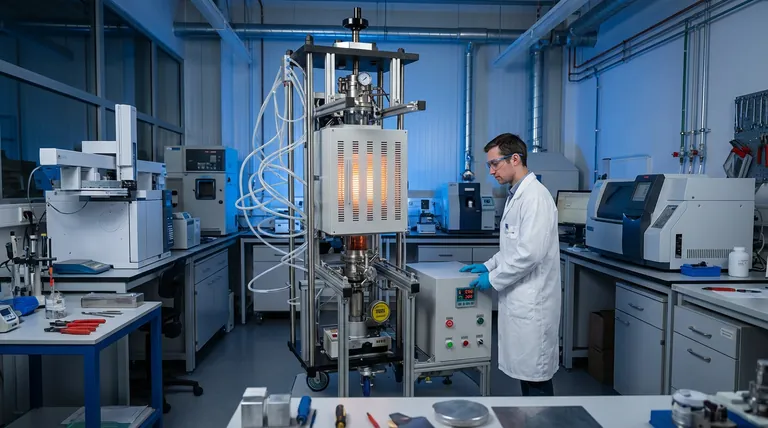
This level of control requires equipment built with uncompromising precision. A vacuum hot press is not just a furnace; it's an integrated system where a high-temperature furnace, a powerful hydraulic press, and a high-vacuum system work in perfect concert. At KINTEK, we understand that investing in such a system is an investment in repeatable, flawless results.
Unlocking the Frontier of Materials
The practical outcome of this process is the ability to create materials that were previously impossible.
- Reactive alloys that would be destroyed by oxygen can be formed with pristine purity.
- Non-oxide ceramics like silicon nitride or boron carbide, essential for armor and cutting tools, can reach their full theoretical density and hardness.
- Advanced composites can be bonded with an integrity that no other process can match.
Ultimately, the choice to use vacuum hot pressing is the choice to take control. It acknowledges the simple, powerful truth that to build something truly solid, you must first begin with a perfect void. The principles are elegant, and their application in a high-performance laboratory furnace is where modern material science is born.
If your work demands materials without compromise, the right equipment is what allows you to eliminate the variables that stand in your way. Contact Our Experts
Visual Guide
Related Products
- Vacuum Hot Press Furnace Machine Heated Vacuum Press
- Vacuum Hot Press Furnace Heated Vacuum Press Machine Tube Furnace
- Vacuum Hot Press Furnace Machine for Lamination and Heating
- Electric Heated Hydraulic Vacuum Heat Press for Lab
- Touchscreen Automatic Vacuum Heat Press
Related Articles
- The Purity Paradox: Choosing the Heart of Your Vacuum Hot Press Furnace
- Comprehensive Guide to Vacuum Hot Press Furnace Application
- Vacuum Hot Press Furnace: A Comprehensive Guide
- Forging Perfection in a Void: The Physics of Ultra-Dense Materials
- Defeating the Void: The Quiet Power of Vacuum Hot Pressing