Blog Beyond the Gauge: The Systematic Hunt for Vacuum Furnace Leaks
Beyond the Gauge: The Systematic Hunt for Vacuum Furnace Leaks

Beyond the Gauge: The Systematic Hunt for Vacuum Furnace Leaks

4 hours ago

The Ghost in the Machine

A high-purity process concludes. Every parameter on the control screen—temperature, pressure, cycle time—was perfect. Yet, the final product is contaminated, oxidized, and unusable. The batch is lost.

The culprit is an invisible saboteur: a microscopic atmospheric leak.

This scenario is a familiar frustration in many labs. We are trained to trust our instruments, to believe the data on the screen. But when a system’s physical integrity is compromised, the gauges only tell part of the story. The real challenge is a psychological one: we must hunt for something we cannot see, in a system we assume is perfectly sealed. This requires moving beyond simple monitoring and adopting a systematic, investigative mindset.

The First Question: Which Way is the Pressure Flowing?

Before you can find a leak, you must understand its nature. The entire diagnostic process hinges on one simple question: is gas leaking out of the furnace, or is air leaking in? The answer depends entirely on the system's pressure relative to the atmosphere.

Leaks Under Positive Pressure: The Telltale Signature

When the internal pressure of a furnace is higher than the outside atmosphere, gas will actively escape. This makes detection relatively straightforward.

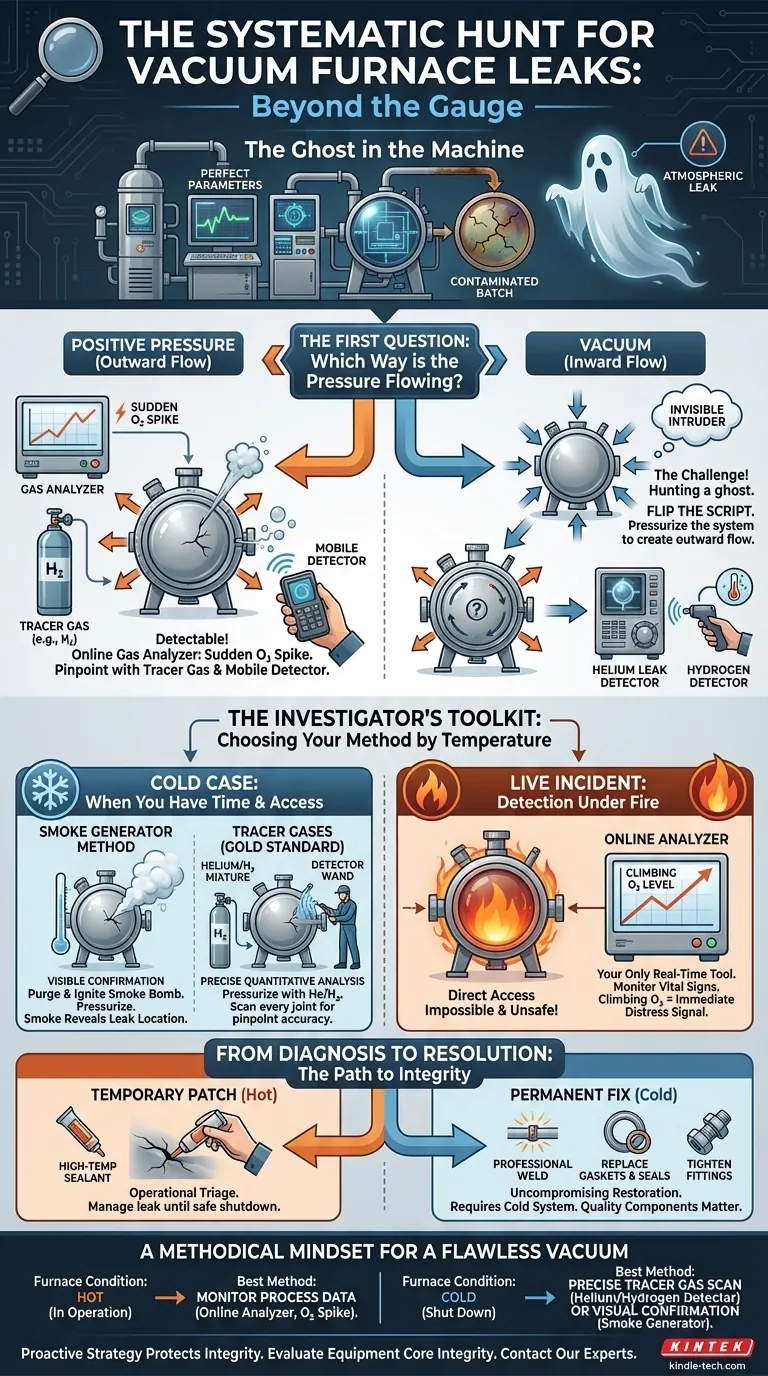
Your first line of defense is your online gas analyzer. A sudden, sharp spike in residual oxygen is the undeniable fingerprint of an atmospheric leak. It’s a clear signal that air is being drawn into the gas circulation path through a breach in the furnace shell or piping.

To pinpoint the exact location, you can introduce a tracer gas and pressurize the vessel. A mobile detector for a gas like hydrogen can then verify the integrity of specific joints, welds, and seals.

Leaks Under Vacuum: The Invisible Intruder

Detecting a leak under vacuum is far more challenging. Here, the pressure differential pulls air into the furnace. There is no outward plume to detect, no escaping gas to trace. You are hunting a ghost.

The most effective strategy is to flip the script. By shutting down the furnace and converting the negative pressure into a slight positive pressure, you turn an inward-flowing leak into an outward-flowing one.

Once pressurized, the invisible becomes detectable. A highly sensitive helium leak detector or a hydrogen detector can be used to scan the exterior of the furnace, transforming a frustrating search into a precise, methodical process.

The Investigator's Toolkit: Choosing Your Method by Temperature

The state of the furnace—hot and operational, or cold and shut down—dictates your tools and strategy. It's a matter of both accessibility and safety.

The Cold Case: When You Have Time and Access

A cold, inactive furnace is a crime scene that can be fully investigated. This is your best opportunity to find persistent, hard-to-find leaks.

The smoke generator method is a triumph of elegant simplicity. After purging the furnace of all combustible gases, a smoke bomb is ignited inside. The vessel is pressurized, and the smoke will pour out of any crack or faulty seal, creating a visible plume that unambiguously reveals the leak's location. It makes the invisible, visible.

For more precise, quantitative analysis, tracer gases are the gold standard. After pressurizing the furnace with helium or a hydrogen mixture, a detector wand is moved over every potential failure point—flanges, welds, feedthroughs, and valve seals. This is the high-tech, definitive approach to pinpointing a breach.

The Live Incident: Detection Under Fire

When a leak is suspected during a hot cycle, you are a first responder, not a forensic investigator. Direct access is impossible and unsafe. Your priority is to manage the situation and protect the process.

Here, your online analyzer is your only real-time tool. It is the furnace's vital signs monitor. A climbing oxygen level is a clear distress signal that demands immediate attention, even if a physical fix must wait.

From Diagnosis to Resolution: The Path to Integrity

Identifying a leak is only half the battle. The path to resolving it requires a clear distinction between temporary measures and permanent solutions.

The Temporary Patch: Keeping the Process Alive

If a leak appears while the furnace is hot and aborting the cycle isn't an option, a high-temperature sealant can be applied to the suspected area. This is operational triage—a battlefield patch designed to manage the leak until the furnace can be safely shut down for a proper repair.

The Permanent Fix: Restoring the System

True, lasting repairs can only be performed when the furnace is cold. Rushing this process guarantees future failures. A permanent fix is uncompromising:

  • Cracked parts must be professionally welded.
  • Aged gaskets and seals must be replaced, not patched.
  • Loose fittings must be tightened to precise torque specifications.

This is where the quality of the initial engineering and components, from seals to the furnace body itself, becomes paramount. Equipment from manufacturers like KINTEK, designed for robust laboratory use with high-quality consumables, minimizes these failure points from the start.

A Methodical Mindset for a Flawless Vacuum

A systematic approach transforms leak detection from a guessing game into a science. Your decision-making process should be clear and methodical.

Furnace Condition Best Detection Method Primary Tool / Indicator
Hot / In Operation Monitor Process Data Online Analyzer (Sudden O₂ Spike)
Cold / Shut Down Precise Tracer Gas Scan Helium or Hydrogen Detector
Cold / Stubborn Leak Visual Confirmation Smoke Generator

Ultimately, a proactive leak detection strategy is fundamental to protecting process integrity, ensuring product quality, and maintaining a safe operational environment. If chasing these invisible faults is compromising your results and wasting valuable time, it might be time to evaluate the core integrity of your equipment. Contact Our Experts

Visual Guide
Beyond the Gauge: The Systematic Hunt for Vacuum Furnace Leaks Visual Guide

Related Products

Related Articles

Related Products

Vacuum Dental Porcelain Sintering Furnace

Vacuum Dental Porcelain Sintering Furnace

Get precise and reliable results with KinTek's Vacuum Porcelain Furnace. Suitable for all porcelain powders, it features hyperbolic ceramic furnace function, voice prompt, and automatic temperature calibration.

Small Vacuum Heat Treat and Tungsten Wire Sintering Furnace

Small Vacuum Heat Treat and Tungsten Wire Sintering Furnace

The small vacuum tungsten wire sintering furnace is a compact experimental vacuum furnace specially designed for universities and scientific research institutes. The furnace features a CNC welded shell and vacuum piping to ensure leak-free operation. Quick-connect electrical connections facilitate relocation and debugging, and the standard electrical control cabinet is safe and convenient to operate.

Molybdenum Vacuum Heat Treat Furnace

Molybdenum Vacuum Heat Treat Furnace

Discover the benefits of a high-configuration molybdenum vacuum furnace with heat shield insulation. Ideal for high-purity, vacuum environments like sapphire crystal growth and heat treatment.

Vacuum Heat Treat Furnace with Ceramic Fiber Liner

Vacuum Heat Treat Furnace with Ceramic Fiber Liner

Vacuum furnace with polycrystalline ceramic fiber insulation liner for excellent heat insulation and uniform temperature field. Choose from 1200℃ or 1700℃ max. working temperature with high vacuum performance and precise temperature control.

600T Vacuum Induction Hot Press Furnace for Heat Treat and Sintering

600T Vacuum Induction Hot Press Furnace for Heat Treat and Sintering

Discover the 600T Vacuum Induction Hot Press Furnace, designed for high-temperature sintering experiments in vacuum or protected atmospheres. Its precise temperature and pressure control, adjustable working pressure, and advanced safety features make it ideal for nonmetal materials, carbon composites, ceramics, and metal powders.

Laboratory High Pressure Vacuum Tube Furnace

Laboratory High Pressure Vacuum Tube Furnace

KT-PTF High Pressure Tube Furnace: Compact split tube furnace with strong positive pressure resistance. Working temp up to 1100°C and pressure up to 15Mpa. Also works under controller atmosphere or high vacuum.

Vacuum Sealed Continuous Working Rotary Tube Furnace Rotating Tube Furnace

Vacuum Sealed Continuous Working Rotary Tube Furnace Rotating Tube Furnace

Experience efficient material processing with our vacuum-sealed rotary tube furnace. Perfect for experiments or industrial production, equipped with optional features for controlled feeding and optimized results. Order now.

Laboratory Vacuum Tilt Rotary Tube Furnace Rotating Tube Furnace

Laboratory Vacuum Tilt Rotary Tube Furnace Rotating Tube Furnace

Discover the versatility of Laboratory Rotary Furnace: Ideal for calcination, drying, sintering, and high-temperature reactions. Adjustable rotating and tilting functions for optimal heating. Suitable for vacuum and controlled atmosphere environments. Learn more now!

1200℃ Controlled Atmosphere Furnace Nitrogen Inert Atmosphere Furnace

1200℃ Controlled Atmosphere Furnace Nitrogen Inert Atmosphere Furnace

Discover our KT-12A Pro Controlled atmosphere furnace - high precision, heavy duty vacuum chamber, versatile smart touch screen controller, and excellent temperature uniformity up to 1200C. Ideal for both laboratory and industrial application.

Ultra-High Temperature Graphite Vacuum Graphitization Furnace

Ultra-High Temperature Graphite Vacuum Graphitization Furnace

The ultra-high temperature graphitization furnace utilizes medium frequency induction heating in a vacuum or inert gas environment. The induction coil generates an alternating magnetic field, inducing eddy currents in the graphite crucible, which heats up and radiates heat to the workpiece, bringing it to the desired temperature. This furnace is primarily used for graphitization and sintering of carbon materials, carbon fiber materials, and other composite materials.

Graphite Vacuum Furnace High Thermal Conductivity Film Graphitization Furnace

Graphite Vacuum Furnace High Thermal Conductivity Film Graphitization Furnace

The high thermal conductivity film graphitization furnace has uniform temperature, low energy consumption and can operate continuously.

2200 ℃ Graphite Vacuum Heat Treat Furnace

2200 ℃ Graphite Vacuum Heat Treat Furnace

Discover the power of the KT-VG Graphite Vacuum Furnace - with a maximum working temperature of 2200℃, it's perfect for vacuum sintering of various materials. Learn more now.

Graphite Vacuum Continuous Graphitization Furnace

Graphite Vacuum Continuous Graphitization Furnace

High-temperature graphitization furnace is a professional equipment for graphitization treatment of carbon materials. It is a key equipment for the production of high-quality graphite products. It has high temperature, high efficiency and uniform heating. It is suitable for various high-temperature treatments and graphitization treatments. It is widely used in metallurgy, electronics, aerospace, etc. industry.

Lab-Scale Vacuum Induction Melting Furnace

Lab-Scale Vacuum Induction Melting Furnace

Get precise alloy composition with our Vacuum Induction Melting Furnace. Ideal for aerospace, nuclear energy, and electronic industries. Order now for effective smelting and casting of metals and alloys.

Rotary Tube Furnace Split Multi Heating Zone Rotating Tube Furnace

Rotary Tube Furnace Split Multi Heating Zone Rotating Tube Furnace

Multi zone rotary furnace for high-precision temperature control with 2-8 independent heating zones. Ideal for lithium ion battery electrode materials and high-temperature reactions. Can work under vacuum and controlled atmosphere.

Vacuum Hot Press Furnace Machine for Lamination and Heating

Vacuum Hot Press Furnace Machine for Lamination and Heating

Experience clean and precise lamination with Vacuum Lamination Press. Perfect for wafer bonding, thin-film transformations, and LCP lamination. Order now!

Vertical High Temperature Graphite Vacuum Graphitization Furnace

Vertical High Temperature Graphite Vacuum Graphitization Furnace

Vertical high temperature graphitization furnace for carbonization and graphitization of carbon materials up to 3100℃.Suitable for shaped graphitization of carbon fiber filaments and other materials sintered in a carbon environment.Applications in metallurgy, electronics, and aerospace for producing high-quality graphite products like electrodes and crucibles.

304 316 Stainless Steel Vacuum Ball Valve Stop Valve for High Vacuum Systems

304 316 Stainless Steel Vacuum Ball Valve Stop Valve for High Vacuum Systems

Discover 304/316 stainless steel vacuum ball valves, Ideal for high vacuum systems, Ensure precise control and durability. Explore now!

Circulating Water Vacuum Pump for Laboratory and Industrial Use

Circulating Water Vacuum Pump for Laboratory and Industrial Use

Efficient circulating water vacuum pump for labs - oil-free, corrosion-resistant, quiet operation. Multiple models available. Get yours now!

Oil Free Diaphragm Vacuum Pump for Laboratory and Industrial Use

Oil Free Diaphragm Vacuum Pump for Laboratory and Industrial Use

Oil-free diaphragm vacuum pump for labs: clean, reliable, chemical-resistant. Ideal for filtration, SPE, and rotary evaporation. Maintenance-free operation.


Leave Your Message