Blog Beyond the Spec Sheet: Mastering Temperature in High-Performance Vacuum Furnaces
Beyond the Spec Sheet: Mastering Temperature in High-Performance Vacuum Furnaces

Beyond the Spec Sheet: Mastering Temperature in High-Performance Vacuum Furnaces

14 hours ago

The Allure of the Maximum Number

When specifying a new piece of laboratory equipment, a familiar cognitive bias often takes hold. We scan the spec sheets, and our eyes are drawn to the biggest, boldest numbers. For a vacuum furnace, that number is almost always the maximum achievable temperature.

There's a certain comfort in choosing the furnace that can go to 2200°C over the one that tops out at 1300°C. It feels like buying capability, a buffer for future, unimagined needs.

But in the world of materials science, this is a psychological trap. The pursuit of the highest temperature often distracts from the variable that truly defines a material's final properties: the precision of its thermal journey.

Deconstructing "High Temperature": A Spectrum, Not a Point

"High temperature" is not a destination. It is a carefully selected environment, a tool to initiate specific physical and chemical transformations. The temperature you need is dictated entirely by the material on your bench and the outcome you intend to achieve.

The Workhorse Range: The Foundation of Metallurgy

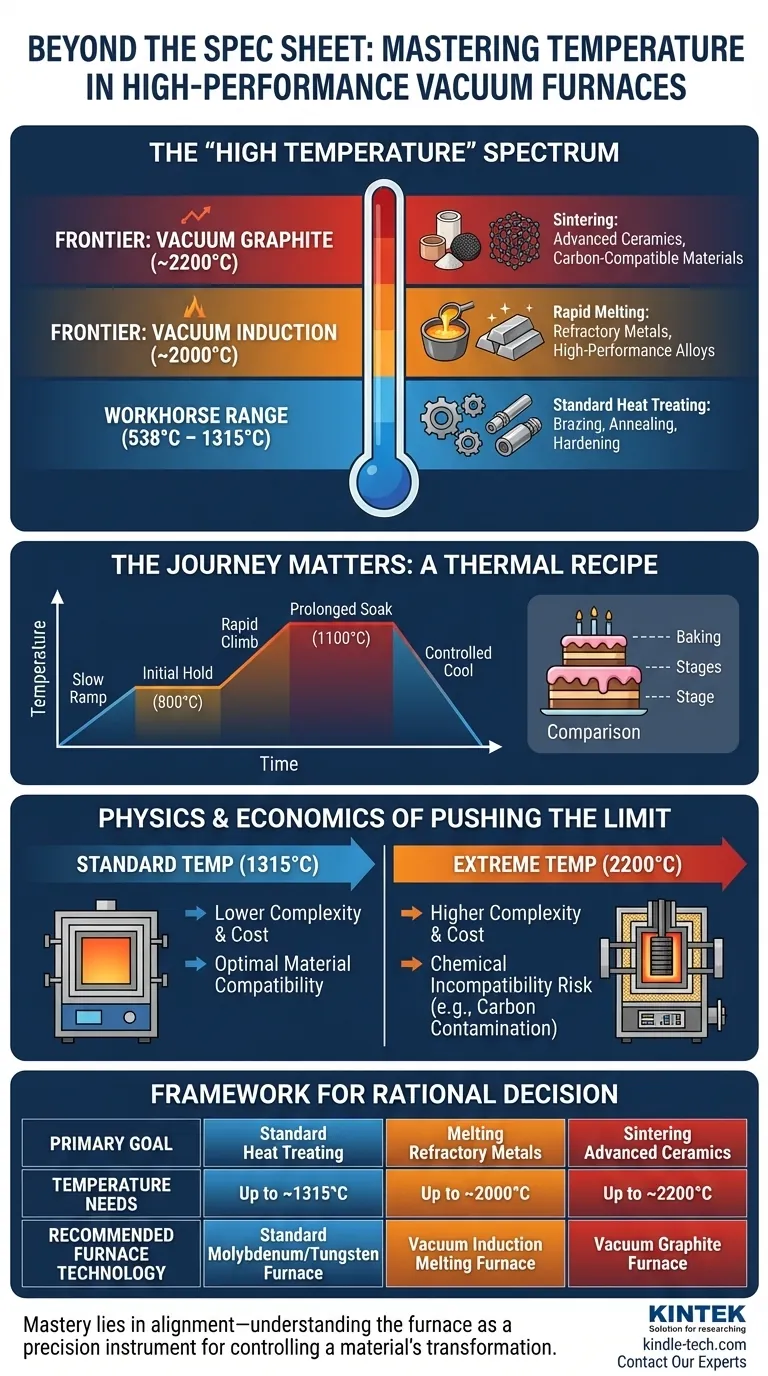
For a vast number of critical industrial processes—brazing, annealing, and hardening steels and other common alloys—the most effective thermal environment lies between 538°C (1000°F) and 1315°C (2400°F).

Furnaces built for this range are the unsung heroes of manufacturing and R&D. They offer a superb balance of performance, versatility, and economic efficiency, enabling the creation of strong, stable, and reliable components.

The Frontier: Forging the Materials of Tomorrow

To create the next generation of materials, we must venture into more extreme thermal landscapes. This is where specialized furnaces come into play, pushing the boundaries of what is possible.

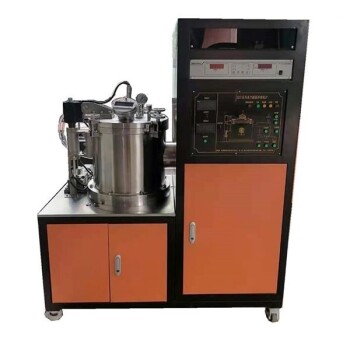
  • Vacuum Induction Furnaces: Capable of reaching up to 2000°C (3632°F), these are designed for the rapid melting of refractory metals and high-performance alloys, creating pure, uniform ingots in a clean environment.
  • Vacuum Graphite Furnaces: Utilizing graphite heating elements, these systems can climb even higher, to 2200°C (3992°F), making them essential for sintering advanced ceramics and other carbon-compatible materials.

The Journey Matters More Than the Destination

A material's final microstructure is a direct record of its history. Reaching a peak temperature of 1100°C is meaningless without considering how it got there and how long it stayed.

Think of it like baking. You don't just put a cake in a 400°F oven. You preheat, you bake for a specific duration, and you control the cooling.

A thermal process is a programmed recipe. It might involve a slow ramp to 800°C for an initial hold, followed by a rapid climb to 1100°C for a prolonged "soak," and then a precisely controlled cooling rate. This control over ramps, holds, and cooling is where true material engineering happens. The maximum temperature is just one note in a complex symphony.

The Physics and Economics of Pushing the Limit

Choosing a furnace with a higher temperature rating than you need isn't just inefficient; it can introduce new problems and unnecessary costs.

The Law of Unintended Consequences

The furnace's internal environment is a chemical system. A graphite heating element, necessary for 2200°C, can introduce carbon into a sensitive alloy, fundamentally altering its properties. This is a classic case of the solution creating a new problem. The heating element must be chemically compatible with the material being processed.

The Compounding Cost of Complexity

As target temperatures rise, so does the engineering complexity. Reaching 2000°C requires more advanced insulation, more sophisticated power controllers, and more robust vacuum systems than a 1300°C furnace. This complexity translates directly into higher acquisition and operational costs. Paying for unused thermal capacity is a poor allocation of a laboratory's budget.

A Framework for a Rational Decision

The right choice is not the furnace with the highest number, but the one whose capabilities are perfectly aligned with your process requirements. The decision should be driven by your material's needs.

Your Primary Goal Temperature Needs Recommended Furnace Technology
Standard Heat Treating (Annealing, Brazing) Up to ~1315°C Standard Molybdenum/Tungsten Furnace
Melting Refractory Metals & Alloys Up to ~2000°C Vacuum Induction Melting Furnace
Sintering Advanced Ceramics & Carbon Materials Up to ~2200°C Vacuum Graphite Furnace

Mastery in materials science lies in this alignment—in understanding that the furnace is not just a heater, but a precision instrument for controlling a material's transformation.

At KINTEK, we build our laboratory furnaces on this philosophy. We specialize in providing equipment tailored to the specific thermal processes our clients need, ensuring that every degree of temperature is controlled, repeatable, and effective. To find the right instrument for your material's journey, Contact Our Experts.

Visual Guide
Beyond the Spec Sheet: Mastering Temperature in High-Performance Vacuum Furnaces Visual Guide

Related Products

Related Articles

Related Products

Laboratory High Pressure Vacuum Tube Furnace

Laboratory High Pressure Vacuum Tube Furnace

KT-PTF High Pressure Tube Furnace: Compact split tube furnace with strong positive pressure resistance. Working temp up to 1100°C and pressure up to 15Mpa. Also works under controller atmosphere or high vacuum.

Vacuum Heat Treat Furnace with Ceramic Fiber Liner

Vacuum Heat Treat Furnace with Ceramic Fiber Liner

Vacuum furnace with polycrystalline ceramic fiber insulation liner for excellent heat insulation and uniform temperature field. Choose from 1200℃ or 1700℃ max. working temperature with high vacuum performance and precise temperature control.

Molybdenum Vacuum Heat Treat Furnace

Molybdenum Vacuum Heat Treat Furnace

Discover the benefits of a high-configuration molybdenum vacuum furnace with heat shield insulation. Ideal for high-purity, vacuum environments like sapphire crystal growth and heat treatment.

2200 ℃ Graphite Vacuum Heat Treat Furnace

2200 ℃ Graphite Vacuum Heat Treat Furnace

Discover the power of the KT-VG Graphite Vacuum Furnace - with a maximum working temperature of 2200℃, it's perfect for vacuum sintering of various materials. Learn more now.

2200 ℃ Tungsten Vacuum Heat Treat and Sintering Furnace

2200 ℃ Tungsten Vacuum Heat Treat and Sintering Furnace

Experience the ultimate refractory metal furnace with our Tungsten vacuum furnace. Capable of reaching 2200℃, perfect for sintering advanced ceramics and refractory metals. Order now for high-quality results.

Vacuum Heat Treat Sintering Brazing Furnace

Vacuum Heat Treat Sintering Brazing Furnace

A vacuum brazing furnace is a type of industrial furnace used for brazing, a metalworking process that joins two pieces of metal using a filler metal that melts at a lower temperature than the base metals. Vacuum brazing furnaces are typically used for high-quality applications where a strong, clean joint is required.

1700℃ Controlled Atmosphere Furnace Nitrogen Inert Atmosphere Furnace

1700℃ Controlled Atmosphere Furnace Nitrogen Inert Atmosphere Furnace

KT-17A Controlled atmosphere furnace: 1700℃ heating, vacuum sealing technology, PID temperature control, and versatile TFT smart touch screen controller for laboratory and industrial use.

Laboratory Muffle Oven Furnace Bottom Lifting Muffle Furnace

Laboratory Muffle Oven Furnace Bottom Lifting Muffle Furnace

Efficiently produce batches with excellent temperature uniformity using our Bottom Lifting Furnace. Features two electric lifting stages and advanced temperature control up to 1600℃.

Vacuum Heat Treat and Molybdenum Wire Sintering Furnace for Vacuum Sintering

Vacuum Heat Treat and Molybdenum Wire Sintering Furnace for Vacuum Sintering

A vacuum molybdenum wire sintering furnace is a vertical or bedroom structure, which is suitable for withdrawal, brazing, sintering and degassing of metal materials under high vacuum and high temperature conditions. It is also suitable for dehydroxylation treatment of quartz materials.

Ultra-High Temperature Graphite Vacuum Graphitization Furnace

Ultra-High Temperature Graphite Vacuum Graphitization Furnace

The ultra-high temperature graphitization furnace utilizes medium frequency induction heating in a vacuum or inert gas environment. The induction coil generates an alternating magnetic field, inducing eddy currents in the graphite crucible, which heats up and radiates heat to the workpiece, bringing it to the desired temperature. This furnace is primarily used for graphitization and sintering of carbon materials, carbon fiber materials, and other composite materials.

Graphite Vacuum Furnace High Thermal Conductivity Film Graphitization Furnace

Graphite Vacuum Furnace High Thermal Conductivity Film Graphitization Furnace

The high thermal conductivity film graphitization furnace has uniform temperature, low energy consumption and can operate continuously.

1800℃ Muffle Oven Furnace for Laboratory

1800℃ Muffle Oven Furnace for Laboratory

KT-18 muffle furnace with Japan Al2O3 polycrystalline fibe and Silicon Molybdenum heating element, up to 1900℃, PID temperature control and 7" smart touch screen. Compact design, low heat loss, and high energy efficiency. Safety interlock system and versatile functions.

600T Vacuum Induction Hot Press Furnace for Heat Treat and Sintering

600T Vacuum Induction Hot Press Furnace for Heat Treat and Sintering

Discover the 600T Vacuum Induction Hot Press Furnace, designed for high-temperature sintering experiments in vacuum or protected atmospheres. Its precise temperature and pressure control, adjustable working pressure, and advanced safety features make it ideal for nonmetal materials, carbon composites, ceramics, and metal powders.

High Temperature Muffle Oven Furnace for Laboratory Debinding and Pre Sintering

High Temperature Muffle Oven Furnace for Laboratory Debinding and Pre Sintering

KT-MD High temperature debinding and pre-sintering furnace for ceramic materials with various molding processes. Ideal for electronic components such as MLCC and NFC.

Laboratory Rapid Thermal Processing (RTP) Quartz Tube Furnace

Laboratory Rapid Thermal Processing (RTP) Quartz Tube Furnace

Get lightning-fast heating with our RTP Rapid Heating Tube Furnace. Designed for precise, high-speed heating and cooling with convenient sliding rail and TFT touch screen controller. Order now for ideal thermal processing!

1200℃ Split Tube Furnace with Quartz Tube Laboratory Tubular Furnace

1200℃ Split Tube Furnace with Quartz Tube Laboratory Tubular Furnace

KT-TF12 split tube furnace: high-purity insulation, embedded heating wire coils, and max. 1200C. Widely used for new materials and chemical vapour deposition.

1400℃ Controlled Atmosphere Furnace with Nitrogen and Inert Atmosphere

1400℃ Controlled Atmosphere Furnace with Nitrogen and Inert Atmosphere

Achieve precise heat treatment with KT-14A controlled atmosphere furnace. Vacuum sealed with a smart controller, it's ideal for lab and industrial use up to 1400℃.

Vertical Laboratory Tube Furnace

Vertical Laboratory Tube Furnace

Elevate your experiments with our Vertical Tube Furnace. Versatile design allows for operation under various environments and heat treatment applications. Order now for precise results!

Graphite Vacuum Furnace IGBT Experimental Graphitization Furnace

Graphite Vacuum Furnace IGBT Experimental Graphitization Furnace

IGBT experimental graphitization furnace, a tailored solution for universities and research institutions, with high heating efficiency, user-friendliness, and precise temperature control.

Vertical High Temperature Graphite Vacuum Graphitization Furnace

Vertical High Temperature Graphite Vacuum Graphitization Furnace

Vertical high temperature graphitization furnace for carbonization and graphitization of carbon materials up to 3100℃.Suitable for shaped graphitization of carbon fiber filaments and other materials sintered in a carbon environment.Applications in metallurgy, electronics, and aerospace for producing high-quality graphite products like electrodes and crucibles.


Leave Your Message