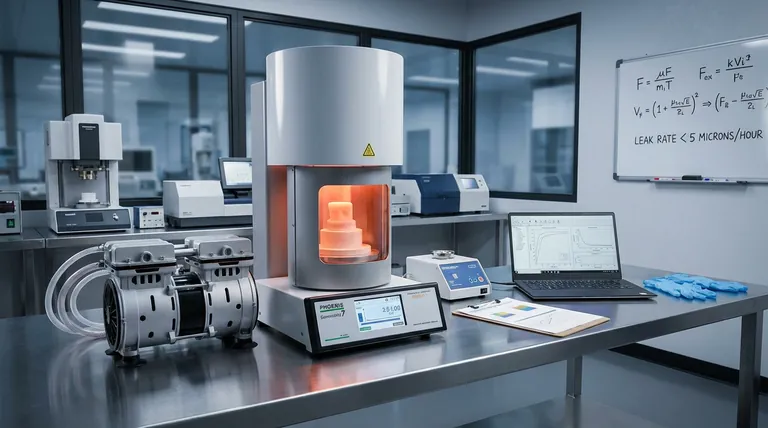
A Chamber of Promises
Imagine an engineer preparing a critical component for an aerospace application. Inside the polished steel walls of a vacuum furnace, a complex brazing process is about to begin. The success of this multi-million-dollar part depends on a simple, invisible promise: that the chamber is a perfectly isolated universe, a sanctuary from the reactive, chaotic atmosphere outside.
This is not just a technical process; it's an act of trust. We trust the furnace to create an environment of absolute purity. The leak rate is the measure of that trust. It’s a number that quantifies the integrity of the vessel's promise.
The Invisible Saboteur
A leak in a vacuum system is a quiet, relentless invasion. It's the slow creep of the outside world into a controlled environment. While seemingly insignificant, this intrusion works directly against the furnace's primary purpose, with consequences that ripple through every aspect of production.
- The Betrayal of Quality: The primary invaders are nitrogen, oxygen, and water vapor. They don’t just contaminate; they actively sabotage. Oxygen molecules cause microscopic oxidation on part surfaces, weakening metallurgical bonds and leading to discoloration, poor performance, and even catastrophic failure.
- The Tax on Efficiency: A leaking furnace forces the high-vacuum pumps into a constant, unwinnable battle. They work overtime to remove gas as fast as it enters, paying a continuous tax in the form of higher energy consumption and accelerated wear. This extends cycle times and quietly inflates operational costs.
- The Erosion of Repeatability: You cannot replicate success if your starting conditions are a random variable. A variable leak rate introduces chaos into a system designed for order, making it impossible to guarantee the same pristine atmosphere from one cycle to the next.
The Moment of Truth: Measuring Integrity
To truly understand a furnace's health, we can't just look at the gauge during operation. We need an honest, isolated conversation with the chamber itself. This is the purpose of a standardized leak rate test.
The procedure is a diagnostic ritual designed to reveal the truth.
The Purge: Quieting the Noise
First, the furnace undergoes a hot, dry, and empty cycle. This isn't just for cleaning; it’s to force the internal surfaces and insulation to release any trapped molecules—a phenomenon called outgassing. We must quiet this internal "noise" so we can listen for the faint whisper of an external leak.
The Isolation: A Test of Self-Reliance
After pumping down to a deep vacuum (typically 1 x 10⁻⁴ Torr or better), the moment of truth arrives. The main valve connecting the chamber to the pumping system is closed.
This is the most critical step. By isolating the chamber, we remove its life support. We force it to stand on its own. The subsequent pressure rise is a pure, unfiltered measure of the chamber's integrity—how well it can maintain its promised environment without help.
The Verdict: A Standard of Trust
The pressure is monitored over time, and the rate of rise is calculated. The industry benchmark for a high-integrity system is a leak rate of less than 5 microns per hour. Anything below this number signifies a trustworthy chamber, capable of protecting its precious cargo.
Psychological Traps: How We Deceive Ourselves
Interpreting the furnace's health is prone to cognitive biases. We can easily mistake one signal for another or be lulled into a false sense of security.
- Confusing Ghosts with Intruders: A pressure rise from outgassing can look identical to a leak. It’s the furnace's own "breath" of trapped water vapor. Without the disciplined hot-and-dry test protocol, operators can spend weeks chasing a non-existent external leak, when the real culprit is internal moisture.
- The Illusion of Power: A sufficiently powerful pumping system can mask a moderate leak during operation. The gauges look good because the pumps are removing the invading atmosphere as quickly as it enters. But the contamination is still happening, silently compromising every part. The isolation test is the only antidote to this dangerous illusion.
What is Your Standard of Purity?
The acceptable leak rate for your operation is a direct reflection of your process's sensitivity and your commitment to quality.
| Process Focus | Recommended Leak Rate | Operational Mindset |
|---|---|---|
| High-Purity / Aerospace | < 2-5 microns/hour | Zero Compromise. The cost of failure is astronomical. The furnace's integrity must be absolute and frequently verified. |
| General Heat Treating | < 5-10 microns/hour | Disciplined Monitoring. The industry standard is a reliable benchmark. Vigilance for any signs of product oxidation is key. |
| Furnace Diagnostics | > 10-20 microns/hour | Critical Failure. This is not a performance issue; it is a system breach. The trust is broken and requires immediate repair. |
Achieving and maintaining these standards requires more than just a well-built furnace. It requires an ecosystem of reliability—from the seals and valves to the instrumentation and consumables. Every component is a link in the chain of trust.
Building that foundation of trust demands a commitment to quality in every part of your system. At KINTEK, we provide the specialized lab equipment and consumables engineered for the uncompromising integrity your most critical work demands.
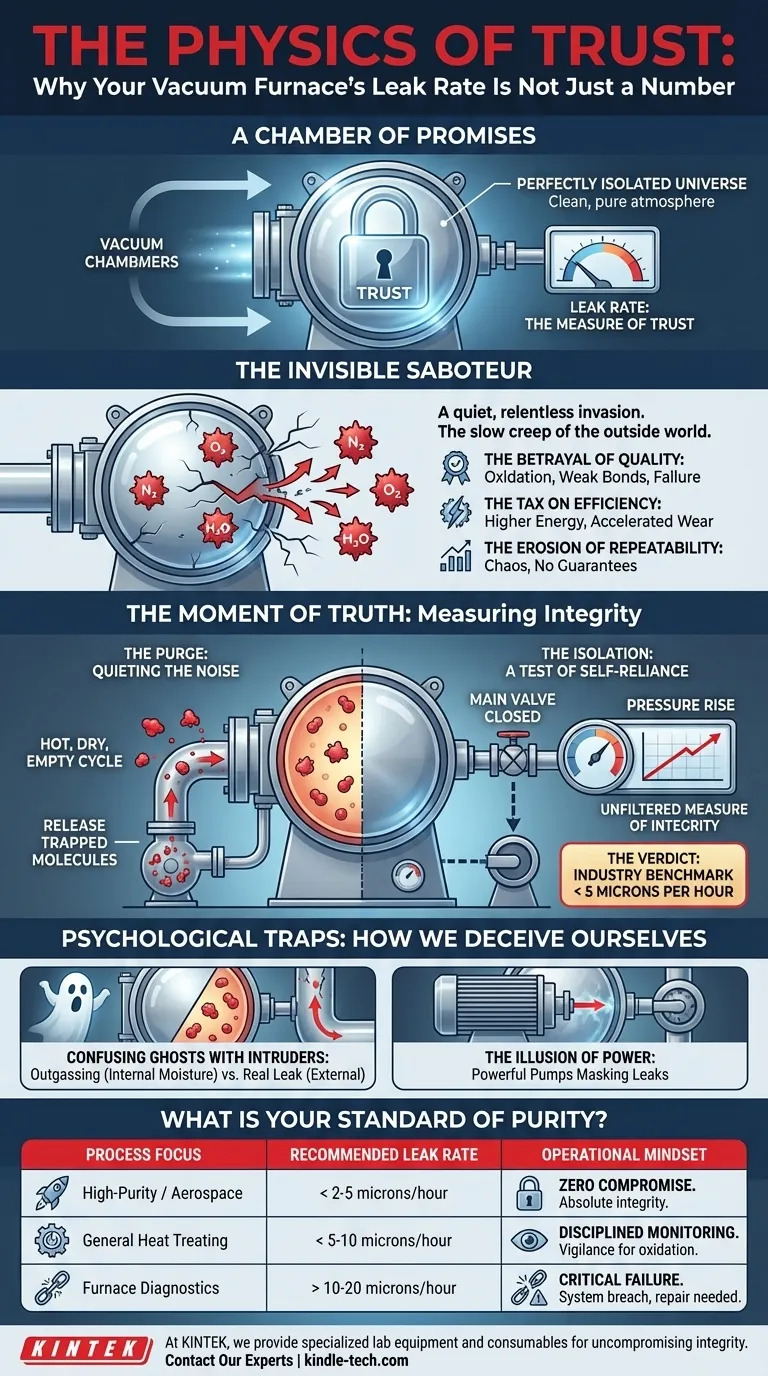
Visual Guide
Related Products
- Vacuum Hot Press Furnace Heated Vacuum Press Machine Tube Furnace
- 600T Vacuum Induction Hot Press Furnace for Heat Treat and Sintering
- Vacuum Hot Press Furnace Machine Heated Vacuum Press
- Vacuum Heat Treat Furnace and Levitation Induction Melting Furnace
- 2200 ℃ Tungsten Vacuum Heat Treat and Sintering Furnace
Related Articles
- The Purity Paradox: Choosing the Heart of Your Vacuum Hot Press Furnace
- Comprehensive Guide to Vacuum Hot Press Furnace Application
- Vacuum Hot Press Furnace: A Comprehensive Guide
- Forging Perfection in a Void: The Physics of Ultra-Dense Materials
- Defeating the Void: The Quiet Power of Vacuum Hot Pressing



















