The Allure of the Single Metric
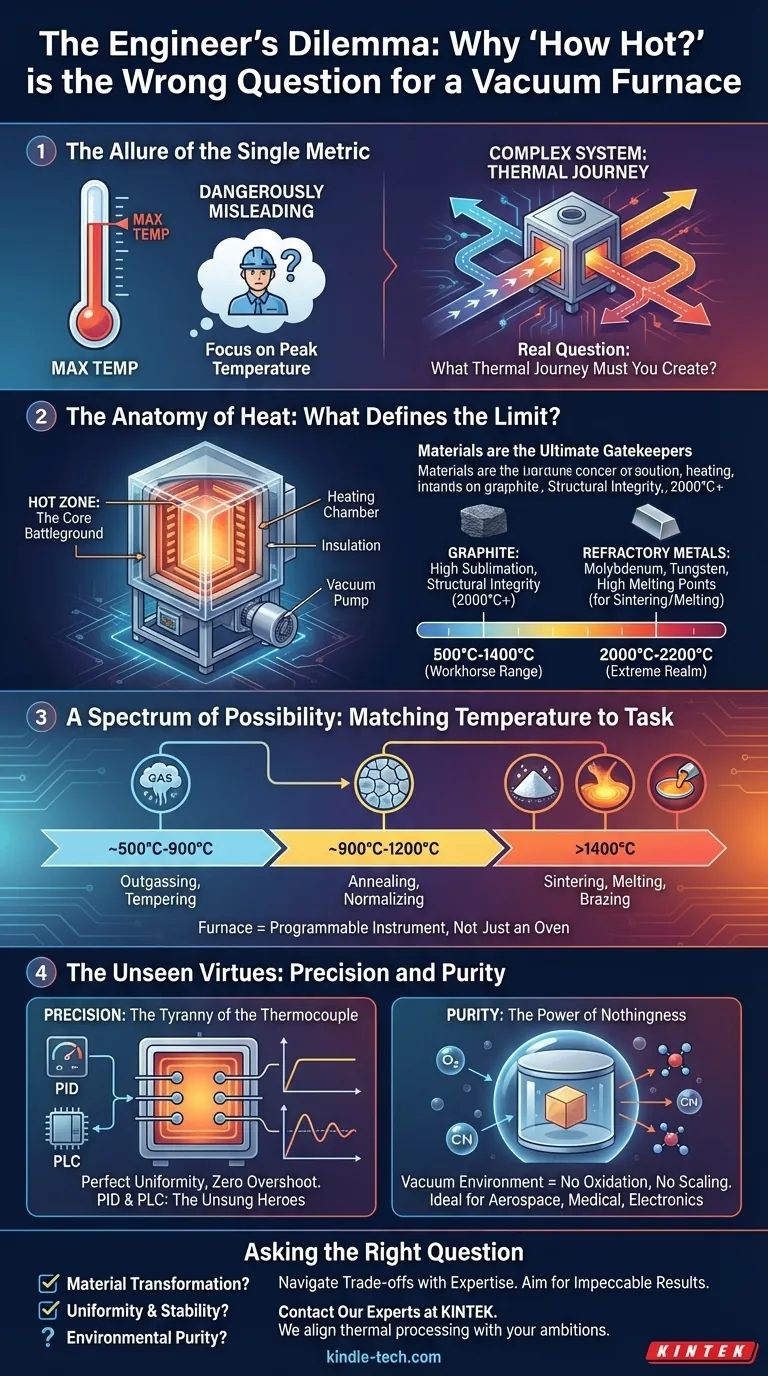
Humans have a powerful psychological bias for simple answers. When faced with a complex system, we instinctively search for a single number to judge it by—horsepower for a car, megapixels for a camera, or maximum temperature for a furnace.
This simplification feels efficient, but it's often dangerously misleading.
An engineer specifying a new vacuum furnace might fixate on the question, "How hot can it get?" It seems logical. But this question is a trap. It mistakes the ceiling for the entire architecture. The real question isn't about the peak temperature; it's about the nature of the thermal journey you need to create.
The Anatomy of Heat: What Defines the Limit?
A vacuum furnace is a carefully contained universe. Its ultimate temperature limit isn't an arbitrary setting but a fundamental law dictated by its physical construction.
The Heart of the Furnace: The Hot Zone
At the core of the furnace is the "hot zone"—the chamber containing the heating elements and insulation. This is where the thermal battle is won or lost. The materials used here are the ultimate gatekeepers of temperature.
A standard furnace, designed for common heat-treating processes, might operate comfortably between 500°C and 1400°C. This range is a workhorse, suitable for annealing, tempering, and vacuum carburizing.
Material Science as the Gatekeeper
To push beyond these limits—into the realm of 2000°C or even 2200°C—requires a different class of materials. Here, we see the elegance of engineering with elements that thrive in extremes.
- Graphite: With its incredibly high sublimation point and structural integrity under vacuum, graphite is the material of choice for heating elements and insulation in many high-temperature furnaces.
- Refractory Metals: Metals like molybdenum and tungsten are also used for their high melting points and stability, allowing furnaces to reach the temperatures needed for sintering ceramics or melting advanced alloys.
The maximum temperature is therefore not a feature to be dialed up, but a consequence of deliberate material science choices.
A Spectrum of Possibility: Matching Temperature to Task
The true value of a furnace lies in its ability to precisely execute specific thermal recipes. Different material transformations awaken at different temperatures, each requiring a unique profile of heating, holding, and cooling.
| Temperature Range | Key Processes | The "Why" |
|---|---|---|
| ~500°C to 900°C | Outgassing, Tempering | Gently purges trapped gases; refines material hardness. |
| ~900°C to 1200°C | Annealing, Normalizing | Alters a metal's microstructure for improved ductility. |
| >1400°C | Sintering, Melting, Brazing | Fuses powdered metals; creates high-performance alloys. |
Viewing the furnace not as an oven, but as a programmable instrument, shifts the focus from raw power to nuanced capability.
The Unseen Virtues: Precision and Purity
If peak temperature is the most visible metric, two other factors are far more critical to the quality of the final product: control and environment.
The Tyranny of the Thermocouple
Reaching 1100°C is one thing. Holding that temperature with near-perfect uniformity across a large component, without overshoot or fluctuation, is another. This is the difference between a blunt instrument and a surgical tool.
Sophisticated control systems, using PID (Proportional-Integral-Derivative) loops and PLCs (Programmable Logic Controllers), are the unsung heroes. They constantly measure and adjust, ensuring the material undergoes the exact transformation intended. For many applications, this stability is infinitely more valuable than a higher peak number.
The Power of Nothingness
The "vacuum" in a vacuum furnace is its primary feature. By removing oxygen, the furnace creates an environment where materials can be heated without the risk of oxidation, scaling, or surface contamination.
This purity is non-negotiable in industries like aerospace, medical implants, and high-performance electronics, where surface integrity and material properties must be perfect. The vacuum ensures that the only changes happening to the workpiece are the ones you designed.
Asking the Right Question
Choosing the right vacuum furnace begins by rejecting the allure of the single, simple metric. Instead of asking "How hot can it get?", the more insightful questions are:
- What specific material transformation do I need to achieve?
- How critical is temperature uniformity and stability for my process?
- What level of environmental purity does my final product demand?
Navigating these trade-offs between peak temperature, process control, and material science is where expertise becomes essential. For labs aiming to achieve not just high temperatures but impeccable results, the first step is a conversation about the end goal. At KINTEK, we provide the specialized lab equipment and expertise to ensure your thermal processing capabilities are perfectly aligned with your ambitions.
To find the instrument that truly meets your needs, Contact Our Experts.
Visual Guide
Related Products
- Vacuum Hot Press Furnace Heated Vacuum Press Machine Tube Furnace
- 600T Vacuum Induction Hot Press Furnace for Heat Treat and Sintering
- Vacuum Hot Press Furnace Machine Heated Vacuum Press
- Vacuum Heat Treat Furnace and Levitation Induction Melting Furnace
- 2200 ℃ Tungsten Vacuum Heat Treat and Sintering Furnace
Related Articles
- The Purity Paradox: Choosing the Heart of Your Vacuum Hot Press Furnace
- Comprehensive Guide to Vacuum Hot Press Furnace Application
- Vacuum Hot Press Furnace: A Comprehensive Guide
- Forging Perfection in a Void: The Physics of Ultra-Dense Materials
- Defeating the Void: The Quiet Power of Vacuum Hot Pressing