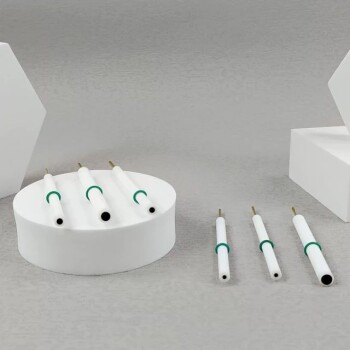
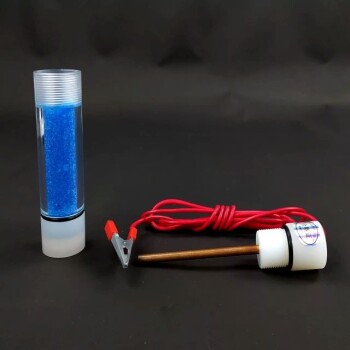
In an enzymatic fuel cell testing system, these three components function as a standard three-electrode electrochemical cell. The Glassy Carbon Electrode (GCE) acts as the Working Electrode (WE) where the enzyme-driven reaction occurs, the Saturated Calomel Electrode (SCE) provides a stable Reference Electrode (RE) potential, and the Graphite Rod serves as the Counter Electrode (CE) to complete the electrical circuit. This configuration isolates the performance of the enzyme from external electrical variables, allowing for the precise measurement of catalytic activity.
The three-electrode setup is designed to decouple the current flow from the potential measurement. This ensures that the electrochemical data collected is a true representation of the enzyme's performance at the working electrode, free from the interference of voltage drops or counter-reactions.
The Functional Roles of the Electrode Trio
The Glassy Carbon Electrode as the Reactive Hub
The GCE serves as the Working Electrode (WE) and is the site of the primary redox reaction. In an enzymatic fuel cell (EFC), it is typically loaded with enzymes and mesoporous carbon to facilitate electron transfer.
Because glassy carbon is chemically inert and highly conductive, it provides a "blank slate" for the enzyme catalyst. This allows researchers to measure the specific current generated by the enzyme’s interaction with its substrate.
The Saturated Calomel Electrode as the Constant Ruler
The SCE functions as the Reference Electrode (RE), providing a stable and known potential against which the Working Electrode is measured. It does not participate in the reaction and carries no significant current.
By maintaining a fixed potential, the SCE allows the potentiostat to precisely control or measure the voltage at the GCE surface. Without this stable baseline, it would be impossible to determine the exact energy levels at which the enzymatic reactions occur.
The Graphite Rod as the Current Sink
The Graphite Rod acts as the Counter Electrode (CE), or auxiliary electrode. Its primary job is to complete the electrical circuit so that current can flow through the cell.
The potentiostat adjusts the current at the Graphite Rod to balance the reaction occurring at the GCE. This prevents the Reference Electrode from being "taxed" by current flow, which would otherwise destroy its potential stability.
Mechanics of the Three-Electrode System
Isolation of Electrochemical Signals
In a two-electrode system, the measured voltage is the sum of both electrodes’ behaviors. The three-electrode setup avoids this by ensuring the electrochemical signals are specifically representative of the processes at the GCE surface.
Maintaining Potential Control
The system uses a feedback loop where the potential is measured between the GCE and the SCE. Meanwhile, the actual electrical current is passed between the GCE and the Graphite Rod.
This separation ensures that the ohmic drop (voltage loss) through the electrolyte and the polarization of the counter electrode do not distort the data. It is the gold standard for characterizing new enzyme-catalyst materials.
Understanding the Trade-offs and Pitfalls
Material Limitations and Surface Area
The Graphite Rod must have a significantly larger surface area than the GCE. If the counter electrode is too small, it can become the rate-limiting step of the experiment, masking the true performance of the enzyme.
Maintenance of the Reference Electrode
The SCE contains a saturated solution of potassium chloride (KCl) and mercury(I) chloride. If the internal solution leaks or becomes contaminated by the fuel cell electrolyte, the reference potential will shift, leading to inaccurate data.
Carbon Surface Fouling
While glassy carbon is an excellent substrate, it is susceptible to fouling from protein adsorption or reaction byproducts. Frequent polishing and cleaning are required to ensure that the measured current reflects the enzyme activity rather than a blocked electrode surface.
Applying This Setup to Your Research
To achieve the most accurate results in enzymatic fuel cell testing, consider your specific experimental goals when configuring these components.
- If your primary focus is Precise Kinetic Characterization: Use this three-electrode setup to isolate the enzyme's turnover rate and onset potential without interference from the cathode or anode.
- If your primary focus is Prototype Power Output: Transition to a two-electrode setup after initial testing to measure the "real-world" voltage and power density of the full fuel cell stack.
- If your primary focus is Long-term Stability: Monitor the GCE performance over time, but ensure the SCE is checked frequently against a fresh reference electrode to account for potential drift.
By strictly defining the roles of the working, reference, and counter electrodes, you transform a complex chemical environment into a controlled, measurable analytical system.
Summary Table:
| Component | Electrode Role | Primary Function | Key Requirement |
|---|---|---|---|
| Glassy Carbon (GCE) | Working (WE) | Site of enzyme-driven redox reaction | Chemically inert & highly conductive |
| Saturated Calomel (SCE) | Reference (RE) | Provides stable baseline potential | Must carry no significant current |
| Graphite Rod | Counter (CE) | Completes the circuit (current sink) | Surface area > Working Electrode |
| Potentiostat | Controller | Manages voltage/current feedback loop | High precision and stability |
Elevate Your Electrochemical Research with KINTEK Precision
Achieving accurate data in enzymatic fuel cell testing requires more than just a setup—it requires high-quality, reliable components. KINTEK specializes in premium laboratory equipment and consumables designed for high-stakes research and industrial applications.
From high-performance electrolytic cells and electrodes to specialized battery research tools, our portfolio is built to ensure your measurements are precise and reproducible. We offer a comprehensive range of solutions, including:
- Electrodes & Cells: Glassy carbon, reference electrodes, and customized electrolytic cells.
- Material Processing: High-temperature furnaces (muffle, vacuum, CVD), crushing systems, and hydraulic pellet presses.
- Lab Essentials: PTFE products, ceramics, crucibles, and cooling solutions like ULT freezers.
Whether you are characterizing enzyme kinetics or scaling up fuel cell prototypes, KINTEK provides the technical expertise and supply reliability your lab needs to succeed.
Ready to optimize your testing system? Contact our experts today to find the perfect equipment for your research goals!
References
- Federica Torrigino, Katharina Herkendell. Sustainably Sourced Mesoporous Carbon Molecular Sieves as Immobilization Matrices for Enzymatic Biofuel Cell Applications. DOI: 10.3390/catal13111415
This article is also based on technical information from Kintek Solution Knowledge Base .
Related Products
- Glassy Carbon Electrochemical Electrode
- Glassy Carbon Sheet RVC for Electrochemical Experiments
- Conductive Carbon Cloth Carbon Paper Carbon Felt for Electrodes and Batteries
- Copper Sulfate Reference Electrode for Laboratory Use
- High Purity Pure Graphite Crucible for Electron Beam Evaporation
People Also Ask
- Why is glassy carbon selected for mediator-assisted indirect oxidation of glycerol? The Key to Unbiased Research
- What are the functions of a glassy carbon electrode in CV testing of antioxidants? Enhance Your Redox Analysis Accuracy
- What characteristics make glassy carbon electrodes suitable as anodes? Ideal for Pure Molten Salt Electrolysis
- What are the primary physicochemical reasons for selecting a carbon electrode as the anode in aluminum recovery? 5 Keys
- Why is a glassy carbon electrode (GCE) considered an ideal substrate for HER? Key Benefits for Catalyst Research