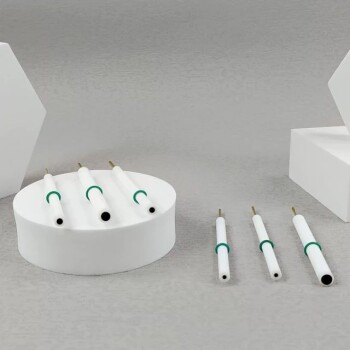
Glassy carbon electrodes (GCEs) are the industry-standard substrate for hydrogen evolution reaction (HER) testing due to their unique combination of high electrical conductivity and extreme electrochemical inertness.
By providing a wide potential window and a high overpotential for hydrogen evolution, the GCE acts as a "neutral platform." This ensures that the measured electrochemical signals—such as overpotential and Tafel slopes—originate entirely from the catalyst material being tested rather than the substrate itself.
The Core Takeaway: The GCE serves as an ideal physical platform because it effectively eliminates background interference. This allows researchers to isolate and accurately measure the intrinsic catalytic performance of new materials across various electrolytes.
The Advantage of Electrochemical Neutrality
High Overpotential for Hydrogen Evolution
The GCE possesses a high overpotential for the hydrogen evolution reaction, meaning its own catalytic activity is nearly zero. Because the substrate does not participate in the reaction, the current signals detected during electrochemical testing are an objective reflection of the catalyst's performance.
A Wide Electrochemical Window
GCEs offer a wide electrochemical window, which provides a broad range of voltages where the electrode remains stable and non-reactive. This property is essential for investigating different catalyst materials without the risk of the substrate undergoing its own redox reactions or degrading during testing.
Minimal Background Current
The material is engineered to produce an extremely low electrochemical background current. This ensures that linear sweep voltammetry (LSV) curves and other diagnostic measurements accurately represent the catalyst's behavior, facilitating precise data for scientific analysis.
Physical and Chemical Structural Integrity
Chemical Inertness Across pH Levels
GCEs exhibit superior chemical stability in both acidic (e.g., 0.5 M H2SO4) and alkaline (e.g., 1.0 M KOH) electrolytes. This versatility allows researchers to use a single substrate type to test catalysts intended for diverse operating environments, from proton exchange membranes to alkaline electrolyzers.
Flat Surface and Uniform Loading
The flat, mirror-like surface of a polished GCE facilitates the uniform dispersion and stable loading of catalyst inks or slurries. This uniformity is critical for maintaining repeatability in test results and ensuring that the catalyst layer has consistent contact with the conductive substrate.
High Electrical Conductivity
Despite its inertness, glassy carbon provides excellent electrical conductivity. It forms efficient electron transport channels between the catalyst and the testing equipment, ensuring that electron transfer kinetics are not limited by the substrate's resistance.
Understanding the Trade-offs
Surface Preparation Requirements
While GCEs are highly effective, their performance is heavily dependent on rigorous surface preparation. Any residual contaminants or scratches from previous tests can lead to non-uniform catalyst loading or artifacts in the electrochemical data, requiring meticulous multi-stage polishing.
Catalyst Adhesion Challenges
The very flatness that makes GCEs ideal can sometimes lead to poor catalyst adhesion, particularly during vigorous gas evolution. If the catalyst film peels off during the hydrogen evolution process, the resulting data will reflect a loss of active sites rather than the material's true degradation profile.
Making the Right Choice for Your Research
To achieve the most accurate results when using a GCE as your working electrode substrate, consider the following recommendations based on your experimental goals:
- If your primary focus is intrinsic activity mapping: Ensure the GCE is polished to a mirror finish using alumina slurries to provide the most consistent, flat surface for catalyst ink application.
- If your primary focus is stability testing: Use a binding agent like Nafion in your catalyst ink to prevent the film from delaminating during the intense gas evolution characteristic of high-current HER testing.
- If your primary focus is wide-pH comparisons: Leverage the GCE’s chemical inertness to keep your substrate constant while only varying the electrolyte, ensuring that changes in performance are solely due to pH-catalyst interactions.
By utilizing a glassy carbon electrode, researchers gain a reliable, non-interfering foundation that ensures electrochemical data is a true reflection of catalyst innovation.
Summary Table:
| Feature | Advantage for HER Testing |
|---|---|
| Electrical Conductivity | Ensures efficient electron transport with minimal resistance. |
| Electrochemical Inertness | High overpotential prevents the substrate from interfering with catalyst signals. |
| Chemical Stability | Resistant to degradation in both acidic (H2SO4) and alkaline (KOH) electrolytes. |
| Surface Morphology | Mirror-like flatness allows for uniform catalyst loading and repeatable results. |
| Potential Window | Wide range of stability allows for testing across various voltage requirements. |
Precision Solutions for Your Electrochemical Research
Unlock more accurate data and accelerate your catalyst innovation with KINTEK. As specialists in laboratory equipment, we provide the high-quality components necessary for rigorous HER testing and material analysis.
Whether you need precision-polished glassy carbon electrodes, specialized electrolytic cells and electrodes, or advanced battery research tools, KINTEK delivers the reliability your research demands. Our comprehensive portfolio also includes high-temperature furnaces, high-pressure reactors, and essential consumables like PTFE and ceramic components designed for extreme environments.
Ready to upgrade your lab's performance? Contact our experts today to find the perfect tools for your specific application.
References
- Lili Zhang, Guangfeng Wu. Charge Redistribution of Co9S8/MoS2 Heterojunction Microsphere Enhances Electrocatalytic Hydrogen Evolution. DOI: 10.3390/biomimetics8010104
This article is also based on technical information from Kintek Solution Knowledge Base .
Related Products
- Glassy Carbon Electrochemical Electrode
- Glassy Carbon Sheet RVC for Electrochemical Experiments
- Conductive Carbon Cloth Carbon Paper Carbon Felt for Electrodes and Batteries
- Copper Sulfate Reference Electrode for Laboratory Use
- Graphite Disc Rod and Sheet Electrode Electrochemical Graphite Electrode
People Also Ask
- How do the glassy carbon electrode, SCE, and graphite rod work together in an enzymatic fuel cell? Optimize EFC Testing
- Why is glassy carbon selected for mediator-assisted indirect oxidation of glycerol? The Key to Unbiased Research
- What are the functions of a glassy carbon electrode in CV testing of antioxidants? Enhance Your Redox Analysis Accuracy
- What characteristics make glassy carbon electrodes suitable as anodes? Ideal for Pure Molten Salt Electrolysis
- What are the primary physicochemical reasons for selecting a carbon electrode as the anode in aluminum recovery? 5 Keys