Measuring melting rate is the process of quantifying the speed at which a solid substance turns into a liquid. It is typically expressed as the mass or volume of material that melts per unit of time (e.g., grams per minute or millimeters per second). The most common methods involve directly tracking changes in mass or dimensions, or indirectly by measuring the energy required to drive the transition.
The core principle to grasp is that melting rate is not an intrinsic property of a material, but a dynamic process governed by heat transfer. The best measurement technique depends entirely on your material, the scale of the system, and the specific question you are trying to answer.
The Core Principle: A Matter of Energy Balance
Understanding how to measure melting rate begins with understanding what drives it: the flow of heat. The process is a constant balance between the energy being supplied to the material and the energy the material consumes to change its phase.
Heat Input vs. Phase Change
Melting only occurs when a substance is at its melting point and additional energy, known as the latent heat of fusion, is supplied. The rate at which you supply this energy directly dictates the melting rate. If you double the power (heat per second) applied to a block of ice at 0°C, you will double the rate at which it turns into water.
Key Factors that Dictate the Rate
Several factors control the speed of heat transfer and, consequently, the melting rate. These include the temperature difference between the heat source and the material, the surface area exposed to heat, and the mode of heat transfer (conduction, convection, or radiation).
The Role of Material Properties
A material's inherent properties are critical. A substance with a high thermal conductivity will transfer heat to its interior more quickly, while one with a high latent heat of fusion will require more energy to melt a given amount of mass, slowing the process for a given heat input.
Common Methods for Measuring Melting Rate
The right technique for your application will depend on the required precision, the size of your sample, and your budget.
The Precision Approach: Differential Scanning Calorimetry (DSC)
DSC is a laboratory technique used for highly accurate measurements on very small samples (typically milligrams). It works by precisely measuring the heat flow into a sample as its temperature is increased at a controlled rate. The instrument records the extra energy required to melt the sample, which can be used to calculate thermodynamic properties and infer rates under specific conditions.
The Direct Approach: Gravimetric Analysis
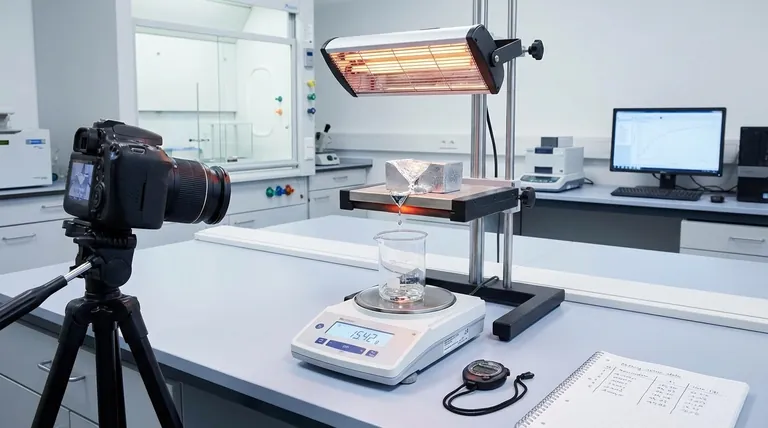
This is a straightforward and practical method for larger samples. The solid material is placed on a mesh or perforated surface over a precision scale. As the material melts, the liquid drips into a collection container on the scale. By recording the mass increase of the collected liquid over time, you can calculate a direct melting rate (e.g., in grams per second).
The Visual Approach: Dimensional Analysis
For processes where the melting front moves in a predictable way (like a block of ice melting from the top down), visual tracking is highly effective. A camera is set up to record the process with a ruler or other scale in the frame. By analyzing the video, you can measure the change in height or dimension of the solid over time to determine a linear melting rate (e.g., in millimeters per minute).
Understanding the Trade-offs and Pitfalls
Choosing a method requires being aware of its limitations and potential sources of error.
Lab Scale vs. Real-World Scale
A DSC provides exquisite detail about a pure material's melting behavior in a controlled environment. However, this data may not accurately represent a large, impure casting melting in a foundry. The scale and conditions of the measurement must match the scale of the process you are studying.
Pure Substances vs. Complex Mixtures
Pure crystalline materials like ice or tin have a sharp, single melting point. In contrast, materials like polymers, alloys, or chocolate melt over a temperature range. This makes defining a single "rate" more complex, as the material will soften and transition gradually.
Assuming Uniform Heating
A common error is assuming the entire sample is heated evenly. Often, the surface is much hotter than the interior, creating temperature gradients. Your measurement may reflect the rate of heat transfer to the surface, not the true phase transition rate of the bulk material.
Environmental Heat Loss
The heat you supply doesn't all go into melting the material. Some is inevitably lost to the surrounding environment. Failing to account for this heat loss can lead to an underestimation of the energy efficiency of your process and an inaccurate correlation between power input and melting rate.
Making the Right Choice for Your Goal
Select your measurement strategy based on your primary objective.
- If your primary focus is precise material characterization: Use Differential Scanning Calorimetry (DSC) to obtain fundamental thermodynamic data on a small, pure sample.
- If your primary focus is a practical, bulk process: Use gravimetric or dimensional analysis for a direct, relevant measurement of how your specific object or system behaves.
- If your primary focus is understanding the melt front dynamics: Use high-speed imaging to visualize and quantify how the solid-liquid interface moves and changes.
By selecting the method that aligns with your specific material and goals, you can accurately quantify and control your melting process.
Summary Table:
| Method | Best For | Key Metric | Sample Scale |
|---|---|---|---|
| Differential Scanning Calorimetry (DSC) | Precise material characterization | Heat Flow | Milligrams |
| Gravimetric Analysis | Practical, bulk processes | Mass Change | Grams+ |
| Dimensional Analysis | Visualizing melt front dynamics | Dimensional Change | Macroscopic |
Need to accurately measure and control your melting processes? KINTEK specializes in providing high-quality lab equipment and consumables for material analysis. Whether you require precise DSC instruments for R&D or robust systems for industrial process control, our solutions deliver reliable data to optimize your operations. Contact our experts today to find the perfect equipment for your laboratory's needs!
Visual Guide

Related Products
- Vacuum Induction Melting Spinning System Arc Melting Furnace
- Lab-Scale Vacuum Induction Melting Furnace
- Non Consumable Vacuum Arc Induction Melting Furnace
- Vacuum Arc Induction Melting Furnace
- Custom PTFE Teflon Parts Manufacturer for PTFE Measuring Cylinder 10/50/100ml
People Also Ask
- What types of metals are typically processed in a vacuum induction melting furnace? High-Purity Alloys for Critical Applications
- What is the function of a vacuum induction melting furnace? Essential Guide for High-Purity FeCrAl Alloy Production
- What is the principle of vacuum induction melting? Achieve Ultra-High Purity Metals
- What core role does a Vacuum Induction Melting furnace play in nickel-free steel production? Achieve High-Purity Alloys
- Why use VIM for rare earth steel? Essential Precision for Melting Reactive Lanthanum and Cerium