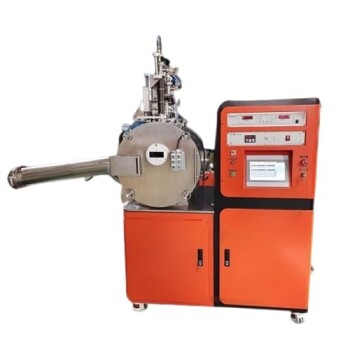
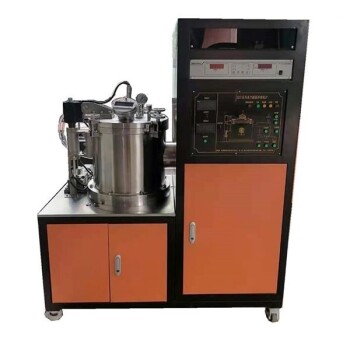
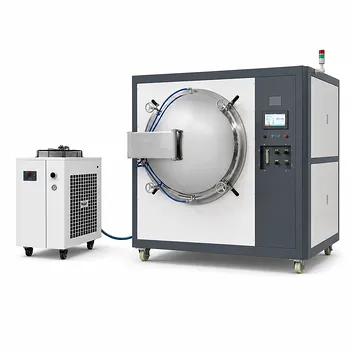
The Vacuum Induction Melting (VIM) furnace serves as the central control environment for the precise synthesis of nickel-free stainless steel alloys. By generating temperatures up to 2200°C within a vacuum or inert gas atmosphere, the furnace physically isolates the melt from atmospheric contamination. This allows metallurgists to strictly control residual oxygen pressure, preventing the degradation of sensitive alloying elements.
The core value of VIM technology lies in its ability to decouple the melting process from environmental variables. It enables the precise study of oxidation kinetics and ensures the successful integration of reactive elements—such as yttrium, chromium, and molybdenum—without the loss of material to uncontrolled oxidation.
Precise Control of Atmospheric Chemistry
The primary challenge in producing advanced alloys, particularly those requiring specific element additions, is the reactivity of the melt with oxygen.
Regulating Residual Oxygen Pressure
The VIM furnace utilizes an integrated vacuum pumping system to manage the internal atmosphere. This allows for the exact control of residual oxygen pressure within the chamber.
According to the primary technical documentation, this control is critical for studying the oxidation kinetics of specific additives. For nickel-free variants that may rely on elements like metallic yttrium for performance properties, this environment prevents the element from oxidizing before it can fully integrate into the alloy matrix.
Preservation of Active Elements
Beyond yttrium, stainless steel relies heavily on chromium and molybdenum. A vacuum environment effectively prevents the oxidation loss of these active elements.
By eliminating contact with air, the system ensures that the calculated composition ratios remain accurate in the final cast. This results in a chemically precise base material that matches the theoretical design of the alloy.
Thermal and Compositional Homogeneity
Producing a high-performance alloy requires more than just preventing contamination; it requires a uniform internal structure.
High-Temperature Capability
The furnace is capable of reaching extremely high temperatures, peaking at 2200°C. This ensures the rapid and complete melting of high-purity raw metals, regardless of their individual melting points.
Electromagnetic Stirring
The induction process used to generate heat provides a secondary benefit: efficient stirring. The electromagnetic fields induce movement within the molten pool.
This natural stirring action ensures a homogeneous distribution of all alloying elements. For researchers and engineers, this guarantees that the chemical composition is consistent throughout the entire ingot, rather than varying between the surface and the core.
Impurity Volatilization
The vacuum environment facilitates the removal of unwanted gases and volatile impurities from the molten pool. By degassing the material in a fluid state, the furnace enhances the overall purity level of the alloy.
Structural Integrity Implications
The method of melting directly correlates to the mechanical performance of the final solid material.
Reduction of Bifilms
Melting in a vacuum significantly reduces the formation of bifilms (double-layered oxide films). By minimizing the initial population of these oxide cracks, the metal becomes less susceptible to structural weaknesses.
Improved Mechanical Properties
Reducing these defects leads to marked improvements in fracture toughness and stress corrosion resistance. This is particularly vital for alloys intended for subsequent strengthening heat treatments, where precipitate splitting could otherwise cause performance drops.
Understanding the Trade-offs
While VIM offers superior control, it introduces specific operational constraints that must be managed.
Batch Processing Limitations
VIM is inherently a batch process involving a crucible housed within a water-cooled jacket. This configuration is ideal for high-precision or research-grade batches but differs significantly from continuous bulk steel production methods.
Refractory Interactions
The metal is melted within a crucible lined with refractory materials. While the vacuum protects the melt from the air, operators must still account for potential interactions between the aggressive, high-temperature melt and the crucible lining itself.
System Complexity
The equipment requires a complex infrastructure, including high-speed vacuum systems and water-cooling for the induction coils and steel shell. Maintaining the integrity of the airtight seal is paramount; any leak compromises the entire "controlled atmosphere" advantage.
Making the Right Choice for Your Goal
The VIM furnace is a specialized tool designed for specific metallurgical outcomes.
- If your primary focus is oxidation kinetics: Prioritize the vacuum system's ability to control residual oxygen pressure to study the specific behavior of reactive elements like yttrium.
- If your primary focus is mechanical toughness: Leverage the vacuum environment to minimize bifilm formation and oxide cracks, ensuring superior fracture resistance.
- If your primary focus is alloy development: Rely on the electromagnetic stirring capability to ensure total homogeneity when introducing new elemental additions.
Success in producing nickel-free stainless steel relies not just on the recipe, but on the absolute rigorous control of the melting environment that only VIM provides.
Summary Table:
| Feature | Benefit in Nickel-Free Alloy Production |
|---|---|
| Vacuum Environment | Prevents oxidation of reactive elements like Yttrium & Chromium |
| 2200°C Max Temp | Ensures rapid, complete melting of high-purity raw metals |
| Electromagnetic Stirring | Guarantees chemical homogeneity across the entire ingot |
| Impurity Volatilization | Degasses the melt to remove volatile impurities and bifilms |
| Atmospheric Control | Allows precise study of oxidation kinetics for advanced R&D |
Elevate Your Material Research with KINTEK Precision
Unlock the full potential of your alloy development with KINTEK’s advanced metallurgical solutions. Whether you are perfecting nickel-free stainless steel or exploring new reactive compositions, our high-performance Vacuum Induction Melting (VIM) furnaces and rotary/vacuum systems provide the rigorous atmospheric control your research demands.
From high-temperature high-pressure reactors to precision crushing and milling systems, KINTEK specializes in laboratory equipment and consumables tailored for the most demanding engineering environments. We empower metallurgists and researchers with:
- Unmatched Thermal Accuracy: Temperatures up to 2200°C for diverse material synthesis.
- Total System Integration: Comprehensive support including cooling solutions, crucibles, and ceramics.
- Customized Laboratory Solutions: From pellet presses to advanced CVD/PECVD systems.
Ready to optimize your melting process and eliminate material contamination?
Contact KINTEK Today to Consult with Our Experts
References
- Alexandr Panichkin, Alexandr Arbuz. RESEARCH OF INJECTION METHODS FOR Y2O3 NANOPARTICLES INTO NICKEL- FREE STAINLESS STEEL DURING INDUCTION VACUUM REMELTING. DOI: 10.59957/jctm.v59.i1.2024.20
This article is also based on technical information from Kintek Solution Knowledge Base .
Related Products
- Lab-Scale Vacuum Induction Melting Furnace
- Vacuum Induction Melting Spinning System Arc Melting Furnace
- Vacuum Heat Treat Furnace and Levitation Induction Melting Furnace
- Vacuum Arc Induction Melting Furnace
- Non Consumable Vacuum Arc Induction Melting Furnace
People Also Ask
- How do vacuum induction or arc melting furnaces facilitate the synthesis of U-Al-C MAX phases? Precision Heat & Purity
- What types of metals are typically processed in a vacuum induction melting furnace? High-Purity Alloys for Critical Applications
- Why use VIM for rare earth steel? Essential Precision for Melting Reactive Lanthanum and Cerium
- What is the primary function of a vacuum induction melting furnace in Ni-Mo-Cr-Fe master alloy prep? Ensure High Purity
- What are the advantages of a vacuum induction melting furnace? Achieve High-Purity Alloys with Precision VIM