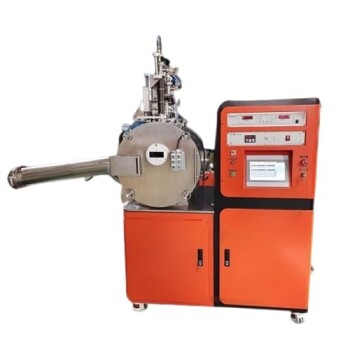
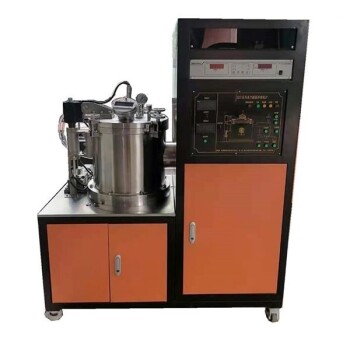
A vacuum induction melting (VIM) furnace functions as the critical purification and homogenization vessel in the production of FeCrAl (Iron-Chromium-Aluminum) alloy ingots. It utilizes electromagnetic induction to rapidly melt raw materials while maintaining a strictly controlled high-vacuum environment to protect reactive elements from atmospheric degradation.
Core Takeaway The VIM furnace is not just a heat source; it is a protective isolation chamber. Its primary value lies in preventing the oxidation of chromium and aluminum, thereby guaranteeing the precise chemical composition and high purity required for nuclear-grade material stability.
Preserving Chemical Integrity
To understand the function of the furnace, you must first understand the vulnerability of the alloy. FeCrAl alloys rely heavily on active elements that are highly sensitive to the open atmosphere.
Preventing Elemental Oxidation
Chromium and aluminum are defined as "active elements." When exposed to air at melting temperatures, they react instantly to form oxides.
The VIM furnace eliminates this issue by operating in a high-vacuum environment. This isolation prevents oxygen in the atmosphere from contacting the molten pool, preserving the metallic state of these critical components.
Minimizing Impurity Content
Beyond saving the primary elements, the vacuum environment actively manages contaminants.
The process minimizes the content of harmful impurities, specifically oxygen and nitrogen. By reducing these impurities, the furnace ensures the material achieves the high purity levels necessary for performance stability.
Precise Composition Control
Because oxidation is eliminated, the loss of alloying elements is negligible.
This allows manufacturers to control the melting atmosphere precisely. Consequently, the final chemical composition of the ingot matches the theoretical specifications accurately.
Achieving Material Homogeneity
While the vacuum protects the chemistry, the induction mechanism ensures the physical structure of the alloy is uniform.
Electromagnetic Eddy Currents
The furnace utilizes the principle of electromagnetic induction.
This generates eddy currents directly within the metal raw materials. These currents cause the metal to heat rapidly and melt from the inside out.
Thorough Mixing in the Liquid State
The electromagnetic forces do more than heat; they induce a stirring action within the molten bath.
This ensures the thorough mixing and homogenization of the various chemical components while they are in a liquid state. The result is an ingot with a consistent composition throughout its volume.
The Foundation for Downstream Processing
The quality of the ingot dictates the success of all subsequent manufacturing steps.
Enabling Forging and Rolling
The VIM furnace produces a "clean" master material with precise chemical ratios.
This high-quality ingot establishes the necessary foundation for subsequent mechanical processes, such as forging and rolling. Without this initial purity, downstream processing would likely suffer from defects.
Meeting Nuclear Standards
The ultimate function of this specific furnace setup is to meet extreme industry standards.
By guaranteeing high purity and minimizing gas content, the equipment produces materials suitable for nuclear-grade applications, where failure is not an option.
Understanding the Operational Trade-offs
While VIM furnaces are essential for FeCrAl, the process requires rigorous management of the vacuum system to be effective.
The Sensitivity of Active Elements
If the vacuum seal is compromised or the pressure is not sufficiently low, the advantages of the process are immediately lost.
Because chromium and aluminum are so reactive, even trace amounts of leakage can lead to oxide inclusions. This sensitivity demands that the equipment be maintained to a much higher standard than standard induction furnaces used for less reactive metals.
Making the Right Choice for Your Goal
The role of the VIM furnace varies slightly depending on your specific quality targets.
- If your primary focus is Nuclear-Grade Reliability: Prioritize the furnace's ability to maintain high vacuum levels to minimize oxygen and nitrogen impurities for maximum stability.
- If your primary focus is Mechanical Workability: Focus on the induction stirring capabilities to ensure the thorough homogenization required for successful forging and rolling.
The VIM furnace is the gatekeeper of quality for FeCrAl alloys; it transforms volatile raw ingredients into a stable, high-performance engineering material.
Summary Table:
| Feature | Function in FeCrAl Production | Benefit for Final Material |
|---|---|---|
| High-Vacuum Environment | Prevents oxidation of active Cr and Al elements | Maintains precise chemical integrity and purity |
| Electromagnetic Induction | Generates internal heat and eddy currents | Rapid melting and efficient energy use |
| Electromagnetic Stirring | Homogenizes the molten liquid bath | Uniform physical and chemical structure throughout |
| Impurity Removal | Minimizes oxygen and nitrogen content | Enhances stability for nuclear-grade applications |
| Composition Control | Eliminates elemental loss during melting | Guarantees ingot matches theoretical specifications |
Elevate Your Material Purity with KINTEK’s Advanced Melting Solutions
Success in FeCrAl production depends on absolute control over impurities and elemental integrity. KINTEK specializes in high-performance laboratory equipment, including state-of-the-art Vacuum Induction Melting (VIM) furnaces, atmosphere furnaces, and induction melting systems designed for the most demanding research and industrial applications.
Our comprehensive portfolio supports your entire workflow—from crushing and milling systems for raw material preparation to hydraulic presses and high-temperature high-pressure reactors for advanced material synthesis. Whether you are developing nuclear-grade alloys or high-performance battery tools, KINTEK provides the precision and reliability you need to eliminate defects and ensure mechanical workability.
Ready to optimize your alloy homogeneity? Contact our technical experts today to discover how KINTEK can enhance your lab's efficiency and material quality.
References
- Mengyu Chai, Yan Song. High-Temperature Tensile Properties and Serrated Flow Behavior of FeCrAl Alloy for Accident-Tolerant Fuel Cladding. DOI: 10.3390/app142411748
This article is also based on technical information from Kintek Solution Knowledge Base .
Related Products
- Lab-Scale Vacuum Induction Melting Furnace
- Vacuum Induction Melting Spinning System Arc Melting Furnace
- Vacuum Heat Treat Furnace and Levitation Induction Melting Furnace
- Non Consumable Vacuum Arc Induction Melting Furnace
- Vacuum Arc Induction Melting Furnace
People Also Ask
- How do vacuum induction or arc melting furnaces facilitate the synthesis of U-Al-C MAX phases? Precision Heat & Purity
- What is the primary function of a vacuum induction melting furnace in Ni-Mo-Cr-Fe master alloy prep? Ensure High Purity
- Why use VIM for rare earth steel? Essential Precision for Melting Reactive Lanthanum and Cerium
- What types of metals are typically processed in a vacuum induction melting furnace? High-Purity Alloys for Critical Applications
- What are the key components inside the vacuum chamber of a vacuum induction melting furnace? A Guide to the Core Melting Assembly