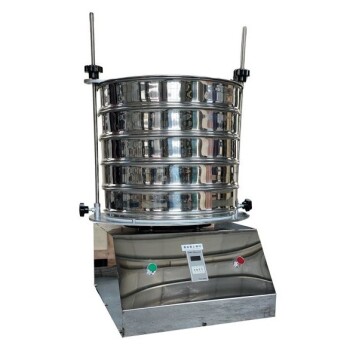
The use of a 20-mesh standard sieve is a critical control point for ensuring the chemical and physical consistency of crushed coconut shell raw materials.
By filtering the biomass through this specific mesh size, producers achieve high particle size uniformity, which is the foundation for effective chemical impregnation. This uniformity ensures that metal salt solutions penetrate every particle evenly, preventing internal imbalances and resulting in a final biochar product with stable, high-capacity adsorption performance.
Precise particle sizing via a 20-mesh sieve transforms raw coconut shells into a standardized feedstock, ensuring uniform chemical absorption and thermal stability. This level of control is essential for producing high-performance activated carbon with predictable industrial properties.
Optimizing the Impregnation Process
Achieving Uniform Chemical Penetration
A 20-mesh sieve ensures that the biomass particles are small and consistent enough for metal salt solutions to reach the core of each grain. When particles are uniform, the impregnation process occurs at a steady rate across the entire batch.
This prevents the common issue of "surface-only" treatment, where the chemical agent fails to reach the center of larger, unscreened chunks.
Preventing Internal Distribution Imbalances
Oversized particles create significant risks during the activation stage because they often harbor untreated internal zones. These imbalances lead to inconsistent pore development within the biomass.
By using a standard 20-mesh sieve, you eliminate these outliers, ensuring that the chemical catalysts are distributed equally throughout the raw material.
Enhancing Thermal and Structural Properties
Facilitating Consistent Heat Transfer
Uniform particle size is essential for maintaining even heat distribution during thermal processing. When all particles are of a similar size, they react to heat at the same rate, preventing some particles from over-carbonizing while others remain under-processed.
This consistency is vital for the structural integrity of the final biochar, as it ensures the entire batch undergoes the same physical transformation.
Improving Gas Diffusion Dynamics
In subsequent processing stages, uniform particles allow for predictable gas diffusion and fluid flow. This is particularly important for the final application of the product in fixed-bed adsorbers.
Standardized sizing ensures that the gas or liquid being filtered can pass through the material with consistent resistance, avoiding "channeling" where the fluid bypasses the filter media.
Understanding the Trade-offs
Sieve Blinding and Throughput
While a 20-mesh sieve provides high precision, it is susceptible to "blinding" or clogging if the raw coconut shells have high moisture or oil content. Frequent cleaning or specialized vibratory equipment may be required to maintain production speeds.
Material Yield and Waste Management
Strict adherence to a specific mesh size inevitably results in a percentage of "overs" and "fines" that do not meet the specification. This can reduce the overall yield of the raw material unless the rejected sizes can be repurposed for other grades of carbon.
Maximizing Quality Through Strategic Sieving
Selecting the right sieving protocol depends on your specific application requirements and the desired performance of the final carbon product.
- If your primary focus is high-capacity adsorption: Use the 20-mesh sieve to ensure total chemical penetration and even distribution of metal salts during the impregnation stage.
- If your primary focus is industrial fixed-bed efficiency: Prioritize the sieve's ability to create a narrow size distribution (typically between 2-4 mm for these applications) to optimize flow dynamics and pressure drop.
Investing in precise particle size control is the most effective way to eliminate variability and ensure the industrial reliability of coconut-based adsorbents.
Summary Table:
| Key Impact Area | Benefit of 20-Mesh Sieving | Effect on Final Product |
|---|---|---|
| Chemical Impregnation | Ensures uniform penetration of metal salt solutions | Stable and high-capacity adsorption performance |
| Thermal Processing | Facilitates consistent heat transfer across particles | Uniform carbonization and structural integrity |
| Fluid Dynamics | Optimizes gas/liquid diffusion dynamics | Prevents channeling in fixed-bed adsorbers |
| Particle Consistency | Eliminates oversized outliers and internal imbalances | Predictable industrial properties and quality |
Elevate Your Material Processing with KINTEK Precision
Achieving superior adsorption performance starts with precise particle size control. KINTEK specializes in high-performance laboratory equipment designed to streamline your research and production workflows. From advanced sieving equipment and crushing and milling systems for feedstock preparation to state-of-the-art high-temperature furnaces (muffle, tube, vacuum) for precise carbonization, we provide the tools you need for consistent, industrial-grade results.
Whether you are developing high-capacity biochars or optimizing industrial adsorbents, our comprehensive portfolio—including hydraulic presses, PTFE consumables, and cooling solutions—ensures your lab operates at peak efficiency.
Ready to eliminate variability in your raw materials? Contact our technical experts today to find the perfect equipment solution for your application!
References
- Yujia Yang, Yong Chen. Effect of CeO2-Reinforcement on Pb Absorption by Coconut Coir-Derived Magnetic Biochar. DOI: 10.3390/ijms24031974
This article is also based on technical information from Kintek Solution Knowledge Base .
Related Products
- Custom PTFE Teflon Parts Manufacturer for PTFE Mesh F4 Sieve
- Three-dimensional electromagnetic sieving instrument
- Laboratory Test Sieves and Sieving Machines
People Also Ask
- What are the primary reasons for selecting PTFE as a matrix? Enhance Composites with Carbon Nanotube Reinforcement
- How is PTFE utilized for insulation in Alloy 22 corrosion setups? Ensure Signal Purity & Accuracy
- Is PTFE corrosion resistant? Discover the Ultimate Chemical Resistance for Your Lab
- What are the specific applications of PTFE in micro-batch slug flow systems? Enhance Your Microfluidic Reaction Purity
- What is the mesh size of a sieve? A Guide to Particle Size and Sieve Selection