The primary advantage of an agitated thin film evaporator (ATFE) is its unique ability to efficiently process challenging liquids that are heat-sensitive, viscous, or prone to fouling. Its mechanically driven wipers create a thin, turbulent film of product on the heated surface, enabling rapid heat transfer and immediate evaporation while preventing the thermal degradation common in other evaporator types.
The core value of an ATFE lies in its mechanical agitation. This single feature directly solves the three most common problems in thermal separation: product degradation from overheating, poor performance with viscous materials, and system downtime from fouling.
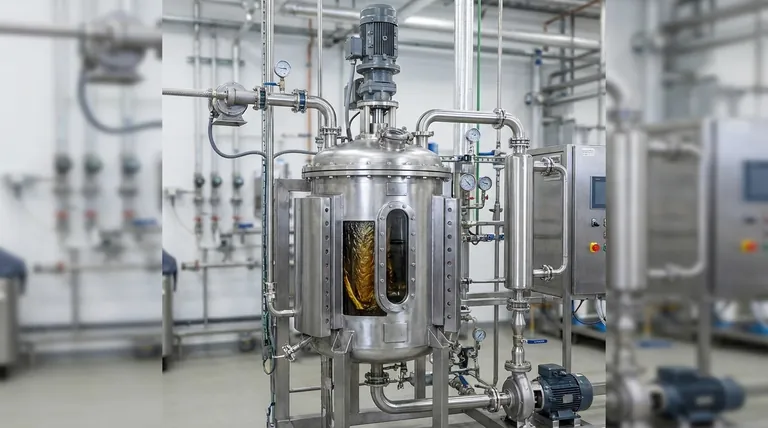
How an ATFE Solves Core Processing Challenges
Traditional evaporators, like shell-and-tube or falling film systems, rely on gravity and natural convection. This works for simple, low-viscosity fluids but fails when materials become thick, sticky, or sensitive to prolonged heat exposure. The ATFE overcomes these limitations through its fundamental design.
The Principle of Mechanical Agitation
At the heart of an ATFE is a central rotor with attached wiper blades that spin at high speed. This rotor is positioned within a vertically or horizontally oriented heated cylinder.
As feed liquid enters, the wipers immediately distribute it as a thin, uniform film against the heated wall. This mechanical action is the source of all its subsequent advantages.
Superior Heat Transfer Efficiency
The thin film created by the wipers is highly turbulent. This turbulence dramatically increases the heat transfer coefficient, allowing for much faster and more efficient heat exchange between the wall and the product.
This means you can achieve higher evaporation rates in a smaller, more compact piece of equipment compared to conventional systems.
Minimal Residence Time for Heat-Sensitive Products
Because the product moves through the system as a thin film and is rapidly vaporized, its exposure time to the heated surface—known as residence time—is incredibly short, often lasting only a few seconds.
This is critical for preserving the quality of heat-sensitive materials like pharmaceuticals, food extracts, vitamins, and fine chemicals, which would degrade or denature with prolonged heat exposure.
Effective Processing of High-Viscosity Liquids
In a standard evaporator, viscous liquids flow slowly, leading to poor heat transfer and localized overheating or "burn-on."
The ATFE’s wipers physically convey the material along the heated surface, ensuring that even highly viscous liquids or slurries are effectively processed without clogging or burning. This makes it ideal for concentrating polymers, resins, and other thick substances.
Prevention of Fouling and Scaling
The continuous sweeping action of the wiper blades acts as a self-cleaning mechanism. It prevents solids from precipitating and building up on the heated wall, a common problem known as fouling or scaling.
This results in consistent thermal performance over long operating cycles and significantly reduces the need for frequent shutdowns for cleaning.
Understanding the Trade-offs and Limitations
While highly effective, an ATFE is a specialized piece of equipment and is not the optimal solution for every application. Understanding its limitations is key to making an informed decision.
Higher Capital Cost
The mechanical complexity of an ATFE, including the rotor, drive system, bearings, and mechanical seals, results in a significantly higher upfront capital cost compared to simpler, static evaporators.
Mechanical Complexity and Maintenance
The presence of moving parts introduces mechanical wear. Mechanical seals are critical components that require regular monitoring and periodic replacement, adding to the maintenance burden and operational cost.
Not Ideal for Simple, Low-Viscosity Fluids
For straightforward applications like evaporating water from a salt solution, an ATFE is often overkill. The added cost and complexity are not justified when a simpler, more economical technology like a multiple-effect or falling film evaporator would suffice.
Making the Right Choice for Your Process
Selecting the correct evaporation technology requires a clear understanding of your material's properties and your primary processing goal.
- If your primary focus is processing heat-sensitive materials: The ATFE's extremely short residence time is its most critical advantage, preventing product degradation.
- If your primary focus is handling highly viscous or fouling fluids: The mechanical action of the wipers makes the ATFE uniquely capable of managing materials that would clog other evaporators.
- If your primary focus is achieving high concentrations in a single pass: The ATFE excels at removing a large percentage of solvent, often taking a product to a final, highly concentrated form efficiently.
- If your primary focus is a cost-sensitive, non-fouling application: A simpler technology like a falling film evaporator is likely a more economical and practical choice.
Ultimately, the agitated thin film evaporator is a powerful tool designed to solve specific, difficult processing challenges that other technologies cannot address.
Summary Table:
| Key Advantage | Core Benefit | Ideal For |
|---|---|---|
| Mechanical Agitation | Creates a thin, turbulent film for rapid heat transfer and prevents fouling. | Heat-sensitive, viscous, or fouling-prone materials. |
| Minimal Residence Time | Short exposure to heat (seconds) preserves product quality. | Pharmaceuticals, food extracts, fine chemicals. |
| Handles High Viscosity | Wipers physically convey material, preventing clogging. | Polymers, resins, thick slurries. |
| Self-Cleaning Action | Continuous wiping prevents scaling and buildup. | Applications requiring long, consistent operating cycles. |
Struggling with heat-sensitive, viscous, or fouling materials in your lab?
KINTEK's agitated thin film evaporators are engineered to solve these exact challenges. Our lab equipment delivers the precise, gentle, and efficient thermal processing you need to protect your valuable products and optimize your workflow.
Let our experts help you enhance your process efficiency and product quality.
Contact KINTEL today for a personalized consultation!
Visual Guide

Related Products
- Aluminized Ceramic Evaporation Boat for Thin Film Deposition
- Tungsten Evaporation Boat for Thin Film Deposition
- Electron Beam Evaporation Coating Oxygen-Free Copper Crucible and Evaporation Boat
- Molybdenum Tungsten Tantalum Evaporation Boat for High Temperature Applications
- Vacuum Hot Press Furnace Machine for Lamination and Heating
People Also Ask
- What is the chemical method for thin film deposition? Build Films from the Molecular Level Up
- Why is an alumina boat and Ti3AlC2 powder bed necessary for Ti2AlC sintering? Protect MAX Phase Purity
- What is the widely used boat made of in thermal evaporation? Choosing the Right Material for High-Purity Deposition
- What are thin films deposited by evaporation? A Guide to High-Purity Coating
- Why is an alumina boat selected for catalyst precursors? Ensure Sample Purity at 1000 °C