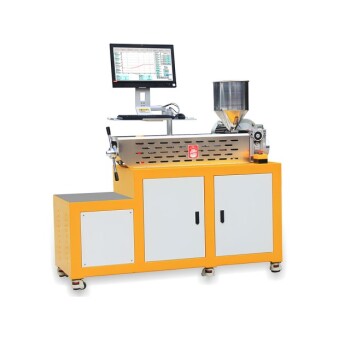
Multi-channel battery testing systems provide the essential infrastructure for high-throughput material characterization. These systems allow researchers to simultaneously assess the cycling stability of multiple supercapacitor samples while maintaining precise control over current density. By automating the recording of real-time voltage-time curves, they enable the rapid calculation of specific capacity, energy density, and power density across diverse processing parameters.
A multi-channel testing system transforms supercapacitor evaluation from a serial bottleneck into a parallel, high-efficiency workflow. Its primary advantage lies in combining high-throughput screening with the long-term data precision required to verify commercial viability.
Maximizing Research Throughput and Efficiency
Parallel Testing of Multiple Samples
The most immediate advantage is the ability to run simultaneous assessments of numerous coin-type supercapacitor samples. This parallelization is critical when screening optimal carbonization temperatures or varying chemical compositions, as it allows for direct comparison under identical environmental conditions.
Accelerated Parameter Screening
By testing multiple configurations at once, researchers can significantly reduce the time required to identify the best processing parameters. What would take months using single-channel equipment can be accomplished in days, accelerating the development cycle for new energy storage materials.
Automated Data Acquisition
These systems automate the long-term recording of voltage and capacity curves, often exceeding durations of 1,200 to 1,000 hours. This automation removes the need for manual intervention, ensuring that data points are collected at high frequencies and stored systematically for analysis.
Precision Control and Analytical Depth
Programmed Constant Current Control
Multi-channel systems provide precise current density control, which is vital for accurate Galvanostatic Charge-Discharge (GCD) testing. This precision allows for the verification of material performance across a wide range of rates, from low speeds (0.1 C) to high-intensity discharge (10 C or up to 10 A/g).
Real-Time Monitoring of Voltage Polarization
The equipment tracks real-time voltage-time curves, allowing researchers to monitor voltage polarization and the stability of voltage platforms. This data is essential for identifying the suppression of dendrite growth and understanding the internal resistance of the supercapacitor.
Quantification of Degradation Mechanisms
High-precision recording of capacity decay rates over thousands of cycles helps evaluate the long-term structural stability of electrode materials. Researchers can use this data to determine exactly when and why a material begins to lose its energy storage efficiency.
Ensuring Long-Term Data Integrity
High Stability over Extended Cycles
The internal hardware of these systems is designed to maintain stable constant current output over thousands of cycles. This stability ensures that the fluctuations recorded are due to the material’s electrochemical behavior rather than equipment drift or error.
Verification of Energy Efficiency
By accurately recording charge and discharge curves, the system allows for the calculation of Coulombic efficiency and overall energy efficiency. This is a decisive factor in determining if a material is suitable for practical, real-world applications.
High-Frequency Data Sampling
Modern systems can record potential fluctuations at high frequencies, capturing subtle electrochemical events that might be missed by slower equipment. This granularity is necessary for verifying the durability of catalysts and the resistance of materials to structural corrosion.
Understanding the Trade-offs
The Two-Electrode Limitation
While multi-channel systems are ideal for testing coin cells in a two-electrode configuration, they may lack the specific potential control offered by three-electrode cells. In a two-electrode setup, the measured potential is the difference between the working and counter electrodes, which can sometimes mask the individual behavior of a specific active material.
Initial Setup Complexity
Managing a high-throughput system requires a robust data management strategy to handle the massive volume of datasets generated. Additionally, the initial cost and maintenance of a multi-channel rig are significantly higher than simpler, single-channel laboratory potentiostats.
Environmental Consistency
Because these systems test multiple samples at once, any temperature fluctuations in the testing environment can affect all samples simultaneously. While this provides a level of internal consistency, it requires strict climate control to ensure the results are comparable to external benchmarks.
Making the Right Choice for Your Goal
How to Apply This to Your Project
To maximize the utility of a multi-channel battery testing system, align your testing protocols with your specific material development objectives.
- If your primary focus is material screening: Use the multi-channel capability to test a broad array of carbonization temperatures and chemical dopants simultaneously to find the "sweet spot" quickly.
- If your primary focus is commercial durability: Prioritize long-term cycling (1,800+ cycles) to quantify capacity retention and structural stability under realistic working environments.
- If your primary focus is high-power applications: Program the system to run varied current densities (from 0.2 A/g to 10 A/g) to map the rate performance and power density of your electrodes.
By leveraging the parallel processing and precision of multi-channel systems, researchers can transition from fundamental material discovery to validated, high-performance energy storage solutions with unprecedented speed.
Summary Table:
| Feature | Research Advantage | Impact on Material Science |
|---|---|---|
| Parallel Testing | Simultaneous assessment of multiple samples | Dramatically reduces development cycles |
| Automated GCD | Continuous 1,000+ hour real-time recording | Ensures high-frequency data integrity |
| Precision Control | Programmed current density (0.1C to 10C) | Accurate capacity & energy density mapping |
| High Stability | Stable output over thousands of cycles | Reliable verification of commercial viability |
| Efficiency | Rapid screening of processing parameters | Faster identification of optimal compositions |
Accelerate Your Energy Storage Breakthroughs with KINTEK
Transition from fundamental material discovery to validated, high-performance solutions with KINTEK’s professional research tools. Whether you are optimizing supercapacitor electrodes or testing long-term cycling stability, our comprehensive portfolio—including high-precision battery testing systems, electrolytic cells and electrodes, and battery research consumables—is designed to ensure unparalleled data accuracy and lab efficiency.
At KINTEK, we specialize in providing the essential infrastructure for modern energy labs, from high-temperature atmosphere furnaces for material synthesis to advanced hydraulic presses for pellet preparation. Contact us today to equip your laboratory and leverage our expertise in high-throughput characterization for your next innovation.
References
- Meenkyoung Jung, Ji Chul Jung. Activated carbons derived from polyethylene terephthalate for coin-cell supercapacitor electrodes. DOI: 10.1007/s11814-023-1466-3
This article is also based on technical information from Kintek Solution Knowledge Base .
Related Products
- Customizable Swagelok Type Test Cells for Advanced Battery Research Electrochemical Analysis
- Battery Lab Equipment 304 Stainless Steel Strip Foil 20um Thick for Battery Test
- Platinum Sheet Electrode for Battery Lab Applications
- Laboratory Hydraulic Press Lab Pellet Press for Button Battery
- Button Battery Case for Battery Lab Applications
People Also Ask
- How does a standardized electrochemical test cell assist in MOx/CNTf electrode screening? Optimize Material Ratios
- Why is a dedicated electrochemical test cell necessary for carbon steel? Ensure Precise Geothermal Corrosion Data
- What is the difference between a voltaic cell and an electrochemical cell? Understand the Two Types of Energy Conversion
- How do the electrochemical cell and three-electrode testing system collaborate? Optimize Zinc Anode Deposition Control
- Why must the electrochemical cell be continuously purged with nitrogen? Ensure Precision in Ni-Cr Corrosion Tests